Rounding Numbers (AQA GCSE Maths): Revision Notes
📚Revision Notes
Rounding numbers
Understanding basic rounding rules
When you need to round a number, the key principle is simple: examine the digit immediately to the right of where you want to round. This digit tells you whether to round up or down.
Important
The fundamental rule:
- If the next digit is 5 or more → round up
- If the next digit is less than 5 → round down
Using place value diagrams
Place value diagrams help you identify which digit to examine when rounding. Each column represents a different place value, from thousands down to thousandths.
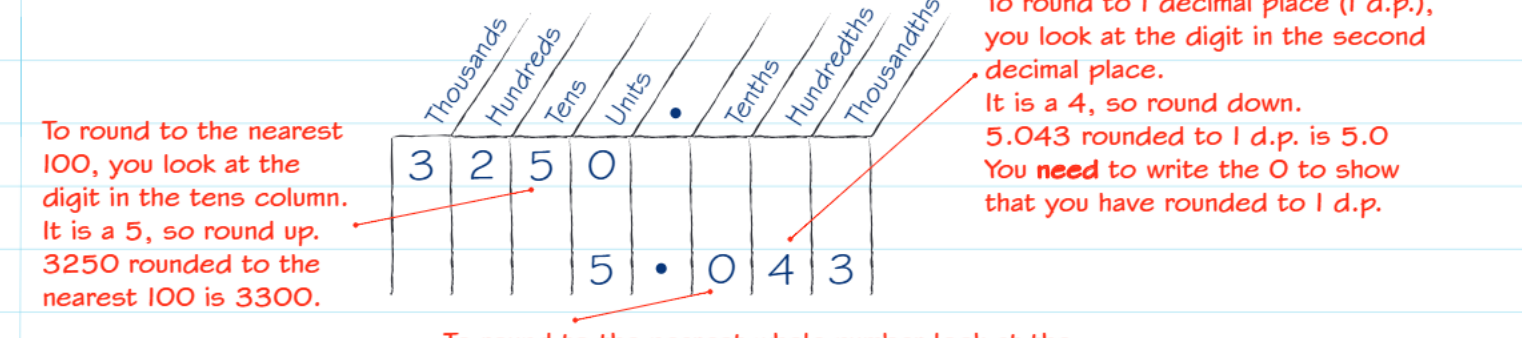
Note
Understanding place value is crucial for accurate rounding. The place value diagram shows exactly which digit controls your rounding decision for any given precision level.
Rounding to the nearest hundred
When rounding to the nearest 100, look at the digit in the tens column. This digit determines whether you round up or down to the nearest hundred.
Example
Worked Example: Rounding 3250 to the nearest hundred
Step 1: Identify the tens digit in 3250 The tens digit is 5
Step 2: Apply the rounding rule Since 5 ≥ 5, we round up
Step 3: Round to nearest hundred 3250 → 3300
Rounding to decimal places
To round to one decimal place, examine the digit in the hundredths column. This process ensures you maintain the correct level of precision in your answer.
Example
Worked Example: Rounding 5.043 to one decimal place
Step 1: Identify the hundredths digit in 5.043 The hundredths digit is 4
Step 2: Apply the rounding rule Since 4 < 5, we round down
Step 3: Round to one decimal place 5.043 → 5.0
Remember: Write the zero to show you've rounded to one decimal place.
Rounding to the nearest whole number
Look at the first digit after the decimal point (the tenths column). If it's 5 or more, round up to the next whole number. If it's less than 5, round down by removing the decimal part.
Significant figures
Significant figures are a way of showing how precise a measurement is. The key rule is that you always begin counting from the first non-zero digit on the left.
Counting significant figures
Note
Rules for counting significant figures:
- Start from the first digit that isn't zero
- Count all digits from that point onwards
- All non-zero digits are significant
- Zeros between non-zero digits are significant
For 27.05: the first non-zero digit is 2, so significant figures are counted as 2, 7, 0, 5 (total: 4 significant figures).
Rounding to significant figures
Understanding how to round to different numbers of significant figures is essential for maintaining appropriate precision in calculations.
Example
Worked Example: Rounding 27.05 to different significant figures
To 1 significant figure:
- Look at the second digit (7)
- Since 7 ≥ 5, round up to 30
To 2 significant figures:
- Look at the third digit (0)
- Since 0 < 5, round down to 27
To 3 significant figures:
- Look at the fourth digit (5)
- Since 5 ≥ 5, round up to 27.1
Numbers less than 1
When dealing with numbers smaller than 1, there's a special rule for significant figures: do not count the zero digits on the left.
Example
Worked Example: Rounding 0.0085 to 1 significant figure
Step 1: Identify significant digits The zeros before the 8 don't count as significant figures The first significant digit is 8
Step 2: Look at the next digit The next digit after 8 is 5
Step 3: Apply the rounding rule Since 5 ≥ 5, round up to get 0.009
Exam tips
- Always identify which place value you're rounding to first
- Write zeros when necessary to show the level of accuracy
- For significant figures, remember to start counting from the first non-zero digit
- Double-check your answer makes sense - it should be close to the original number
Summary
Key Points to Remember:
- 5 or more rounds up, less than 5 rounds down - this is the golden rule
- Use place value diagrams to identify which digit controls the rounding
- Significant figures start counting from the first non-zero digit
- Always write zeros when they're needed to show the correct number of decimal places
- For numbers less than 1, ignore leading zeros when counting significant figures