Sampling (AQA GCSE Maths): Revision Notes
📚Revision Notes
Sampling
What is sampling?
When conducting statistical research, you need to understand two fundamental concepts that form the foundation of data collection.
Population - This refers to the complete group of individuals or items that you want to investigate or learn about. For example, if you wanted to study the eating habits of teenagers in your town, all the teenagers in that town would be your population.
Sample - This is a smaller group selected from the population to represent the whole group. Instead of surveying every teenager in your town (which would be impractical), you might choose 50 teenagers to survey. These 50 teenagers are your sample.
Note
The key idea is that you can use information gathered from your sample to make predictions and draw conclusions about the entire population.
Why use sampling?
There are several important advantages to using samples instead of trying to survey entire populations:
Cost effectiveness - Surveying a sample costs significantly less money than attempting to collect data from every member of a population.
Time efficiency - Gathering information from a smaller group takes much less time than surveying everyone in the population.
Easier analysis - Working with smaller amounts of data makes it simpler to perform calculations and identify patterns in your results.
These benefits make sampling an essential tool in statistical research, allowing researchers to gain valuable insights without the enormous resources that would be needed to survey entire populations.
Random sampling methods
For your sample to provide reliable information about the population, it must be selected properly. The most important type of sampling is random sampling.
Random sample - In this type of sample, every member of the population has an equal opportunity to be selected. This helps ensure that your sample fairly represents the whole population.
There are two main approaches for creating a random sample:

Method 1: Hat method - Write the name of every person in the population on separate pieces of paper, put all the papers in a hat, and randomly draw out the number of names you need for your sample.

Method 2: Number assignment - Give each member of the population a unique number, then use a computer programme or calculator to generate random numbers to select your sample members.
Note
Both methods ensure that the selection process is fair and unbiased.
Common sampling problems
When samples are not chosen carefully, they can lead to unreliable results. Understanding these problems helps you avoid them in your own research.
Important
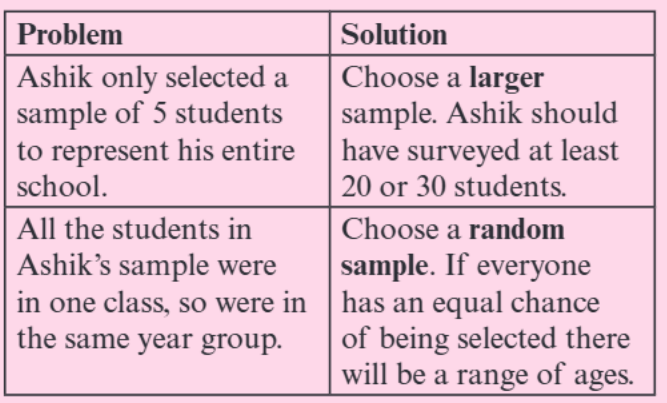
Problem 1: Sample too small - If you only select a very small number of people (like 5 students to represent an entire school), your results may not accurately reflect the population. Small samples are more likely to be affected by unusual responses from individual participants.
Solution: Choose a larger sample size. Aim for at least 20-30 participants when possible, as larger samples generally provide more reliable results.
Important
Problem 2: Non-random selection - If all your sample members come from the same group (like one class or year group), they may be too similar to represent the diverse population properly.
Solution: Use random sampling techniques to ensure different types of people have equal chances of being selected, creating age diversity and other important variations.
Worked example: Television watching habits
Let's examine a practical example to understand how sampling issues can affect research results.
Example
Worked Example: Analysing Television Watching Data
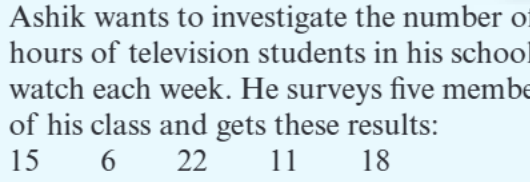
The scenario: Ashik wants to investigate how many hours of television students at his school watch each week. He surveys five classmates and collects this data: 15, 6, 22, 11, and 18 hours.
Calculating the mean:
- Total hours = 15 + 6 + 22 + 11 + 18 = 72 hours
- Mean = 72 ÷ 5 = 14.4 hours per week
Analysis of reliability: This estimate is not very reliable because the sample size is too small. With only 5 students representing the entire school, the results could easily be skewed by individual responses.
Improving the method: Ashik should select a larger sample size and use random sampling to choose students from different year groups and classes throughout the school.
Practice with real data
Understanding sampling concepts becomes clearer when you work with actual examples and analyse the reliability of different approaches.
Example
Worked Example: Comparing Sample Reliability
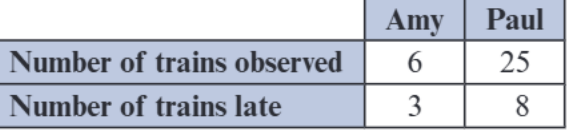
The situation: Amy and Paul are investigating train punctuality at their local station. Here's their data:
- Amy observed 6 trains, with 3 running late
- Paul observed 25 trains, with 8 running late
Reliability comparison: Amy's statement that "There is a 50:50 chance that a train will be late" is based on a very small sample (only 6 trains). Paul's data, based on 25 trains, provides a more reliable foundation for estimating train punctuality because his larger sample size reduces the impact of random variation.
Key insight: Larger samples typically provide more accurate estimates of population characteristics than smaller samples.
Remember!
Summary
Key Points to Remember:
- Population is the entire group you want to study, while a sample is the smaller group you actually survey
- Random sampling gives every population member an equal chance of selection, making your sample more representative
- Larger samples generally provide more reliable results than smaller samples
- Avoid bias by using proper random sampling techniques rather than selecting convenient groups
- Sample problemscan lead to inaccurate conclusions about the population, so careful planning is essential