The AND / OR Rules (AQA GCSE Maths): Revision Notes
📚Revision Notes
The AND / OR Rules
Understanding when multiple events occur
In probability, we often need to calculate the chances of more than one event happening. The AND and OR rules help us work out these probabilities, but first we need to understand the difference between independent and dependent events.
Independent vs dependent events
Note
Understanding the difference between independent and dependent events is crucial for applying the AND/OR rules correctly.
Independent events are when one event happening doesn't change the probability of another event occurring. For example, if you roll two dice, getting a 6 on the first die doesn't affect what you'll get on the second die.
Dependent events are when one event happening does affect the probability of another event occurring. For example, if you pick a blue ball from a bag and don't put it back, this changes the probability of picking another blue ball afterwards.
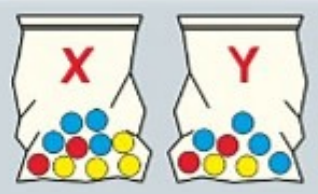 Think of it this way: if you're picking balls from bags X and Y, whether the ball stays in or gets removed makes all the difference to your next pick!
Important
Key distinction: Independent events don't affect each other's probabilities, while dependent events do. Always identify which type you're dealing with before applying the rules.
The AND rule
The AND rule helps us find the probability that both events happen. When we want both event A and event B to occur, we use:
This formula works when the events are independent. The key word here is "both" - we multiply the individual probabilities together.
Example
Worked Example: Finding the probability of two yellow balls
Dave picks one ball randomly from each of two bags. We want to find the probability that he picks a yellow ball from both bags.
Step 1: Find individual probabilities
- Probability of yellow from bag X =
- Probability of yellow from bag Y =
Step 2: Apply the AND rule
- Probability of yellow from both bags =
The multiplication makes sense because getting both events is less likely than getting just one of them.
The OR rule
The OR rule helps us find the probability that at least one event happens. This means either event A happens, or event B happens, or both happen.
The complete OR rule is:
We subtract because when we add and , we've counted the cases where both happen twice, so we need to remove that overlap.
Note
The subtraction step is crucial! When events can happen together, we must avoid double-counting the overlap.
However, when events cannot happen together (called mutually exclusive events), the formula becomes simpler:
| Colour | red | blue | yellow | green |
|---|---|---|---|---|
| Probablity | 0.25 | 0.3 | 0.35 | 0.1 |
Example
Worked Example: Spinner probability
With a spinner that has red, blue, yellow, and green sections, the probability of landing on red OR green is:
Step 1: Check if events are mutually exclusive
- The spinner can't land on both colours at the same time ✓
Step 2: Apply the simplified OR rule
When to use each rule
Understanding when to apply each rule is essential for solving probability problems correctly.
Use the AND rule when:
- You want both events to happen
- You see words like "and", "both", "all"
- You're looking for the intersection of events
Use the OR rule when:
- You want at least one event to happen
- You see words like "or", "either", "at least one"
- You're looking for the union of events
Important
Critical checks to perform:
- For AND rule: Are the events independent or dependent?
- For OR rule: Can the events happen at the same time?
Getting these checks wrong will lead to incorrect answers!
Summary
Key Points to Remember:
- Independent events don't affect each other's probabilities, while dependent events do affect each other
- AND rule uses multiplication: for independent events
- OR rule uses addition: , but just when events are mutually exclusive
- "× with AND" and "+ with OR" - but watch out for overlap in OR calculations!
- Always check whether events are independent/dependent for AND, and whether they can happen together for OR