Density (AQA GCSE Maths): Revision Notes
📚Revision Notes
Density
What is density?
Density is a measure of how much mass is packed into a given volume. It tells us how tightly matter is squeezed together in a material. The formal definition states that density is the mass per unit volume of a material.
Different materials have different densities. For example, lead has a much higher density than wood because the same volume of lead contains much more mass than the same volume of wood.
Note
The concept of density helps explain why some objects float while others sink. Objects with lower density than water (less than 1 g/cm³) will float, while those with higher density will sink.
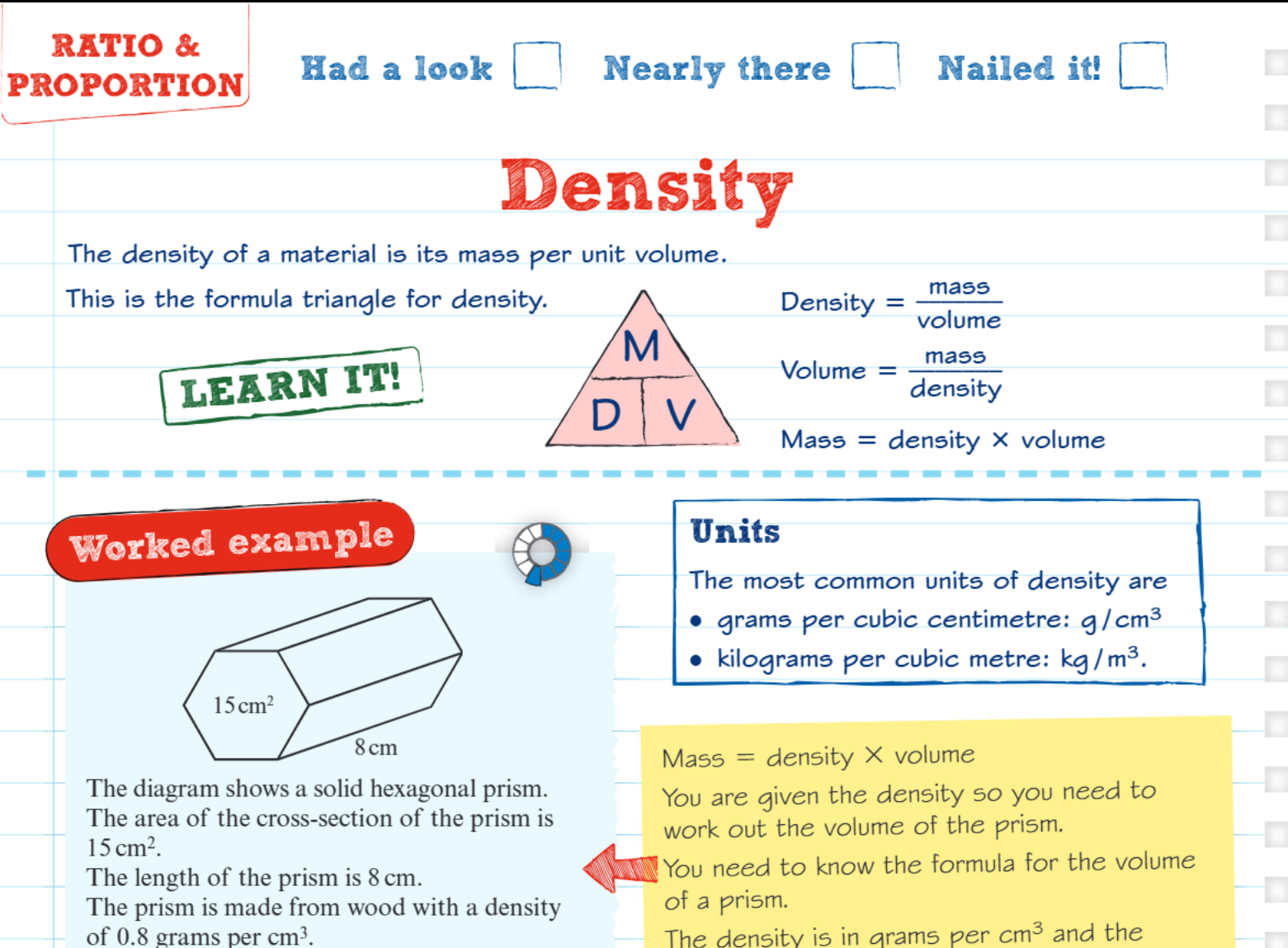
The density formula
The relationship between mass, density, and volume can be remembered using a formula triangle. This triangle helps you rearrange the formula depending on what you need to find.
The three key relationships are:
Important
To use the triangle, cover up the quantity you want to find. The remaining letters show you which calculation to perform. This method prevents formula confusion and ensures you use the correct relationship every time.
Units for density
Density is measured using two main units:
- Grammes per cubic centimetre (g/cm³) - commonly used for smaller objects and materials
- Kilogrammes per cubic metre (kg/m³) - commonly used for larger objects and in scientific contexts
Note
When solving problems, always check that your units match. If the density is given in g/cm³, make sure your mass is in grammes and your volume is in cm³. Mismatched units are one of the most common sources of errors in density calculations.
Calculating with density
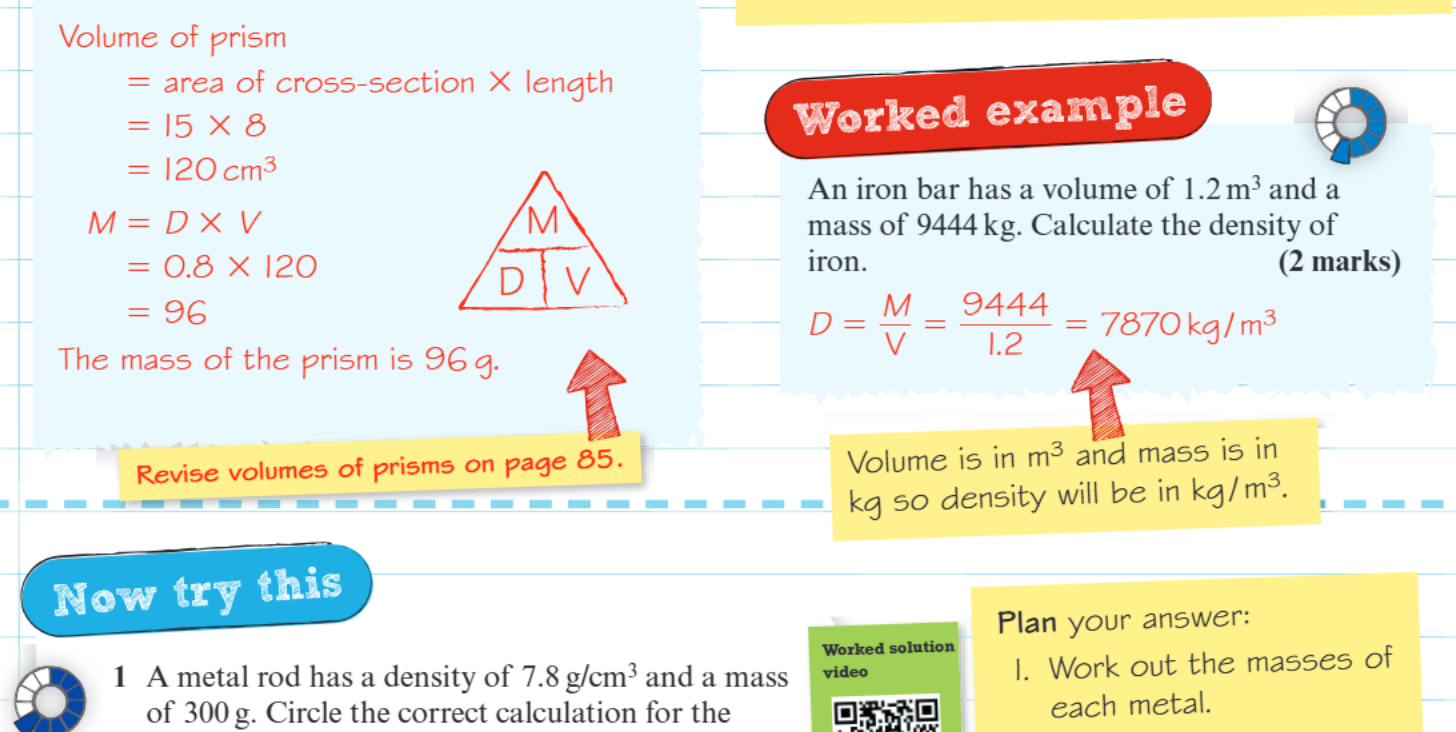
Finding mass from density and volume
When you know the density and volume of an object, you can calculate its mass using:
First, work out the volume if it's not given directly. For prisms, the volume equals the cross-sectional area multiplied by the length.
Example
Worked Example: Finding Mass
A metal block has a density of 8.0 g/cm³ and a volume of 25 cm³. What is its mass?
Step 1: Identify the formula Mass = density × volume
Step 2: Substitute the values Mass = 8.0 g/cm³ × 25 cm³ = 200 g
Step 3: Check units The cm³ cancels out, leaving grammes as expected.
Finding density from mass and volume
When you know both the mass and volume, you can calculate density using:
Remember to use consistent units throughout your calculation.
Problem-solving approach
When tackling density problems, follow this systematic approach:
Important
Step-by-Step Problem Solving:
- Identify what you know - mass, density, or volume
- Identify what you need to find - the remaining quantity
- Choose the correct formula using the triangle method
- Check your units are consistent
- Substitute the values and calculate
- Include the correct units in your final answer
For mixed materials problems, you may need to calculate the total mass and total volume separately before finding the overall density.
Exam tips
Note
Essential Exam Strategies:
- Always show your working clearly - even if your final answer is wrong, you can still earn method marks
- Include units in every step of your calculation to avoid unit errors
- Double-check that your answer makes sense - does a density of 50,000 kg/m³ seem reasonable?
- For prism problems, remember that volume = cross-sectional area × length
- Use the formula triangle if you forget which formula to use
Remember!
Summary
Key Points to Remember:
- Density measures how much mass fits into a unit volume
- Use the formula triangle to remember: , ,
- Common units are g/cm³ and kg/m³
- Always check your units match throughout calculations
- For mixed materials, calculate total mass and total volume first, then find overall density