Metric units (AQA GCSE Maths): Revision Notes
📚Revision Notes
Metric units
What are metric units?
Metric units are a standardised system of measurement used worldwide. The metric system is based on powers of 10, which makes conversions between different units straightforward and logical.
You can convert between metric units by multiplying or dividing by 10, 100, or 1000. The key to successful conversions is understanding the relationship between different units and knowing which direction to convert.
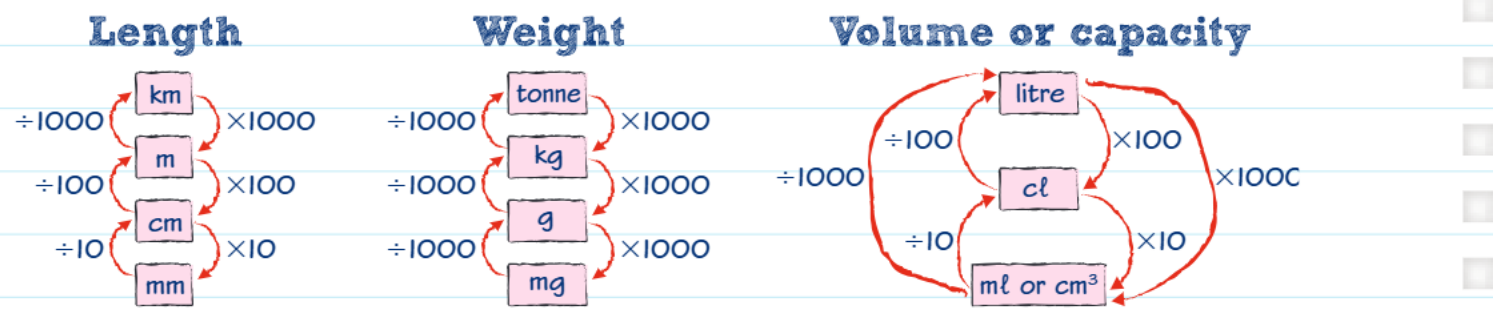
Length conversions
Length is measured using four main metric units, from largest to smallest:
- Kilometre (km) - used for long distances
- Metre (m) - the base unit for length
- Centimetre (cm) - used for smaller measurements
- Millimetre (mm) - used for very small measurements
Note
Understanding the hierarchy of length units is essential for successful conversions. Always remember that as you move from larger to smaller units, the numbers get bigger, and vice versa.
Conversion relationships for length:
- 1 km = 1000 m (divide by 1000 to convert km to m, multiply by 1000 to convert m to km)
- 1 m = 100 cm (divide by 100 to convert m to cm, multiply by 100 to convert cm to m)
- 1 cm = 10 mm (divide by 10 to convert cm to mm, multiply by 10 to convert mm to cm)
Weight conversions
Weight uses four main metric units, from largest to smallest:
- Tonne - used for very heavy objects
- Kilogram (kg) - the base unit for weight
- Gram (g) - used for lighter objects
- Milligram (mg) - used for very light measurements
Conversion relationships for weight:
- 1 tonne = 1000 kg
- 1 kg = 1000 g
- 1 g = 1000 mg
Note
Notice that weight conversions all use factors of 1000, making them easier to remember than length conversions. This consistency in weight measurements simplifies calculations significantly.
Volume and capacity conversions
Volume and capacity measurements have some special relationships that are important to understand:
- Litre - the main unit for liquid capacity
- Centilitre (cl) - smaller liquid measurements
- Millilitre (ml) - very small liquid measurements
- Cubic centimetre (cm³) - solid volume measurements
Key volume relationships:
- 1 litre = 100 cl
- 1 cl = 10 ml
- 1 ml = 1 cm³ (this is a crucial relationship to remember)
- 1000 cm³ = 1 litre
- 1 m³ = 1000 litres
Important
The relationship 1 ml = 1 cm³ is frequently tested in exams. This connection between liquid volume (millilitres) and solid volume (cubic centimetres) is essential to memorise, as it often appears in problem-solving questions.
Using place value diagrams for conversions
Place value diagrams help you multiply and divide by 10, 100, and 1000 accurately. This method involves moving digits rather than moving decimal points.
To multiply by 10, 100, or 1000:
Move the digits 1, 2, or 3 places to the left respectively. Fill empty spaces with zeros.
Example
Worked Example: Multiplying using place value
Problem: Calculate 0.35 × 1000
Step 1: Identify the operation We need to multiply by 1000, so move digits 3 places to the left
Step 2: Move the digits
- The digits 3 and 5 move three places to the left
- Empty spaces are filled with zeros
Step 3: Write the answer 0.35 × 1000 = 350
To divide by 10, 100, or 1000:
Move the digits 1, 2, or 3 places to the right respectively. Add decimal points where needed.
Example
Worked Example: Dividing using place value
Problem: Calculate 120 ÷ 1000
Step 1: Identify the operation We need to divide by 1000, so move digits 3 places to the right
Step 2: Move the digits
- The digits 1, 2, and 0 move three places to the right
- A decimal point is added before the 1
Step 3: Write the answer 120 ÷ 1000 = 0.12
Worked example: converting units in context
Example
Worked Example: Converting units in context
Problem: The weight of a ream of paper is 2.5 kg. There are 500 sheets of paper in a ream. Work out the weight in grammes of one sheet of paper.
Step-by-step solution:
Step 1: Convert the total weight to grammes
- 2.5 kg needs to be converted to grammes
- Since 1 kg = 1000 g, multiply by 1000
- 2.5 × 1000 = 2500 g
Step 2: Find the weight of one sheet
- Total weight = 2500 g
- Number of sheets = 500
- Weight of one sheet = 2500 ÷ 500 = 5 g
Answer: Each sheet of paper weighs 5 grammes.
Check your conversion: Always verify that your conversion makes sense. A gramme is smaller than a kilogramme, so the number should be larger when converting from kg to g.
Exam tips
When tackling metric conversion questions in exams, keep these strategies in mind:
- Remember the conversion factors: 10, 100, and 1000 are your key numbers
- Check your answers: Does the result make logical sense?
- Know the special relationships: 1 ml = 1 cm³ often appears in exam questions
- Practice with place value diagrams to avoid decimal point errors
- Read questions carefully to identify which units you're converting between
Summary
Key Points to Remember:
- Metric conversions use factors of 10, 100, and 1000 only
- When converting to smaller units, your answer gets bigger (multiply)
- When converting to larger units, your answer gets smaller (divide)
- 1 millilitre equals 1 cubic centimetre (1 ml = 1 cm³)
- Place value diagrams help prevent errors when multiplying or dividing by powers of 10