Other compound measures (AQA GCSE Maths): Revision Notes
📚Revision Notes
Other compound measures
What are compound measures?
A compound measure combines two different basic measurements to create a new type of measurement. For example, speed is a compound measure because it combines distance and time to give us a single value that tells us how fast something is moving.
These measurements are essential in many areas of maths and science because they help us understand relationships between different quantities.
Note
Compound measures are everywhere in daily life! Think about fuel efficiency (distance per litre), population density (people per square kilometre), or even your internet speed (data per second).
Pressure
Pressure measures how much force is applied over a specific area. When you press down on something, the pressure depends on both how hard you push and how large the area is that you're pushing on.
The most common units for measuring pressure are:
- Newtons per square centimetre (N/cm²)
- Newtons per square metre (N/m²)
Formula triangle for pressure
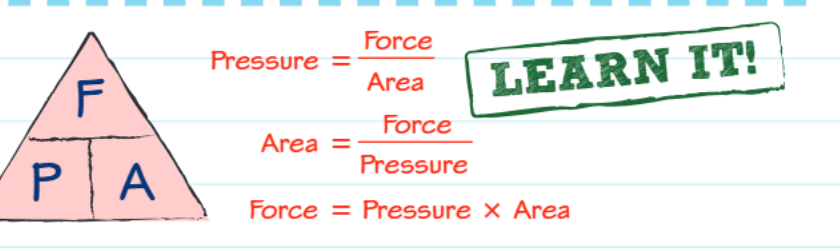
The formula triangle shows you how pressure, force and area are related. To use it, cover up the quantity you want to find, and the remaining letters show you the calculation:
- Pressure =
- Area =
- Force =
Important
Remember: smaller area means higher pressure! This is why a nail has a sharp point - it concentrates all the force into a tiny area, creating enormous pressure that can pierce materials.
Example
Worked Example: Calculating Force from Pressure
If water at a depth of 15m has a pressure of 14.7 N/cm², and you need to find the force on a diving mask with surface area 360 cm²:
Step 1: Identify the formula
Step 2: Substitute the values
Step 3: Calculate
Rates
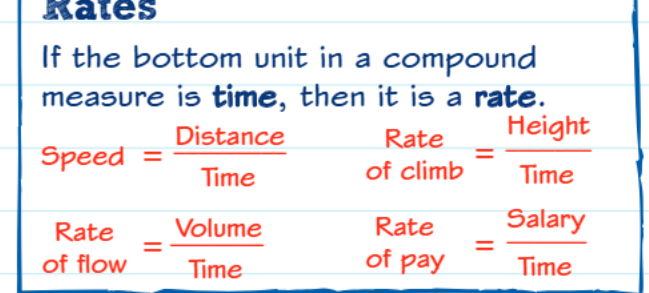
A rate is a special type of compound measure where time is the bottom unit (denominator). If you see time at the bottom of a fraction in a compound measure, you're looking at a rate.
Common examples of rates include:
- Speed = (how fast something moves)
- Rate of climb = (how quickly something goes up)
- Rate of flow = (how quickly liquid flows)
- Rate of pay = (how much someone earns per hour)
Note
The key identifier of a rate is that time appears in the denominator (bottom) of the fraction. This tells us we're measuring "how much per unit of time".
Example
Worked Example: Rate of Flow Problem
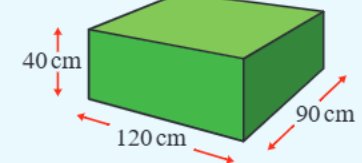
Aaron has a fish tank shaped like a cuboid with dimensions 120cm × 90cm × 40cm. He fills it with water at a rate of 12 litres per minute. How long will it take to half-fill the tank?
Step 1: Calculate the volume of the tank
Step 2: Find half the capacity
Step 3: Calculate the time using the rate Using:
Answer: It will take 18 minutes to half-fill the tank.
Problem-solving strategy
When solving compound measure problems, follow this systematic approach:
Important
Essential Problem-Solving Steps:
- Work out what you're looking for - identify the unknown quantity
- Look at the units to help you work out which calculation to use
- Plan your strategy - break complex problems into smaller steps
- Convert units if necessary before calculating
- Check your answer makes sense
Many compound measure problems require you to use multiple maths skills, including calculating volumes, converting units, and working with rates.
Summary
Key Points to Remember:
- Compound measures combine two basic measurements to create something more useful
- Pressure = and you can rearrange this formula using the triangle method
- If time is at the bottom of a compound measure, it's called a rate
- Common rates include speed, rate of flow, and rate of climb
- Always check your units and convert them if needed before calculating