Percentage change 1 (AQA GCSE Maths): Revision Notes
📚Revision Notes
Percentage change 1
Percentage changes are used to increase or decrease amounts by a given percentage. There are two main methods you can use to calculate these changes, and you also need to know how to find what percentage change has occurred.
Note
Understanding percentage changes is essential for many real-world applications, from calculating discounts and price increases to analysing data changes over time.
Method 1: Traditional calculation
This method involves calculating the percentage amount first, then adding or subtracting it from the original amount.
For a decrease:
- Calculate the percentage of the original amount
- Subtract this from the original amount
For an increase:
- Calculate the percentage of the original amount
- Add this to the original amount
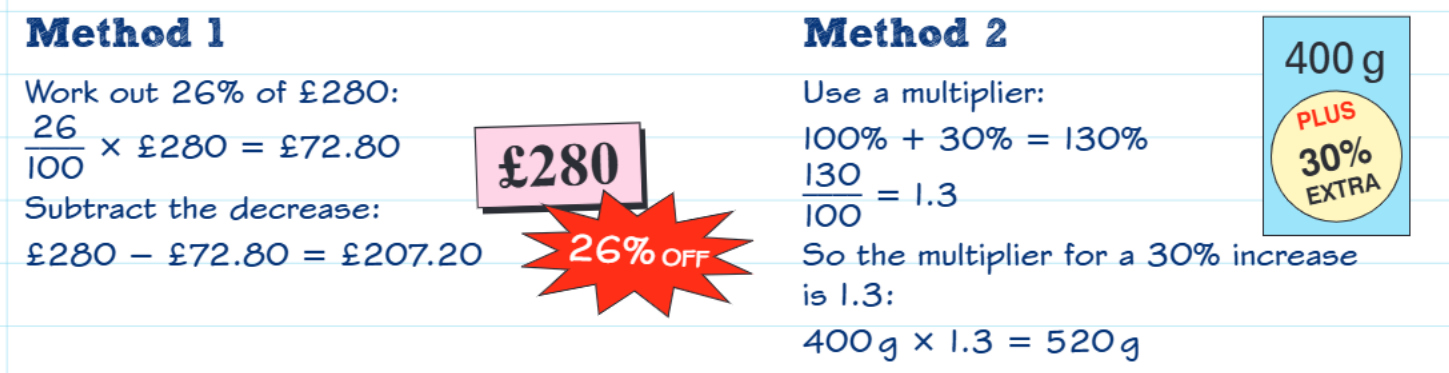
Example
Worked Example: 26% Discount Calculation
The example shows a 26% discount on £280:
- First calculate 26% of £280:
- Then subtract:
Method 2: Multiplier method
This method uses multipliers to calculate percentage changes in one step. It's often quicker and reduces the chance of errors.
For increases:
- Add the percentage to 100% to find the multiplier
- Example: 30% increase = 100% + 30% = 130% = 1.3
For decreases:
- Subtract the percentage from 100% to find the multiplier
- Example: 26% decrease = 100% - 26% = 74% = 0.74
Example
Worked Example: 30% Increase Using Multipliers
The example shows a 30% increase on 400g:
- Multiplier = 1.3
- New amount =
Calculating percentage increase or decrease
When you need to find what percentage change has occurred, use this method:
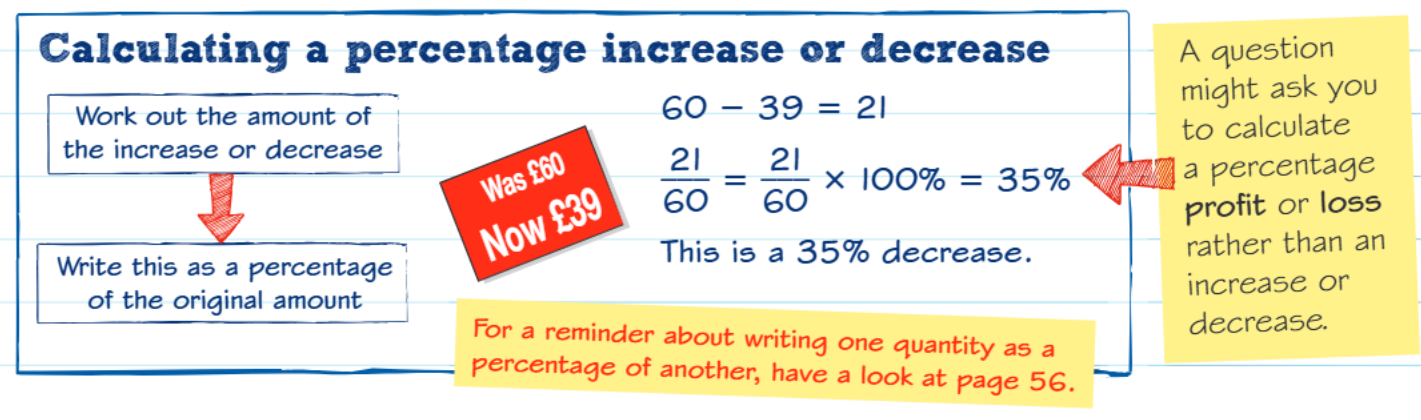
Formula:
Steps:
- Find the change by subtracting (new amount - original amount)
- Divide the change by the original amount
- Multiply by 100% to get the percentage
Example
Worked Example: Finding Percentage Decrease
The example shows a price change from £60 to £39:
- Change =
- Percentage =
- This is a 35% decrease
Working with money
Important
When working with money, you must give your answer to 2 decimal places.
Note
Exam tip: Check your answer by using an easier percentage that's close to the one in the question.

For example, if calculating 5.2% of £650, you could check by calculating 5% of £650 = £32.50, so your answer should be close to this amount.
Key tips for percentage changes
- Increases result in multipliers greater than 1
- Decreases result in multipliers less than 1
- Always identify whether you're finding a percentage change or applying one
- Questions might ask for percentage profit or percentage loss rather than increase or decrease
- Use the multiplier method when possible as it reduces calculation steps
Summary
Key Points to Remember:
- Method 1: Calculate the percentage amount, then add or subtract it
- Method 2: Use multipliers (more efficient for most calculations)
- Finding percentage change:
- Money answers must have 2 decimal places
- Check your work using easier percentages close to the given value