Percentages (AQA GCSE Maths): Revision Notes
📚Revision Notes
Percentages
What is a percentage?
A percentage represents how many parts out of every 100. The term per cent literally means out of 100, so when we say 25%, we mean 25 out of every 100 parts.
You can write any percentage as a fraction with 100 as the denominator. This makes it easy to understand and work with percentages in calculations.
Note
The visual concept of percentages becomes clearer when you think of them as parts of a whole divided into 100 equal pieces. This is why percentage grids with 100 squares are so useful for understanding what different percentages actually represent.
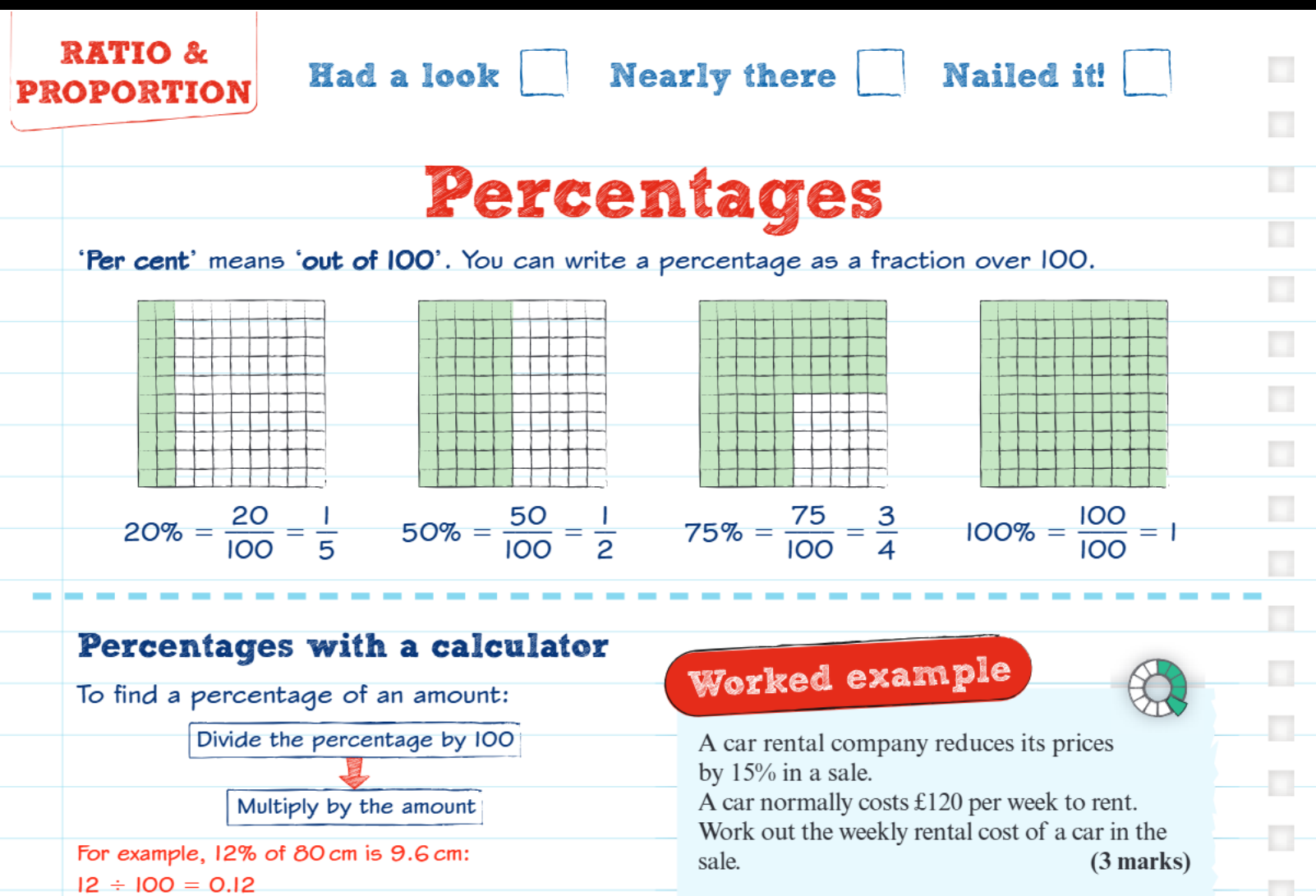
The visual grids above show how percentages relate to fractions. Each grid contains 100 small squares, making it easy to see what different percentages look like:
- 20% = 20 out of 100 = 1/5
- 50% = 50 out of 100 = 1/2
- 75% = 75 out of 100 = 3/4
- 100% = 100 out of 100 = 1
Finding percentages using a calculator
When you need to find a percentage of an amount, follow this simple two-step process:
Important
Essential Calculator Method for Percentages:
Step 1: Divide the percentage by 100 Step 2: Multiply your answer by the amount
This method works for any percentage calculation and should be memorised for exams.
Example
Worked Example: Finding 12% of 60 cm
Step 1: Divide the percentage by 100
Step 2: Multiply by the amount cm
Therefore, 12% of 60 cm = 9.6 cm
Alternative method
You can also calculate percentages by working out 1% first, then multiplying by the required percentage. This method is particularly useful for mental calculations or when you don't have a calculator available.
Converting quantities to percentages
To express one quantity as a percentage of another quantity, use this method:
Important
Method for Converting to Percentages:
Step 1: Divide the first quantity by the second quantity Step 2: Multiply your answer by 100
Remember: First ÷ Second × 100 = Percentage
Example
Worked Example: Converting Fractions to Percentages
If 3 out of 12 yoghurts are strawberry flavoured:
Step 1: Divide first by second
Step 2: Multiply by 100 %
Therefore, 25% of the yoghurts are strawberry flavoured.
Worked examples
Example 1: Price reductions
A car rental company reduces its prices by 15% in a sale. A car normally costs £120 per week to rent. What is the weekly rental cost in the sale?
Example
Worked Example: Calculating Sale Prices
Step 1: Find 15% of £120
Step 2: Subtract the discount from original price
Answer: The car costs £102 per week in the sale
Example 2: Converting to percentages
In a year group of 96 students, 60 own a bicycle. Express 60 as a percentage of 96.
Example
Worked Example: Student Bicycle Ownership
Step 1: Divide first quantity by second quantity
Step 2: Multiply by 100 %
Answer: 62.5% of the students own a bicycle
Exam tips
Mastering percentage calculations requires both understanding the methods and applying good exam technique. Here are essential strategies to help you succeed:
Note
Important Exam Strategies:
- Always show your working clearly for percentage calculations
- Check your answers make sense - percentages cannot exceed 100% unless you're dealing with increases
- When finding percentage reductions, remember to subtract your calculated amount from the original value
- Use the visual grid method to check your understanding of what percentages look like
- Look out for questions asking you to find both the percentage and the final amount after a reduction
Remember!
Summary
Key Points to Remember:
- Percentage means out of 100 - think of it as parts per hundred
- To find a percentage of an amount: divide the percentage by 100, then multiply by the amount
- To convert to percentages: divide the first number by the second, then multiply by 100
- Always show your working in exam questions for full marks
- Check your answers - do they make logical sense in the context of the problem?