Ratios (AQA GCSE Maths): Revision Notes
📚Revision Notes
Ratios revision note
Introduction to ratios
A ratio is a way of comparing quantities or amounts. Ratios show the relationship between different parts of a whole or between different quantities. Understanding ratios is essential for solving many mathematical problems, and there are several key techniques you need to master.
Note
Ratios are fundamental to many areas of mathematics, from geometry and algebra to statistics and probability. Mastering ratio techniques will help you solve complex problems more efficiently.
Writing ratios as fractions
The most straightforward way to express a ratio is by converting it into a fraction. When you have a ratio like , you can write this as a fraction by placing one number over the other.
For example, if apples and oranges are in the ratio , this tells us there are as many apples as oranges, or alternatively, times as many oranges as apples. This fraction form makes it easier to work with ratios in calculations.
Example
Worked Example: Converting Ratios to Fractions
If books and magazines are in the ratio :
- There are as many books as magazines
- There are times as many magazines as books
- For every 3 books, there are 7 magazines
Reducing ratios to their simplest form
Just like fractions, ratios can be simplified by finding common factors. To reduce a ratio to its simplest form, you need to divide all the numbers in the ratio by the same value - specifically, by their highest common factor.
A ratio is in its simplest form when there's no number (other than 1) that divides evenly into all parts of the ratio. For example, to simplify , you would notice that both numbers can be divided by 3. So becomes , which cannot be simplified further.
Example
Worked Example: Simplifying Ratios
Simplify the ratio :
Step 1: Find the highest common factor of 24 and 36
- Factors of 24: 1, 2, 3, 4, 6, 8, 12, 24
- Factors of 36: 1, 2, 3, 4, 6, 9, 12, 18, 36
- HCF = 12
Step 2: Divide both numbers by the HCF
Note
Calculator tip: If you're allowed to use a calculator, you can enter a ratio as a fraction (like ) and use the fraction button to automatically reduce it. Then convert the result back to ratio form.
The more awkward cases
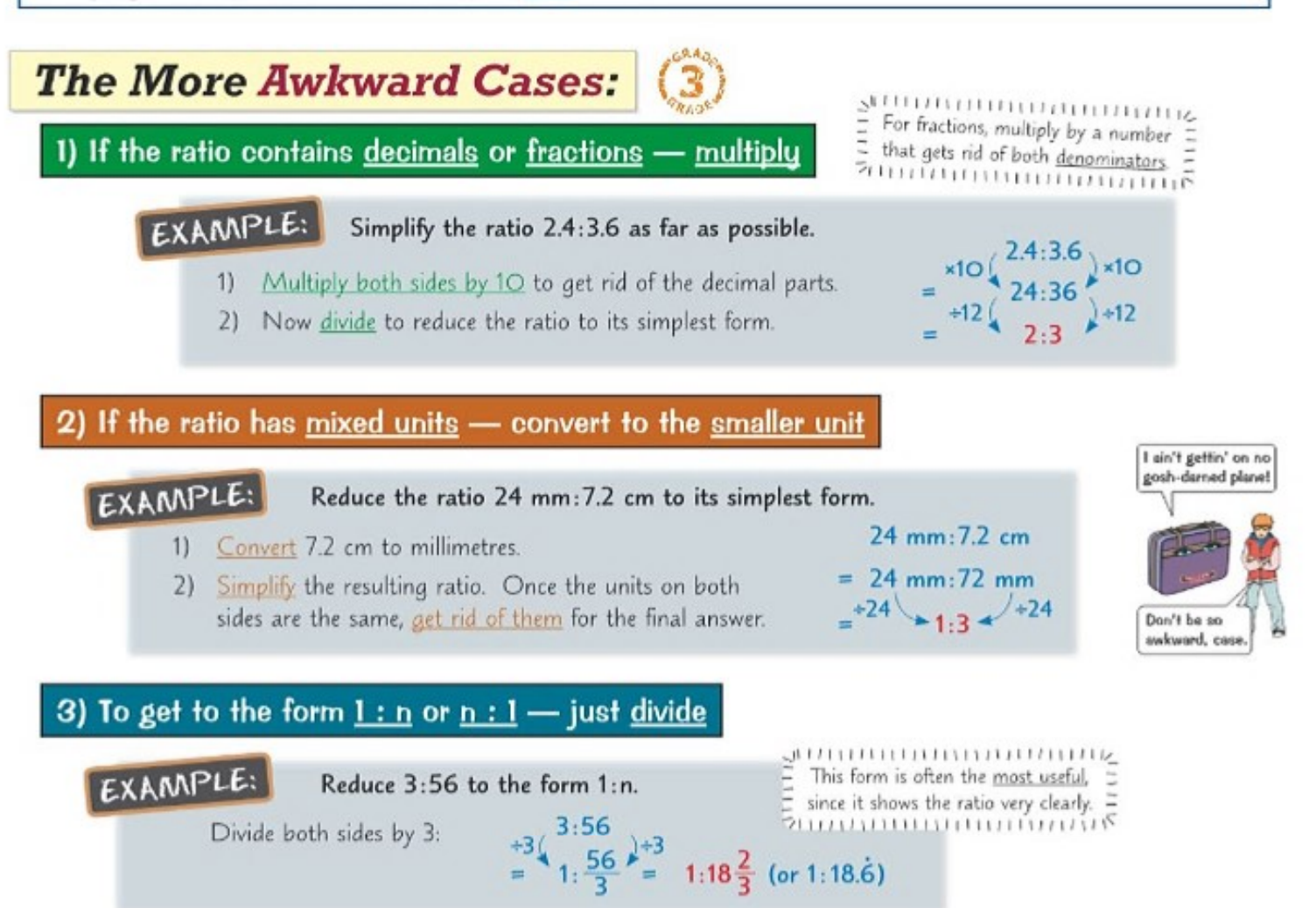
Some ratios require special handling before they can be simplified. These more challenging scenarios include ratios with decimals, mixed units, and cases where you need unit ratios.
Ratios with decimals or fractions
When dealing with ratios that contain decimal numbers, you need to eliminate the decimal places first. Do this by multiplying both parts of the ratio by an appropriate power of 10.
For instance, if you have the ratio , multiply both sides by 10 to get . Then you can simplify this by dividing both numbers by their highest common factor (12) to get .
Example
Worked Example: Ratios with Decimals
Simplify the ratio :
Step 1: Eliminate decimals by multiplying by 10
Step 2: Find the HCF of 15 and 24 HCF = 3
Step 3: Divide both by the HCF
Ratios with mixed units
When a ratio contains different units, you must convert everything to the same unit before simplifying. Always convert to the smaller unit to avoid decimals.
For example, with mm: cm, first convert cm to millimetres (72 mm). This gives you mm: mm. Now you can simplify by dividing both by 24 to get .
Important
Always convert to the smaller unit when dealing with mixed units. This prevents you from introducing decimals, which would make the problem more complex.
Creating unit ratios
Sometimes you need to express a ratio in the form or . This is particularly useful when you want to see how many times bigger one quantity is than another.
To create a unit ratio, simply divide both parts of the ratio by one of the numbers. For example, to convert to the form , divide both parts by 3. This gives you .
Scaling up ratios
When you know the ratio between parts and the actual size of one part, you can find the size of the other parts by scaling up the ratio proportionally.
The key principle is that the two parts of a ratio are always in direct proportion. This means if one part doubles, the other part doubles too. If one part triples, the other part triples as well.
Example
Worked Example: Scaling Up Ratios
Mortar is made from sand and cement in the ratio . If you use 21 buckets of sand, how much cement do you need?
Step 1: Find the scale factor (sand has been multiplied by 3)
Step 2: Apply the same scale factor to cement buckets of cement needed
Part ratios

Part
ratios occur when the left-hand side of a ratio is included in the right-hand side. These ratios compare a part to the total amount.For example, if Mrs Miggins has tabby cats and ginger cats in the ratio (tabby to total), this means that out of every 5 cats, 3 are tabby cats and 2 are ginger cats (since ).
When working with part
ratios, remember that:- The ratio tells you what fraction of the whole each part represents
- You can find the other parts by subtracting from the whole
- You can scale up using the same proportional principles
Note
In part
ratios, be careful to identify which number represents the part and which represents the whole. The whole will always be larger than any individual part.Proportional division
Proportional division involves splitting a total amount into parts according to a given ratio. This is a three-step process that's essential for many ratio problems.
Important
The Three-Step Process for Proportional Division:
Step 1: ADD UP THE PARTS If you have a ratio like , add these numbers together to find the total number of parts: parts.
Step 2: DIVIDE TO FIND ONE "PART" Divide the total amount by the number of parts to find the value of one part. If £9100 is being divided in the ratio , then one part = £9100 ÷ 13 = £700.
Step 3: MULTIPLY TO FIND THE AMOUNTS Multiply the value of one part by each number in the ratio to find the individual amounts. So the person with 4 parts gets .
Example
Worked Example: Proportional Division
Three friends share £240 in the ratio . How much does each person get?
Step 1: Add up the parts parts
Step 2: Find the value of one part One part = £240 ÷ 16 = £15
Step 3: Calculate each person's share
- Person 1:
- Person 2:
- Person 3:
Check: £45 + £75 + £120 = £240 ✓
Changing ratios
Some problems involve ratios that change when quantities are added or removed. These require careful step-by-step analysis.
The key approach is to:
- Find the original numbers of each quantity
- Work out how the quantities change
- Write the new ratio and simplify if necessary
Note
For more complex changing ratio problems, you might need to:
- Write ratios as equations using variables
- Turn ratios into fractions
- Solve simultaneous equations
For example, if you know the ratio of male to female pupils is , and then teachers are added in the ratio (male to female), you can use algebraic methods to find the new overall ratio.
Summary
Key Points to Remember:
- Simplify ratios by dividing all parts by their highest common factor
- For decimals and fractions: multiply to eliminate decimal places first
- For mixed units: convert to the smaller unit before simplifying
- For proportional division: add up the parts, find one part, then multiply
- Part ratios include one part within the total - subtract to find the other parts
- Unit ratios show direct comparison by making one part equal to 1
- Scaling up uses direct proportion - if one part changes by a factor, all parts change by the same factor