Nuclear Fission Diagrams (AQA GCSE Physics): Revision Notes
📚Revision Notes
4.4.3 Nuclear Fission Diagrams
Note
The process:
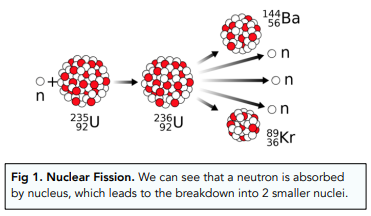
- The nucleus absorbs a neutron. In most fission reactions, the unstable nucleus will absorb a neutron as the first step.
- The nucleus splits into 2. Once the neutron has been absorbed, the nucleus will split into 2 smaller nuclei. Energy is released through the fission reaction.
- Neutrons and gamma rays are emitted. The nucleus will also emit 2 or 3 high-energy neutrons when the fission reaction is happening. As well as 2 or 3 neutrons, gamma rays are also emitted
Drawing Nuclear Fission:
Below, we can see a representation of nuclear fission. You may be asked to draw a diagram like this in an exam, so here's how to do it:
- Draw a neutron. This is essentially a small circle. You can label it 'n'.
- Draw a large nucleus. As you can see in the diagram below, the nucleus must be made up of smaller particles.
- Draw 2 more nuclei. Since this is a fission reaction, we need to draw the 2 neutrons that are produced.
- Draw 2 or 3 neutrons. Fission reactions produce more neutrons, which we need to represent on our diagram as small circles again.
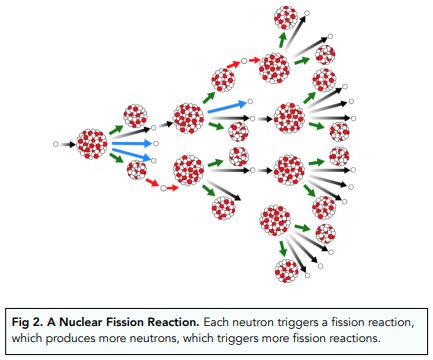
- Draw more fission reactions. From one of the neutrons, draw an arrow to another nuclei. This is the continuation of the chain reaction. The end product should look similar to the diagram below: