Hooke's Law (AQA GCSE Physics): Revision Notes
📚Revision Notes
5.3.2 Hooke's Law
Hooke's Law
Definition
Note
The extension of an elastic object, such as a spring, is directly proportional to the force applied, provided that the limit of proportionality is not exceeded.
This means that if the force applied to an object is doubled, then the extension of the object also doubles. If no force is applied, there is no extension. However, this only applies within the limit of proportionality of the elastic object, such as a spring.
Note
The limit of proportionality is the point at which additional force will not be supported by the linear relationship of Hooke's law.
The elastic limit is the maximum point to which an elastic material can stretch and still return to its original shape. Once the elastic limit is exceeded, the elastic object will not return to its original shape. At this point, the object becomes permanently deformed and the object will no longer show the original elastic behaviour.
Note
Formula
- The force applied to the spring, in Newtons
- The spring constant, in Newtons per metre
- The extension, in metres
Force/Extension Graph
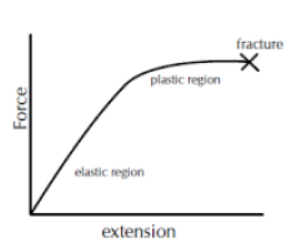
Linear Line
- This is the elastic region.
- It follows Hooke's Law.
- The gradient is .
Limit of Proportionality
- The point it stops being linear is the limit of proportionality.
- From then on, it does not obey Hooke's Law.
Non-Linear Line
- There is plastic behaviour here.
- It does not follow Hooke's Law.
- If shallow:
- Lots of extension for not a lot of force.
- Easy to stretch.
Brittleness
- If the graph is just linear, with no non-linear end section, the material is brittle, so it snaps instead of stretches after the elastic limit.