Terminal Velocity (AQA GCSE Physics): Revision Notes
📚Revision Notes
5.6.14 Terminal Velocity
Note
Terminal Velocity is the constant speed that a falling object eventually reaches when the force of gravity pulling it down is balanced by the frictional force (air resistance) acting against it.
Note
At terminal velocity, the object stops accelerating and moves at a steady speed in a constant direction. This occurs when the resultant force acting on the object is zero, meaning the downward force of gravity is exactly balanced by the upward force of air resistance.
Factors Affecting Terminal Velocity:
- The shape and surface area of the object: Objects with a larger surface area or more streamlined shapes experience different amounts of air resistance, affecting their terminal velocity.
- The terminal velocity varies for different objects due to differences in mass, shape, and the fluid they are falling through (such as air or water).
Example
Example: A skydiver reaches terminal velocity when the upward force of air resistance equals the downward force of gravity, causing them to fall at a constant speed until they deploy their parachute.
Falling in a Fluid (Physics Only)
-
Initially, the object will fall freely under gravity (9.8 m/s²).
-
However, drag forces will act (see skydiver).
-
Then the object will move at terminal velocity.
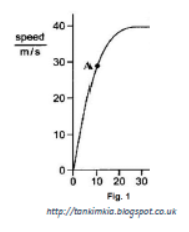
-
The graph shows an initial steep gradient, which dies off to a flat gradient as acceleration decreases due to increasing drag, until no acceleration at terminal velocity ~40 m/s⁻¹ in this case.
Note
Equations
- Average Speed:
- Acceleration:
- Equation of Motion:
- Kinetic Energy: