Reaction Time (AQA GCSE Physics): Revision Notes
📚Revision Notes
5.8.3 Reaction Time
Note
Thinking distance is influenced by several factors:
- Vehicle speed: The faster the vehicle is moving, the greater the distance covered while the driver reacts.
- Reaction time: A slower reaction time means more distance is travelled before the brakes are applied.
Note
Reaction time varies from person to person but generally falls between 0.2 and 0.9 seconds. Factors that can influence reaction time include:
- Tiredness
- Drugs
- Alcohol
- Distractions (e.g., using a phone, listening to the radio)
Measuring Reaction Time
Note
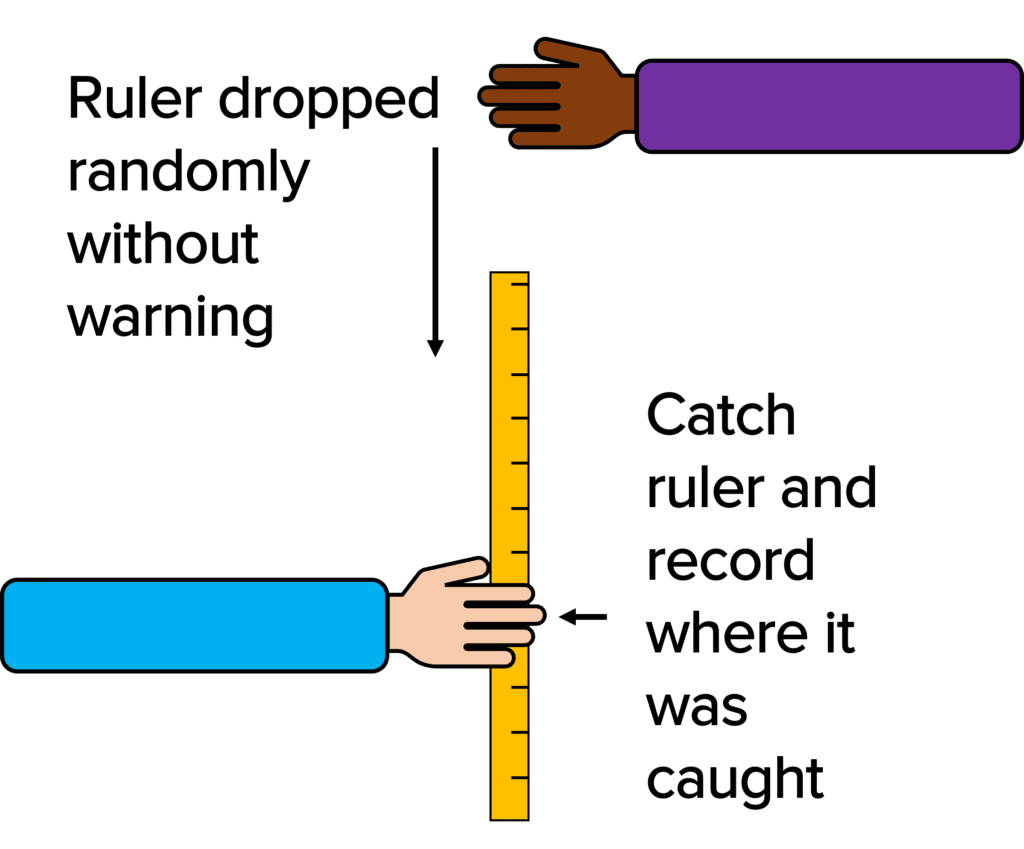
To measure a person's reaction time, using a standard stopwatch is ineffective since reaction times are typically less than a second. A simple alternative method is to drop a ruler and measure the distance it falls before being caught.
Note
Method:
- Place your hand at the 0 cm mark on a ruler, with your thumb and forefinger hovering over the spot. Have someone else hold the ruler from the top.
- Without warning, the person holding the ruler should drop it. Your goal is to catch it as quickly as possible.
- The point where your thumb and forefinger catch the ruler indicates the distance it fell during your reaction time. A longer distance means a slower reaction time.
Note
Given that the acceleration due to gravity is 9.81 m/s², you can use this and the formula to calculate the actual reaction time.
Note
To improve the accuracy of the experiment, repeat the test several times and calculate an average reaction distance or time. You can also experiment with how distractions affect reaction time.