Electromagnetic (EM) Waves (AQA GCSE Physics): Revision Notes
📚Revision Notes
6.2.1 Electromagnetic (EM) Waves
Electromagnetic Waves
Note
Electromagnetic waves are transverse waves that transfer energy from the source of the waves to an absorber.
Visible Light
- If we pass white light through a prism, it splits into a spectrum.
- Each colour of light has a different wavelength and frequency.
- Visible light is the only part of the electromagnetic spectrum that can be detected by the human eye.
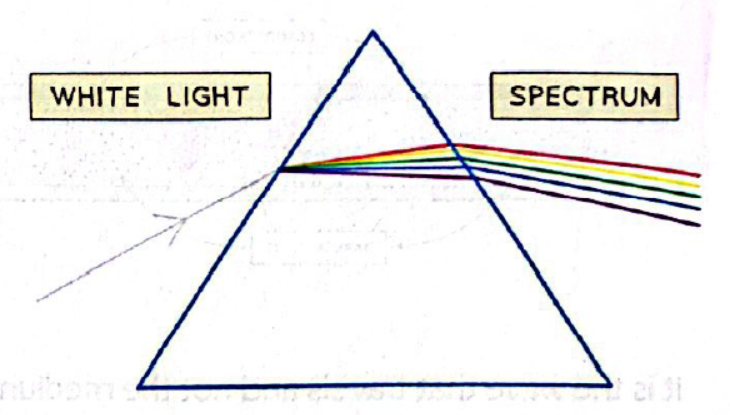
Spectrum Order (from lower frequency, longer wavelength to higher frequency, shorter wavelength)
- Red
- Orange
- Yellow
- Green
- Blue
- Indigo
- Violet
Characteristics
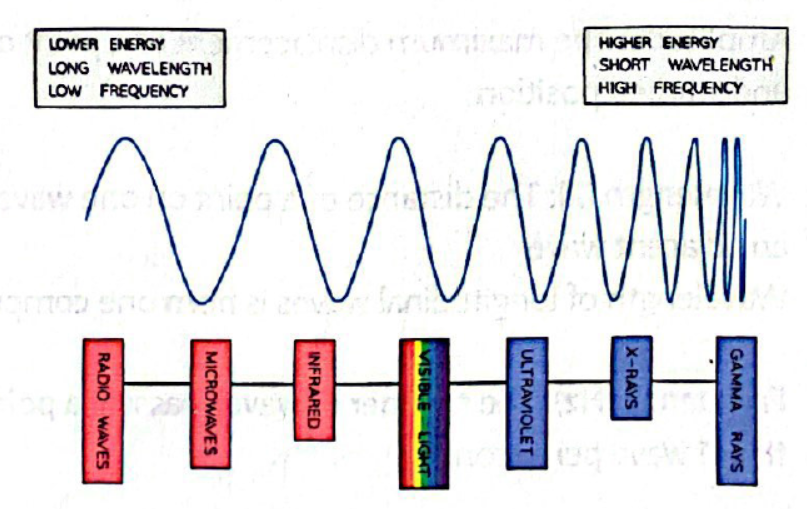
- Lower frequency, longer wavelength (Red) to higher frequency, shorter wavelength (Violet).
- The electromagnetic spectrum is a continuous spectrum.
- They do not need a medium to travel in. All EM waves travel through a vacuum at 3 × 10⁸ m/s.
Mnemonic for Spectrum Order
Note
"Raw meat is very unsanitary, except giraffe"
- Helps to remember the colours of visible light in order.
Uses of Electromagnetic (EM) Waves
Radio Waves
- Transmission of Radio and Terrestrial TV Signals
- Can travel long distances before being absorbed by buildings and trees.
- Longer radio waves can spread out between hills due to diffraction.
- Reflect off charged particles in the ionosphere, allowing them to travel long distances around the Earth.
Microwaves
- Heating Food
- Water molecules in food absorb the energy of microwaves, causing the temperature of the food to increase.
- Communication with Satellites in Space
- Microwaves can pass through the Earth's atmosphere without being refracted or reflected.
Infrared
- Emitted by Electrical Heaters and Cooking Food
- The energy of infrared is easily absorbed by the surface of objects.
- Infrared Cameras
- Used to check buildings for heat losses.
Visible Light
- Communication Using Fibre Optics
- Optical fibres are thin strands of glass that transmit pulses of light to carry information.
- Carrying Telephone and Cable TV Signals
- Short wavelengths allow it to carry a large amount of information.
Ultraviolet
- Energy Efficient Light Bulbs
- Ultraviolet light is created inside the bulb and converted to visible light by the bulb's internal surface.
- More energy-efficient due to the shorter wavelength of ultraviolet light.
- Sun Tanning
X-Rays and Gamma Rays
- Medical Imaging
- X-rays: Visualise broken bones.
- Gamma Rays: Detect cancer.
- Both are very penetrating and can pass through body tissues.
- X-rays are absorbed by bones, making them visible on X-ray images.
- Cancer Treatment
- Both X-rays and Gamma Rays can be used to treat cancer.
Electromagnetic Waves
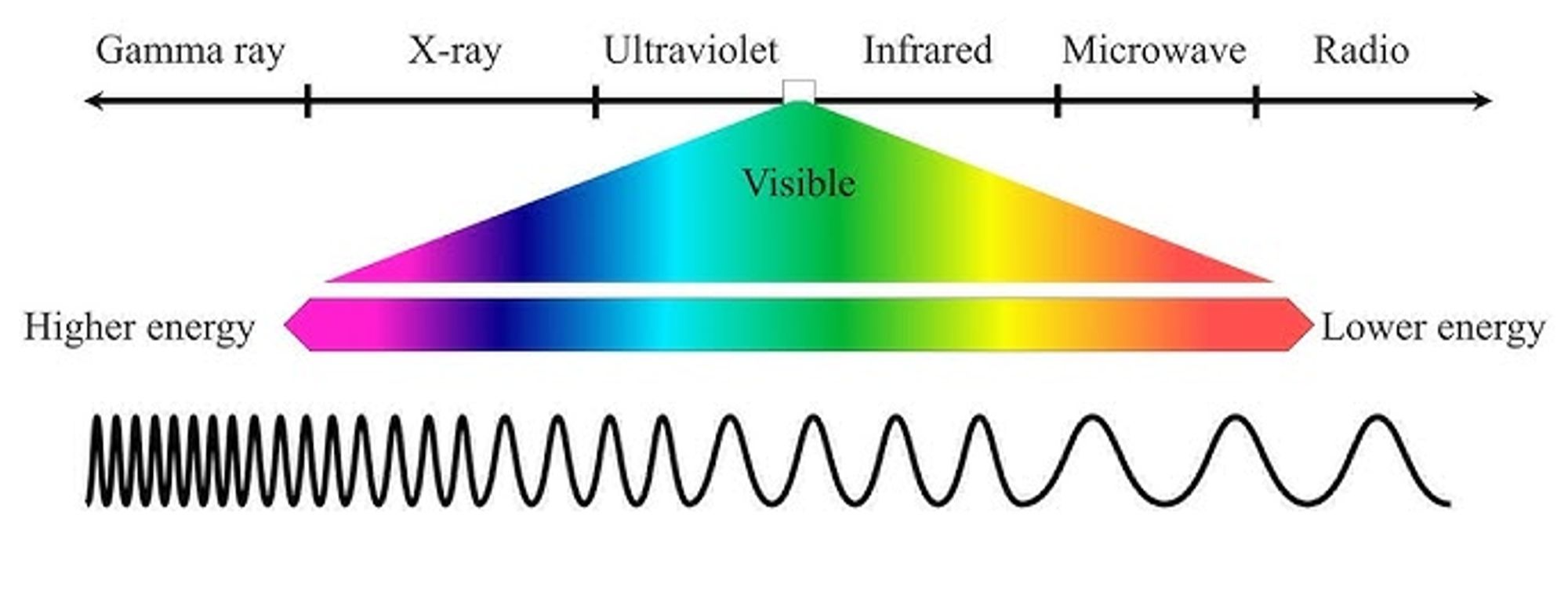
Need to learn the main groups, and in which order (for increasing wavelength or frequency).
- These are transverse waves.
- Do not need particles to move.
- In space, all waves have the same velocity (speed of light).
- They can transfer energy from a source to an absorber.
- Microwave source to food.
- Sun emits energy to Earth.
Relationships
- As speed is constant for all EM waves.
- As the wavelength decreases, the frequency must increase.
- As frequency increases, the energy of the wave increases.
Eyes
- Our retina can only detect visible light, a small part of the entire EM spectrum.
- This visible light is still an EM wave like X-rays and microwaves, do not forget!