Saturated Hydrocarbons (Edexcel GCSE Chemistry Combined Science): Revision Notes
📚Revision Notes
Saturated Hydrocarbons
Note
Saturated hydrocarbons are hydrocarbons that contain only single bonds between carbon atoms. Each carbon atom in a saturated hydrocarbon is bonded to as many hydrogen atoms as possible, meaning they are "saturated" with hydrogen.
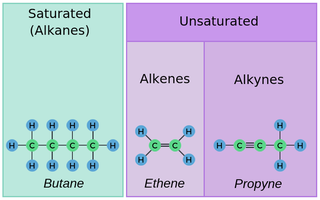
Alkanes: An Example of Saturated Hydrocarbons
- Alkanes are the simplest type of saturated hydrocarbons.
- They follow the general formula CnH₂n+₂.
- All the bonds between the carbon atoms in alkanes are single covalent bonds.
Properties of Saturated Hydrocarbons
- Less Reactive:
- Saturated hydrocarbons are generally less reactive than unsaturated hydrocarbons because they only have single bonds, which are strong and stable.
- Burn Readily: Alkanes burn in the presence of oxygen (combustion), releasing a lot of energy, which is why they make good fuels.
- Complete combustion produces carbon dioxide and water.
- Incomplete combustion (when there's not enough oxygen) can produce carbon monoxide and soot.
- Boiling Point Increases with Size:
- The larger the alkane molecule, the stronger the intermolecular forces, leading to higher boiling points.
Examples of Saturated Hydrocarbons
| Alkane | Molecular Formula |
|---|---|
| Methane | CH₄ |
| Ethane | C₂H₆ |
| Propane | C₃H₈ |
| Butane | C₄H₁₀ |
Note
Saturated hydrocarbons are found in crude oil and natural gas and are used as fuels due to their ability to burn cleanly and release energy efficiently.