Human activity (Edexcel GCSE Geography A): Revision Notes
📚Revision Notes
Human activity in coastal landscapes
Human activities significantly transform coastal environments, creating both positive and negative impacts on landscapes, communities, and ecosystems. Understanding these interactions is crucial for managing coastal areas sustainably and preparing for the challenges of coastal change.
Types of human activity and their impacts
There are three main categories of human activity that affect coastal landscapes: urbanisation, agriculture, and industry. Each type creates distinct impacts on the coastal environment.
Note
The impacts of human activity on coastal landscapes can be both positive and negative, and understanding these different effects is essential for sustainable coastal management planning.
Urbanisation
Urban development along coastlines brings significant changes to natural coastal processes. The weight of buildings and infrastructure makes cliffs more vulnerable to erosion and collapse, as the additional load increases stress on already unstable coastal rocks and soil.
Urbanisation also alters natural drainage patterns, with changes to surface water flow increasing soil saturation. This makes coastal slopes more prone to landslides and erosion. However, urban development can have positive effects too, as it raises public interest in protecting coastal landscapes, often leading to conservation initiatives and coastal management schemes.
Agriculture
Farming activities in coastal areas create complex environmental impacts. Agricultural practices tend to increase soil erosion, as ploughing and livestock grazing remove protective vegetation cover, making soil more vulnerable to wind and water erosion. This increased erosion leads to higher levels of sedimentation in coastal waters, which can affect marine ecosystems and water quality.
On the positive side, agricultural land use can create valuable wildlife habitats, particularly when traditional farming methods are used. Coastal meadows, salt marshes used for grazing, and field boundaries can support diverse plant and animal communities.
Note
The relationship between agriculture and coastal environments demonstrates how human activities can have both harmful and beneficial effects on the same ecosystem.
Industry
Industrial activities in coastal zones create significant environmental pressures. Industries often increase air, noise, and visual pollution, degrading the natural beauty and tranquillity of coastal areas. Industrial development can destroy important habitats for birds, marine animals, and coastal wildlife through direct habitat loss and pollution.
However, industry also brings economic benefits, providing wealth and employment opportunities to coastal communities. This economic activity can support local populations and fund infrastructure development, though these benefits must be balanced against environmental costs.
Coastal recession and flooding
Important
Coastal recession is another term for coastal retreat - this key definition frequently appears in exam questions and assessments.
Coastal recession occurs when coastlines erode and move inland over time. Combined with coastal flooding, these processes create wide-ranging impacts on coastal communities.
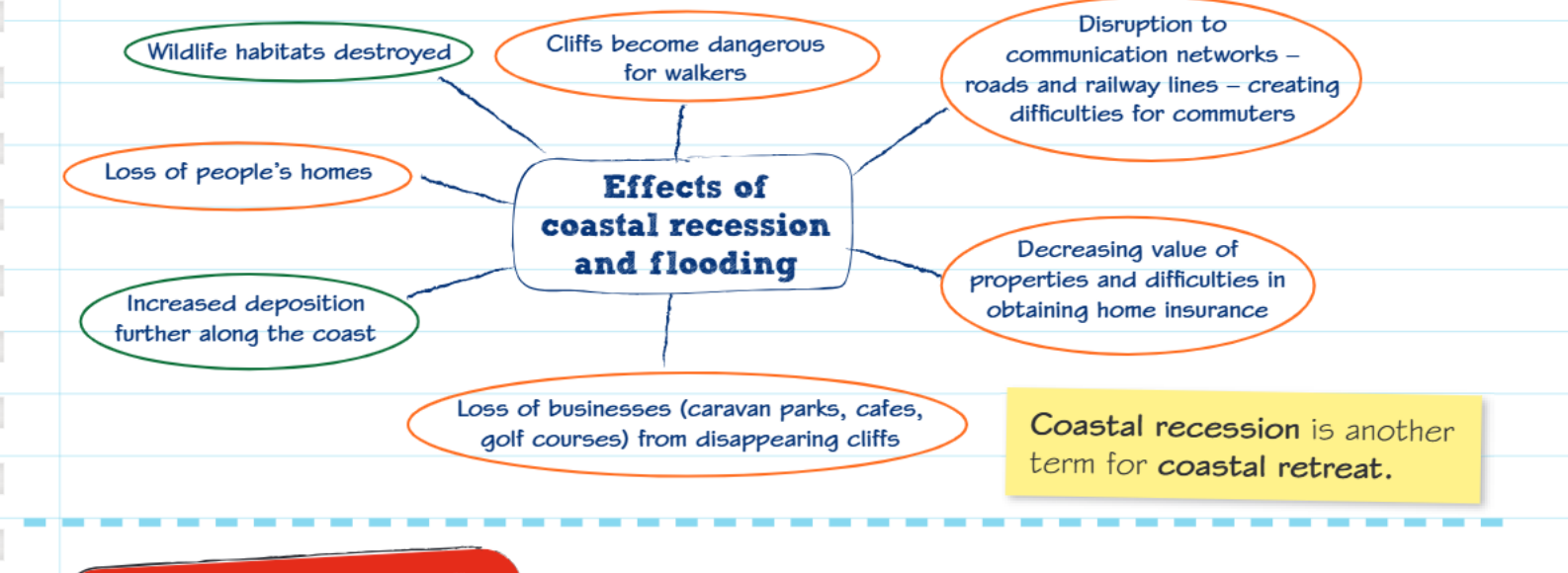
The effects of coastal recession and flooding extend across social, economic, and environmental dimensions. People lose their homes as cliffs retreat and properties become uninhabitable, creating personal hardship and community disruption. Coastal paths and cliff-top areas become dangerous for walkers and tourists, affecting recreational use of the coast.
Economic impacts include decreasing property values in affected areas and increasing difficulties in obtaining home insurance, as insurers view coastal properties as high-risk investments. Local businesses such as caravan parks, cafes, and golf courses may be lost as cliffs disappear, removing employment and income sources from coastal communities.
Infrastructure suffers significant disruption when coastal recession affects transport networks. Roads and railway lines that run along coastlines can be damaged or destroyed, creating difficulties for commuters and isolating coastal communities from essential services and economic opportunities.
Note
Environmental effects of coastal recession are complex - while habitats may be destroyed in retreating areas, the process can also lead to increased sediment deposition further along the coast, potentially creating new habitats and landforms in other locations.
Example
Worked Example: Analysing Coastal Recession Impacts
When explaining how coastal recession and flooding affect people, focus on specific mechanisms rather than just describing what happens:
Step 1: Identify the direct physical impact Many homes on clifftops around the UK coastline face the threat of disappearing as cliffs retreat towards the sea.
Step 2: Trace the wider consequences This process disrupts transport systems, particularly railway lines that follow coastal routes, preventing people from travelling or requiring expensive detours that cost time and money.
Step 3: Consider economic effects Farmers in coastal areas lose valuable farmland to recession, directly reducing their income and threatening their livelihoods. In areas affected by flooding, residents often face higher home insurance costs, making it more expensive to live in these vulnerable locations.
These examples show the interconnected nature of coastal processes and human activities.
Summary
Key Points to Remember:
-
Three key human activities affect coastal landscapes: urbanisation (building development), agriculture (farming), and industry (manufacturing and processing)
-
Coastal recession and coastal retreat mean the same thing - the gradual erosion of coastlines moving inland over time
-
Impacts are interconnected - coastal recession affects homes, businesses, transport, insurance costs, and natural habitats simultaneously
-
Economic effects are significant - property values decrease, insurance becomes difficult to obtain, and businesses may be lost to coastal erosion
-
Environmental impacts are mixed - while habitats may be destroyed in some areas, increased sediment deposition can create new coastal features elsewhere