The world's ecosystems (Edexcel GCSE Geography A): Revision Notes
📚Revision Notes
The world's ecosystems
Introduction to global ecosystems
Large-scale ecosystems, known as biomes, are distributed across different regions of our planet and each has unique characteristics. The location and features of these ecosystems are determined by climate conditions and local environmental factors. Understanding how these factors work together helps us explain why certain types of vegetation and wildlife are found in specific parts of the world.
Note
The relationship between climate and ecosystem distribution is fundamental to understanding global biodiversity patterns. This connection explains why similar ecosystems can be found at similar latitudes around the world, even on different continents.
Climate factors affecting ecosystem distribution
Climate plays the most significant role in determining where different ecosystems develop. Three main climate factors control the global distribution of biomes: temperature, precipitation, and sunshine hours.
Important
These three climate factors work together to create the environmental conditions that determine which plants and animals can survive in any given location. Understanding their combined effects is essential for predicting ecosystem distribution patterns.
Temperature patterns
Temperature varies dramatically across the Earth's surface due to differences in latitude. As you move away from the equator towards the poles, temperatures become progressively colder. This temperature gradient explains why boreal forests in northern regions experience much harsher conditions than tropical rainforests near the equator.
The length of growing seasons also depends on temperature - warmer locations enjoy longer periods when plants can actively grow and reproduce, whilst colder regions have much shorter growing seasons that limit plant development.
Example
Temperature Variation Example: Latitude Effects
At the equator (0° latitude): Average temperatures remain around 25-27°C year-round At 60°N latitude (southern Alaska): Average temperatures range from -10°C in winter to 15°C in summer At 80°N latitude (northern Greenland): Average temperatures rarely exceed 5°C even in summer
Precipitation and global circulation
The amount of rainfall an area receives is controlled by global atmospheric circulation patterns. Desert regions typically experience very low precipitation because they are located where dry air masses descend from the upper atmosphere. This descending air prevents cloud formation and creates the arid conditions characteristic of desert ecosystems.
In contrast, areas near the equator receive heavy rainfall due to rising warm air that creates frequent thunderstorms and consistent moisture throughout the year.
Note
The global circulation system creates predictable bands of high and low precipitation around the Earth. This is why deserts are commonly found around 30° latitude (both north and south), while tropical rainforests cluster near the equator.
Sunshine hours and photosynthesis
The number of daylight hours available for photosynthesis varies significantly between different latitudes. Tundra ecosystems in far northern regions receive much fewer sunshine hours compared to tropical rainforests. This reduced sunlight availability severely limits the amount of photosynthesis that plants can carry out, resulting in much simpler vegetation communities dominated by short grasses and small shrubs.
Major world biomes and their characteristics
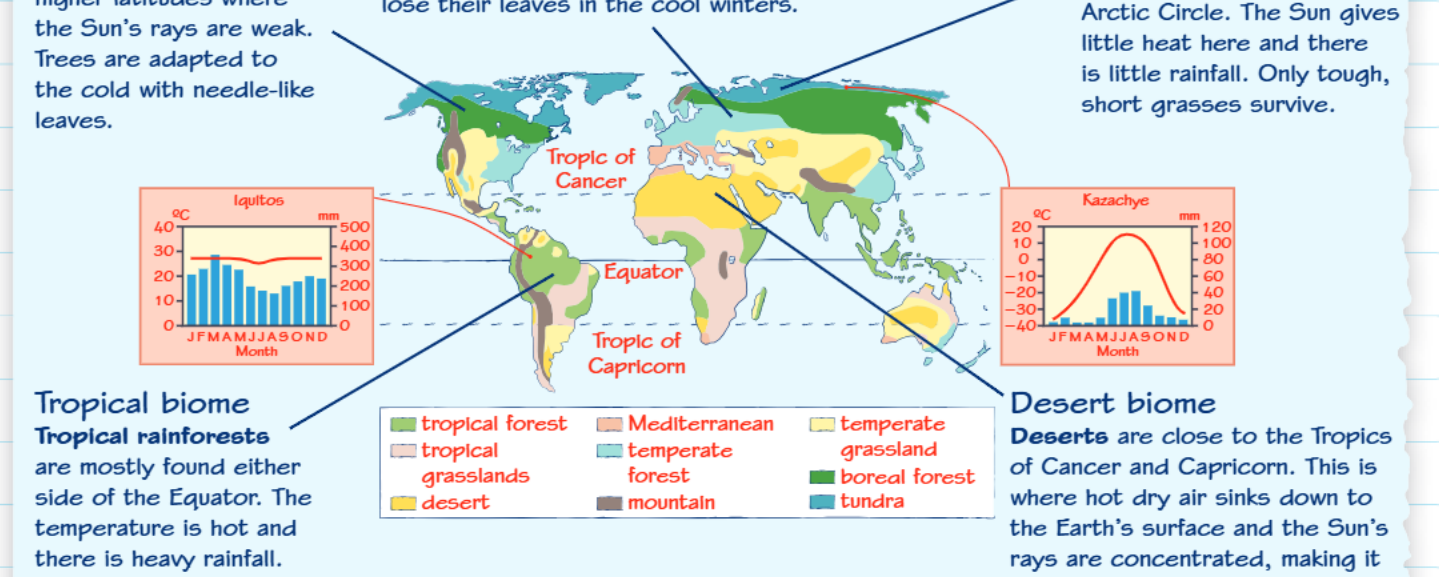
The world's major biomes each have distinct characteristics that reflect their climate conditions:
Tropical biome
Tropical ecosystems are predominantly located near the equator, forming a belt that stretches from west to east just north and south of the equatorial line, typically between 23.50°N and 5°S latitude. The Amazon rainforest serves as an excellent example, spanning mainly between the Equator and the Tropic of Capricorn in Brazil.
These regions experience consistently hot temperatures throughout the year with heavy rainfall that supports dense vegetation growth. The combination of warmth and moisture creates ideal conditions for the highest biodiversity levels found anywhere on Earth.
Desert biome
Desert ecosystems occur close to the Tropics of Cancer and Capricorn, where hot, dry air descends and creates concentrated solar radiation conditions. The intense heat combined with very low precipitation means that only specially adapted plants and animals can survive in these harsh environments.
Desert organisms have evolved remarkable adaptations to conserve water and cope with extreme temperature fluctuations between day and night.
Example
Desert Adaptation Example: Water Conservation
Cacti store water in thick, fleshy stems and have waxy coatings to prevent water loss Desert animals like kangaroo rats can survive without drinking water, getting all moisture from their food Many desert plants have deep root systems extending 10-15 metres underground to access groundwater
Boreal biome (Taiga)
Boreal forests are found at high latitudes where the sun's energy reaches the Earth's surface at a much weaker intensity. These regions experience long, harsh winters and short growing seasons. Trees in boreal forests have adapted to these challenging conditions by developing needle-like leaves that reduce water loss and can withstand freezing temperatures.
The dominant tree species are conifers such as spruce, fir, and pine, which remain green throughout the year and can photosynthesize whenever conditions permit.
Temperate biome
Temperate forests experience moderate climates with distinct seasonal variations. These ecosystems receive adequate rainfall throughout the year, but temperatures change significantly between summer and winter. Many trees in temperate forests are deciduous, meaning they lose their leaves during cooler months to conserve energy and reduce water loss.
This seasonal adaptation allows temperate forests to make the most of favourable growing conditions whilst surviving harsh winter periods.
Tundra biome
The tundra is located within the Arctic Circle, where the sun provides minimal heating throughout the year. These regions experience extremely cold temperatures and receive very little rainfall. Only the toughest vegetation can survive these conditions - primarily short grasses and small shrubs that grow close to the ground for protection from harsh winds.
The tundra has a very short growing season, sometimes lasting only a few months, during which plants must complete their entire annual growth cycle.
Important
Each biome represents a unique set of evolutionary solutions to specific climate challenges. The adaptations seen in each biome have developed over millions of years and demonstrate how life responds to different environmental pressures.
Local factors affecting ecosystem distribution
While climate provides the broad framework for ecosystem distribution, local factors can create variations within the same general biome type.
Rock and soil type differences
The underlying geology and soil composition can significantly influence vegetation types within the same ecosystem. For example, in northwestern Australia, areas with poor, sandy soils support much shorter grasses compared to regions with richer soils, even though they share the same general climate conditions.
Different rock types weather to produce soils with varying nutrient content, drainage properties, and pH levels, all of which affect which plant species can successfully establish themselves.
Note
Soil formation is a slow process that can take hundreds to thousands of years. The parent rock material, combined with climate and biological activity, determines the final soil characteristics that will support different plant communities.
Altitude variations
Elevation changes can create dramatic differences in plant communities within the same geographical area. As altitude increases, temperatures typically become cooler, creating different growing conditions at various heights.
At lower elevations, you might find lowland rainforests and mangrove communities thriving in warm, moist conditions. However, at higher elevations around 1,200 metres above sea level, cooler temperatures and increased cloud cover create conditions suitable for moist cloud forests with completely different species compositions.
Example
Altitude Variation Example: Mountain Ecosystems
Sea level: Tropical rainforest with high temperatures (25-30°C) and high humidity 1,200m elevation: Cloud forest with cooler temperatures (15-20°C) and frequent mist 2,500m elevation: Alpine grassland with cold temperatures (5-10°C) and strong winds 4,000m+ elevation: Snow line with permanent ice and very limited vegetation
Describing ecosystem distribution
When analysing ecosystem distribution patterns, geographers use the ODE framework:
Note
The ODE Framework for Ecosystem Analysis
- Overall distribution: Describe the general global pattern
- Data: Include specific facts, figures, and locations
- Example: Provide concrete examples to illustrate the pattern
This systematic approach ensures comprehensive coverage of distribution patterns and helps explain the relationship between environmental factors and ecosystem locations.
Summary
Key Points to Remember:
- Large-scale ecosystems (biomes) are distributed globally based primarily on climate conditions, particularly temperature, precipitation, and sunshine hours
- Temperature decreases with increasing latitude, creating a gradient from hot tropical climates near the equator to cold polar conditions at high latitudes
- Global atmospheric circulation patterns control precipitation distribution, with deserts forming where dry air descends and rainforests developing where moist air rises
- Local factors like rock type, soil composition, and altitude can create variations within the same biome type
- Each major biome has evolved distinct characteristics and adaptations that reflect their specific environmental conditions