Tropical rainforest features (Edexcel GCSE Geography A): Revision Notes
📚Revision Notes
Tropical rainforest features
Tropical rainforests are among the most important ecosystems on our planet, supporting incredible biodiversity and playing a crucial role in global ecological balance. These complex environments have distinctive characteristics that make them both highly productive and vulnerable to environmental changes.
What makes tropical rainforests special
Tropical rainforests represent some of the most biodiverse and productive ecosystems on Earth. They contain an extraordinary variety of plant and animal species, many of which are found nowhere else in the world. These forests play essential roles in regulating global climate patterns, storing carbon, and providing resources for both local communities and the wider world.
Note
Tropical rainforests cover less than 2% of Earth's surface but contain over 50% of the world's plant and animal species. This makes them incredibly important for maintaining global biodiversity.
Components of tropical rainforest ecosystems
Understanding tropical rainforests requires examining both their living and non-living elements, which work together to create these remarkable ecosystems.
Living components (biotic factors)
The biotic elements include all the living organisms within the rainforest. This encompasses the vast array of plant species, from towering emergent trees to ground-level shrubs and countless species of epiphytes. Animal life is equally diverse, ranging from large mammals like jaguars and primates to countless species of birds, reptiles, amphibians, and insects. Humans also form part of the biotic component, particularly indigenous communities who have lived in these forests for generations.
Non-living components (abiotic factors)
The abiotic elements consist of the physical and chemical environment that supports life in the rainforest. Climate is perhaps the most important abiotic factor, characterised by consistently high temperatures and abundant rainfall. Soil composition, water availability, and atmospheric conditions all contribute to the unique environment that tropical rainforests provide.
How components work together
The living and non-living components of tropical rainforests are deeply interconnected. Plants depend on the warm, humid climate and nutrient availability in the soil, while also creating the microclimate through transpiration and shade. Animals rely on plants for food and shelter, whilst contributing to seed dispersal and pollination. This interdependence means that changes to one component can have cascading effects throughout the entire ecosystem.
Important
Critical Concept: Interdependence
Biotic and abiotic components depend on each other completely. Their interaction makes the ecosystem function as a whole. Remove or significantly alter one component, and the entire system can collapse.
Climate characteristics
Tropical rainforests experience a distinctive climate pattern that creates ideal conditions for rapid plant growth and high biodiversity. Understanding these climate features helps explain why these ecosystems are so productive yet also fragile.
Temperature patterns
Temperatures in tropical rainforests remain consistently high throughout the year, typically ranging between 20-28°C. This lack of seasonal temperature variation means that plant growth can continue year-round, contributing to the high productivity of these ecosystems. The warm conditions also accelerate biological processes like decomposition and nutrient cycling.
Rainfall patterns
Precipitation is abundant in tropical rainforests, often exceeding 2000mm annually. Rainfall may vary somewhat between seasons, but most tropical rainforests receive significant precipitation throughout the year. This constant moisture availability supports the lush vegetation and contributes to the rapid cycling of nutrients through the ecosystem.
Example
Climate Example: Amazon Rainforest
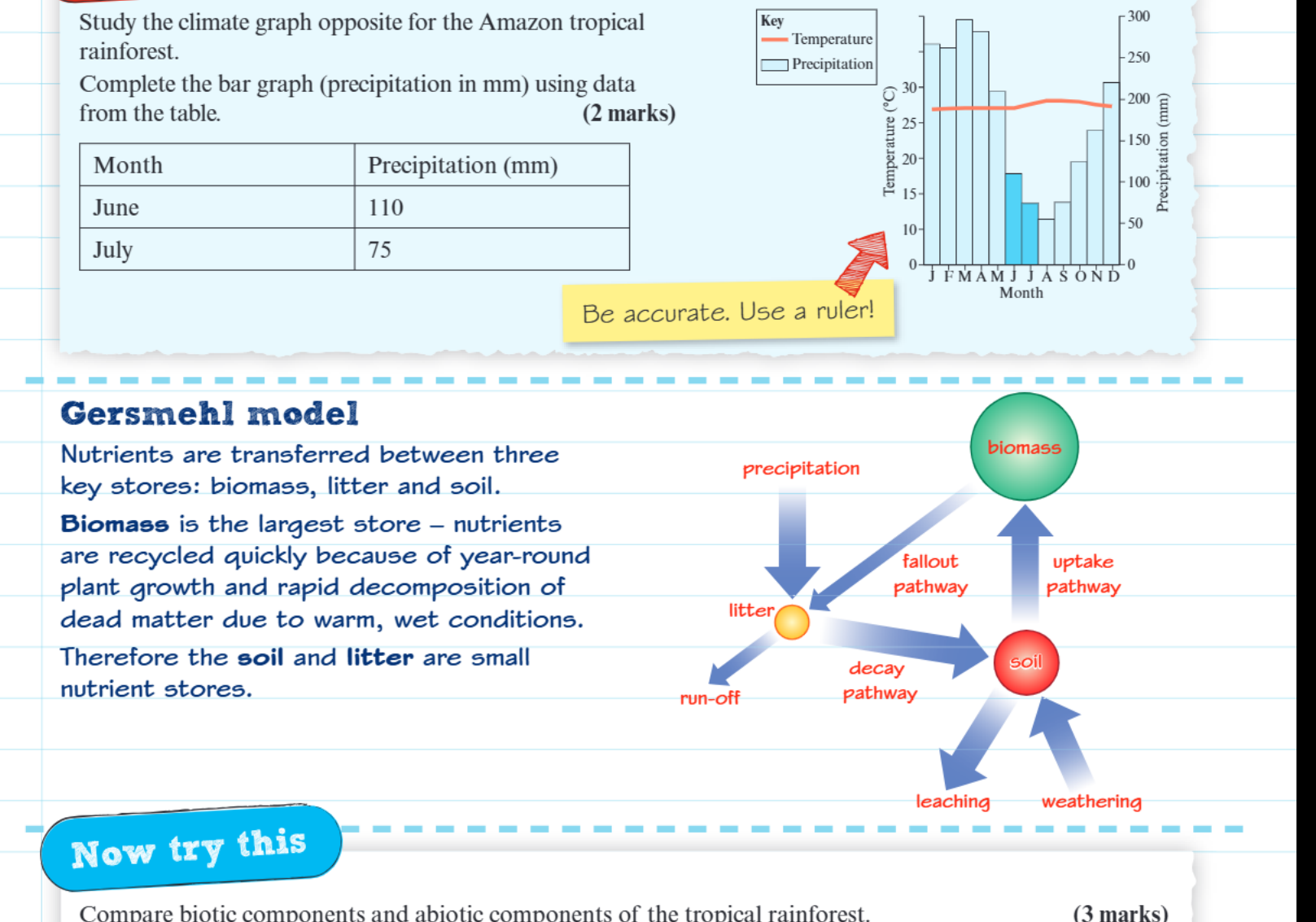
The Amazon rainforest demonstrates typical tropical rainforest climate patterns:
- Temperature: Remains consistently warm (20-28°C) year-round
- Rainfall: Even in drier months, precipitation remains substantial
- June: 110mm rainfall
- July: 75mm rainfall
- Result: Continuous growing conditions for vegetation
Soil and nutrient challenges
Despite supporting incredibly lush vegetation, tropical rainforest soils face significant challenges that affect how nutrients move through these ecosystems.
The problem of leaching
Heavy rainfall in tropical rainforests creates a major challenge for soil fertility. As water moves downward through the soil profile, it carries dissolved nutrients away from the root zone where plants need them most. This process, known as leaching, means that despite high biological productivity, the soil itself contains relatively few available nutrients.
Important
Common Misconception Alert
Many people assume that tropical rainforest soils must be very fertile because of the lush vegetation. In reality, the soils are nutrient-poor due to constant leaching from heavy rainfall.
Chemical weathering effects
The combination of warm temperatures and abundant moisture accelerates chemical weathering of rock and soil minerals. While this process can release some nutrients, the warm, humid conditions mean that many nutrients are quickly broken down into forms that are either taken up immediately by plants or washed away by rainfall. This rapid weathering contributes to the relatively low nutrient content of tropical rainforest soils.
Note
The warm, wet conditions that make tropical rainforests so productive also create their biggest challenge - nutrients are constantly being washed away or rapidly used up, leaving soils surprisingly poor in stored nutrients.
The Gersmehl model of nutrient cycling
The Gersmehl model provides an excellent way to understand how nutrients move through tropical rainforest ecosystems, explaining why these forests can support such lush growth despite having nutrient-poor soils.
Three main nutrient stores
The model identifies three key places where nutrients are stored within the ecosystem. The biomass store contains nutrients held within living plant and animal tissues. The litter store consists of nutrients in dead organic matter on the forest floor, such as fallen leaves, branches, and dead animals. The soil store contains nutrients available in the soil itself.
Why biomass dominates
In tropical rainforests, the biomass store is by far the largest of the three nutrient stores. This occurs because the warm, wet conditions promote rapid plant growth throughout the year, allowing vegetation to quickly absorb and incorporate available nutrients. Additionally, the constant warmth and moisture mean that dead organic matter decomposes very quickly, releasing nutrients that are immediately taken up by living plants rather than accumulating in the soil.
Important
Key Concept: Rapid Nutrient Recycling
Nutrients are recycled incredibly quickly in tropical rainforests because of:
- Year-round plant growth due to constant warmth
- Rapid decomposition of dead matter in warm, wet conditions
- Immediate uptake of released nutrients by living vegetation
This is why most nutrients are stored in living biomass rather than soil.
Transfer pathways between stores
Nutrients move between the three stores through various pathways. Uptake transfers nutrients from soil to biomass as plants absorb minerals through their roots. When plants and animals die, nutrients move from biomass to litter through the fallout pathway. Decay processes then transfer nutrients from litter back to the soil store. However, nutrients can also be lost from the system through leaching and runoff, while new nutrients enter through precipitation and weathering of rock material.
Note
The Gersmehl model shows that tropical rainforests operate as a "closed loop" system where nutrients are constantly cycling between biomass, litter, and soil stores. The key difference from other ecosystems is the speed of this cycling and where most nutrients are stored.
Human interactions
Indigenous communities have developed sophisticated ways of living within tropical rainforest ecosystems without causing significant environmental damage. These groups typically practice small-scale hunting and gathering, along with sustainable farming techniques that work with natural forest cycles. They often spread seeds from fruit and nuts they consume, actually helping to maintain forest biodiversity. Their traditional knowledge of forest resources and ecological relationships has been developed over many generations.
Note
Indigenous peoples don't just live in tropical rainforests - they actively contribute to maintaining biodiversity through practices like seed dispersal. Their traditional ecological knowledge represents thousands of years of sustainable forest management.
Remember!
Summary
Key Points to Remember:
-
Tropical rainforests contain both biotic (living) and abiotic (non-living) components that depend on each other for the ecosystem to function properly
-
The climate features consistently high temperatures and abundant rainfall year-round, creating ideal conditions for plant growth
-
Despite lush vegetation, soils are nutrient-poor due to leaching from heavy rainfall and rapid chemical weathering
-
The Gersmehl model shows that most nutrients are stored in biomass (living plants and animals) rather than in the soil, due to rapid recycling in warm, wet conditions
-
Indigenous peoples have developed sustainable ways of living in these forests that actually help maintain biodiversity through practices like seed dispersal