Tropical rainforest management (Edexcel GCSE Geography A): Revision Notes
📚Revision Notes
Tropical rainforest management
Tropical rainforests face significant pressure from human activities, making sustainable management essential for preserving these vital ecosystems. Understanding how political and economic factors can work together to protect rainforests whilst supporting local communities is crucial for long-term conservation success.
The Amazon rainforest case study
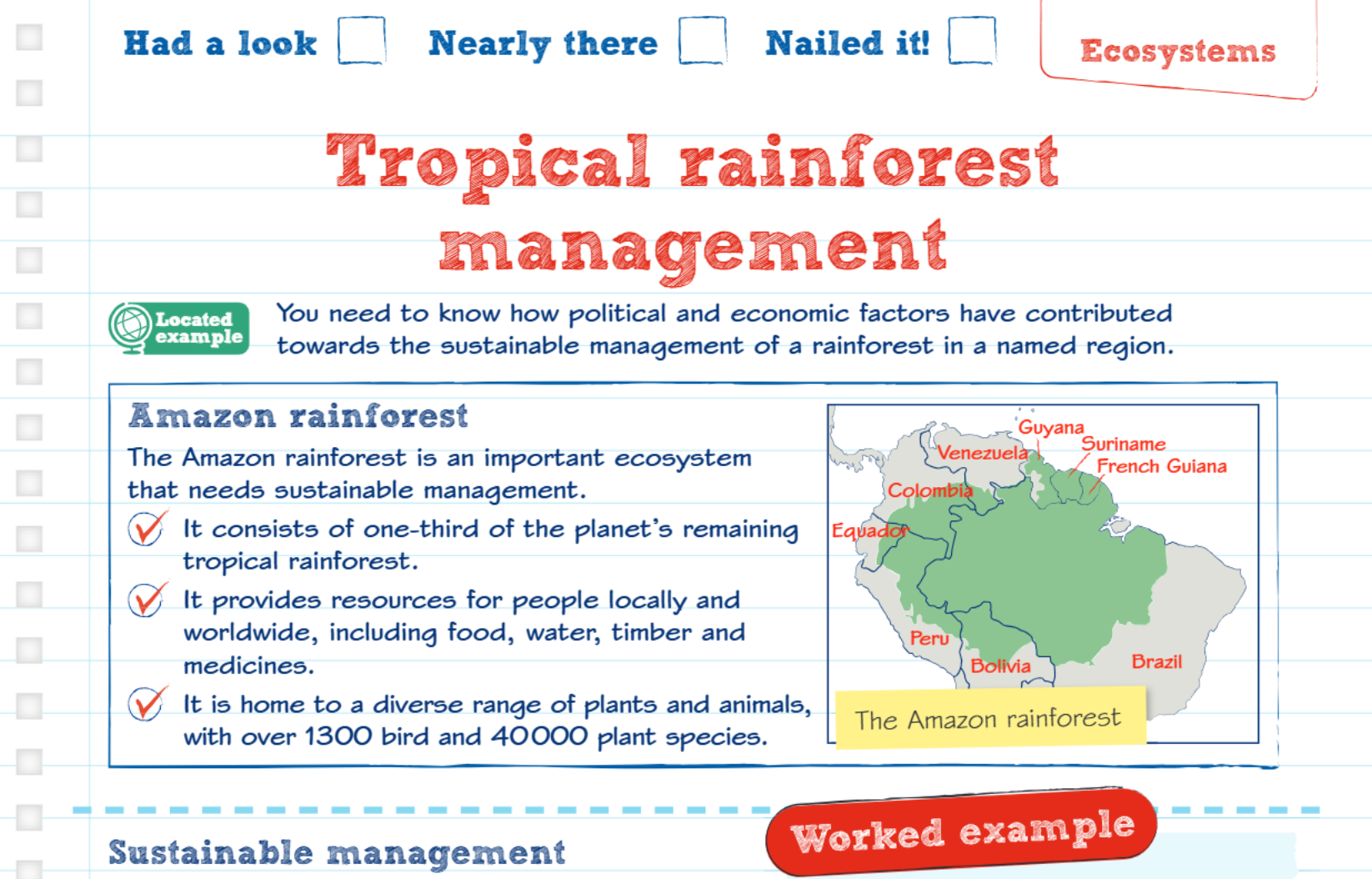
The Amazon rainforest serves as one of the world's most important examples of tropical rainforest management challenges and solutions. This massive ecosystem spans across multiple South American countries and represents a critical global resource that requires careful stewardship.
Important
The Amazon's significance cannot be overstated - it contains approximately one-third of all remaining tropical rainforest on Earth. This vast forest system provides essential resources including food, fresh water, timber, and medicines that benefit both local populations and the global community.
The biodiversity within the Amazon is extraordinary, supporting over 1,300 different bird species and more than 40,000 plant species, making it one of the most biodiverse regions on the planet.
Sustainable management strategies
Government policies and governance in Brazil
Brazil has developed a comprehensive approach to managing its portion of the Amazon through a system of National Forests. These designated areas remain under state ownership, but the government can grant timber concessions to private companies, allowing them to manage and harvest from specific forest areas under strict regulations.
Example
Brazil's National Forest System in Action
Scale: 31 National Forests covering a combined area larger than England
Process:
- Government maintains ownership of forest areas
- Private companies receive controlled timber concessions
- Companies must conduct thorough biodiversity surveys before logging
- Only approved areas can be harvested under strict regulations
This approach successfully balances economic needs with environmental protection.
Economic approaches to forest conservation
One innovative strategy involves recognising the commercial value of forests beyond traditional logging. Timber companies operating in areas like Paragominas have begun to understand that undamaged forest represents a valuable commercial asset that can generate sustainable income over time. This shift in perspective encourages long-term forest management rather than short-term extraction.
Note
The development of sustainable management techniques, also known as reduced-impact logging, has proven to be more economically viable than traditional methods. These approaches can be up to 12% cheaper than conventional logging whilst causing significantly less environmental damage.
Ecotourism as a management tool
Ecotourism has emerged as a powerful tool for rainforest conservation, providing economic alternatives that don't involve forest destruction. This approach works through the establishment of visitor centres that serve educational purposes, teaching both local communities and tourists about the importance of forest conservation.
The economic benefits of ecotourism extend beyond simple tourist revenue. It creates alternative employment opportunities for local people that don't require tree removal, such as working as guides, in hospitality, or in conservation education. This provides communities with sustainable income streams whilst maintaining forest cover.
Logging methods comparison
Conventional logging impacts
Traditional logging practices have historically caused significant environmental damage to tropical rainforests. When conventional methods are used, the forest becomes fragmented as large areas are cleared, disrupting wildlife habitats and ecosystem connectivity.
Important
The standard practice involves cutting down every tree in a designated area, with between 10-20 additional trees typically damaged for every tree that is successfully harvested. This causes extensive collateral damage to the forest ecosystem.
Reduced-impact logging benefits
Reduced-impact logging represents a more sustainable alternative that maintains forest structure whilst still allowing timber extraction. This method involves careful selection of mature trees for harvesting, leaving younger "seed" trees in place to support forest regeneration.
The direction in which trees fall is carefully calculated and controlled to minimise damage to surrounding vegetation. This approach results in much less fragmentation compared to conventional methods and allows for quicker forest regeneration. The forest canopy remains largely intact, preserving habitat connectivity and supporting continued biodiversity.
Summary
Key Points to Remember:
-
The Amazon rainforest contains one-third of the world's remaining tropical rainforest and supports incredible biodiversity with over 1,300 bird species and 40,000 plant species
-
Brazil manages forest sustainability through National Forests where the government grants controlled timber concessions whilst requiring biodiversity surveys before logging
-
Ecotourism provides economic alternatives to deforestation by creating jobs in education, guiding, and conservation whilst generating income from forest preservation
-
Reduced-impact logging is both more environmentally friendly and more cost-effective than conventional logging, being up to 12% cheaper whilst causing less forest fragmentation
-
Sustainable forest management requires balancing economic needs with environmental protection through careful planning, regulation, and alternative income sources