Glacial processes (Edexcel GCSE Geography A): Revision Notes
📚Revision Notes
Glacial processes
Understanding how glaciers shape our landscapes is essential for studying glaciated upland areas. Various physical processes work together to create the distinctive features we see in these regions today.
Glacial erosion
Glacial erosion was crucial in shaping the UK's upland landscapes during past ice ages. Two main types of erosional processes continue to modify these areas even today.
The processes of glacial erosion have created some of the most dramatic landscape features in the UK, from deep U-shaped valleys to sharp mountain ridges. These same processes continue to operate today, though at a much reduced scale compared to full glacial conditions.
Note
Even though the UK is no longer covered by glaciers, many of the erosional processes that originally shaped these landscapes continue to operate today, particularly freeze-thaw weathering in highland areas.
Freeze-thaw weathering
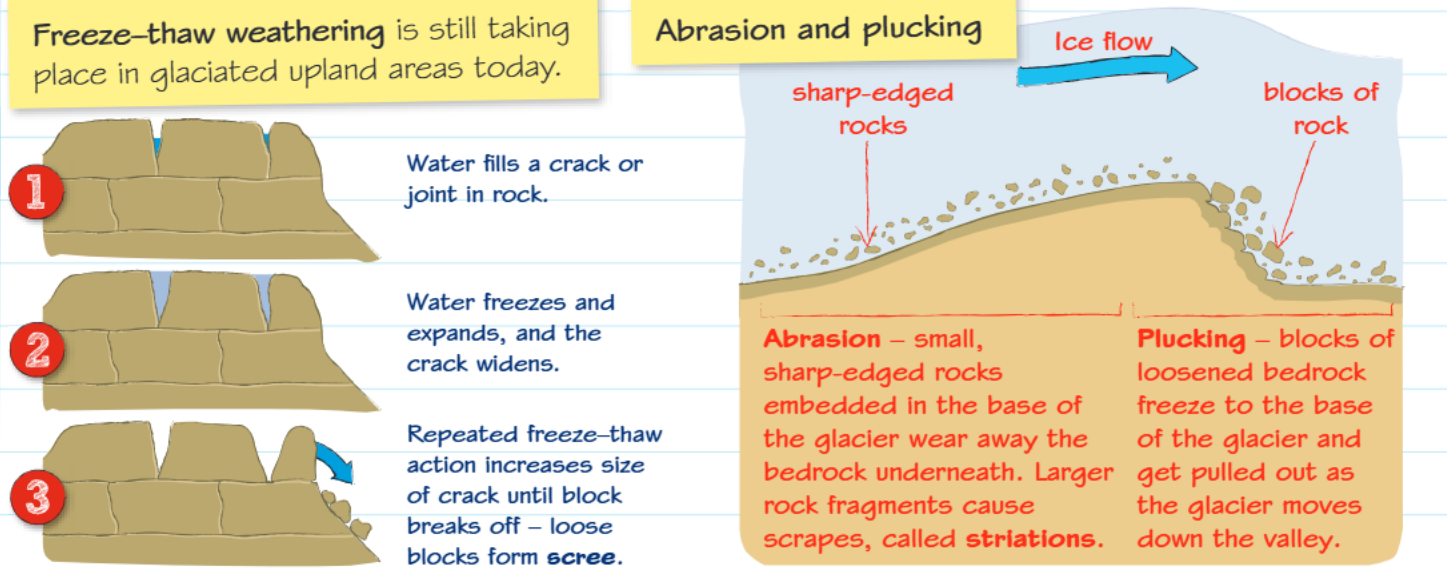
This weathering process remains active in glaciated upland areas and follows a distinctive three-stage cycle. Initially, water enters cracks and joints within rock formations. When temperatures drop below freezing, this water transforms into ice and expands by approximately 9% of its original volume. This expansion applies tremendous pressure to the surrounding rock, gradually widening the existing cracks.
As this freeze-thaw cycle repeats over time, the cracks become progressively larger until entire blocks of rock break away from the main formation. These loose rock fragments accumulate at the base of slopes, forming deposits called scree.
Example
Worked Example: The Freeze-Thaw Weathering Process
Step 1: Water fills a crack or joint in rock during warmer periods or rainfall
Step 2: When temperature drops below 0°C, water freezes and expands by 9%, widening the crack
Step 3: Repeated freeze-thaw cycles gradually enlarge the crack until rock blocks break off, forming scree slopes at the base of cliffs
Abrasion and plucking
Moving glaciers erode the landscape through two primary mechanisms. Abrasion occurs when small, sharp-edged rocks become embedded in the glacier's base and act like sandpaper against the underlying bedrock. As the glacier moves, these rocks scrape and wear away the surface beneath. Larger rock fragments create distinctive grooves in the bedrock known as striations, which show the direction of ice flow.
Plucking involves a different process where blocks of bedrock become loosened by freeze-thaw action or other weathering processes. These loosened blocks then freeze to the glacier's base and get pulled away as the ice moves down the valley. This process is particularly effective on the downstream side of rock obstacles.
Important
Remember the key difference: Abrasion scrapes the bedrock surface like sandpaper, while plucking pulls away loosened blocks of rock. Both processes work together to create the characteristic features of glaciated valleys.
Transport and deposition
Glaciers transport enormous amounts of material through two main movement mechanisms. Basal sliding occurs when meltwater at the glacier's base acts as a lubricant, allowing the entire ice mass to slide downhill over the bedrock. Internal flow happens when ice crystals within the glacier slide over each other, causing the ice to deform and change shape as it moves.
When glaciers melt, they deposit their transported material in different ways. Fluvioglacial material consists of sediments that meltwater streams carry away from the glacier and deposit elsewhere. These deposits are typically well-sorted as the flowing water separates particles by size. Till deposits form when ice melts and directly deposits material without water transport, creating unsorted mixtures of different-sized particles.
The distinction between these two types of deposition is crucial for understanding glaciated landscapes. Fluvioglacial deposits often form distinctive landforms like outwash plains and eskers, while till creates features such as moraines and drumlins.
Post-glacial processes
Even after glaciers have retreated, glaciated landscapes continue changing through ongoing processes. Soil movement involves the slow downward migration of saturated soil particles under gravity's influence. Frost action weakens soil structure, and when the ground becomes waterlogged, it can act as a slip plane, causing materials to move downslope.
Rock falls and slides represent faster mass movement processes. Freeze-thaw weathering continues to loosen rocks on steep glaciated slopes, and these materials can suddenly fall or slide rapidly to valley floors, constantly reshaping the landscape.
Note
Post-glacial processes are particularly active during spring when freeze-thaw cycles are most frequent and when snowmelt increases water content in soils and rock cracks.
UK weather and climate context
Understanding past climates helps explain current glaciated landscape features. The most recent significant glacial period in the UK was the Pleistocene, which ended approximately 12,000 years ago. During this time, temperatures fluctuated above and below freezing, creating ideal conditions for both freeze-thaw weathering and glacial erosion processes.
Winter accumulation of snow and ice exceeded summer melting (ablation), allowing glaciers to advance across much of the UK. As temperatures gradually increased at the Pleistocene's end, ablation began exceeding accumulation, causing glaciers to retreat and leaving behind the distinctive landscape features we observe today.
Current weather patterns continue to influence these landscapes. Seasonal temperature variations still trigger freeze-thaw cycles, particularly during winter months when temperatures regularly cross the freezing point over 24-hour periods, maintaining the weathering processes that originally helped shape these areas.
Summary
Key Points to Remember:
- Freeze-thaw weathering follows a three-step cycle: water fills cracks, freezes and expands, then breaks off rock fragments to form scree slopes
- Glacial erosion occurs through abrasion (scraping action) and plucking (pulling away loosened blocks)
- Glaciers transport material through basal sliding and internal flow, then deposit it as either fluvioglacial material or till
- Post-glacial processes like soil movement and rock falls continue modifying these landscapes today
- The UK's glaciated features formed mainly during the Pleistocene period, which ended around 12,000 years ago