Weather and Climate (Edexcel GCSE Geography A): Revision Notes
📚Revision Notes
California drought case study
Background and timeline
California experienced a severe drought from 2012 to the present day, representing one of the most significant water crises in the state's history. By January 2014, the situation had become so critical that California was in its third consecutive year of drought conditions, prompting the governor to declare a state of emergency.
The drought was caused by several factors working together. Lower than normal rainfall and reduced snowfall on the west coast meant less water was available from natural sources. Additionally, California's heavy dependence on the over-used Colorado River for water supplies meant that when this source began to fail, the state's water reserves dropped dramatically.
Note
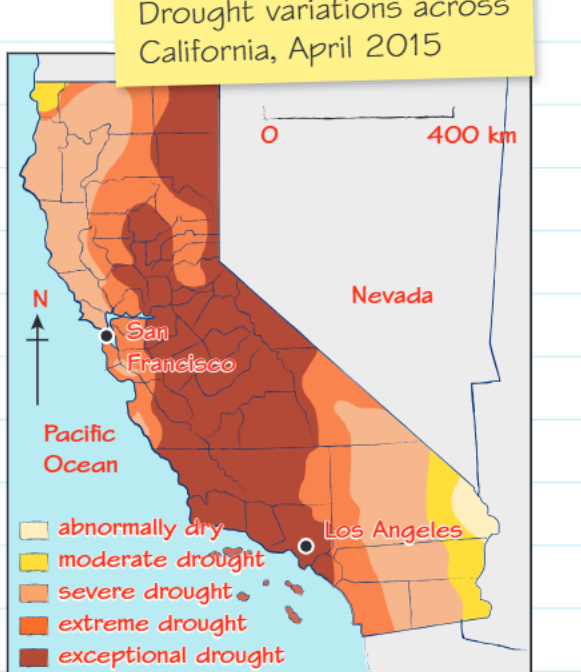
The drought severity map shows how different regions of California were affected, with the central and southern areas experiencing the most extreme drought conditions in April 2015. This visual evidence demonstrates the uneven distribution of drought impacts across the state.
Main hazards of the drought
The California drought created three primary hazards that had serious consequences for both people and the environment:
Subsidence occurred when groundwater levels dropped significantly, causing the land above to settle and sink to a lower level. This created structural problems for buildings, roads, and other infrastructure as the ground literally moved beneath them.
Contamination became a major issue as reduced freshwater pressure allowed seawater to be drawn inland, polluting both land and drinking water supplies. This made previously clean water sources unsafe for human consumption and agricultural use.
Wildfires started and spread much more quickly than usual because vegetation had become extremely dry due to the lack of water. These fires posed serious risks to people's homes, lives, and property whilst also causing significant environmental damage.
Important
These three hazards - subsidence, contamination, and wildfires - often occur together during severe droughts, creating compound risks that can overwhelm emergency response systems and cause cascading failures across multiple sectors.
Impacts on people and ecosystems
Economic and social impacts
The drought had enormous financial consequences for California. The state faced costs of approximately $2.7 billion per year, reducing the amount of money available to spend on essential services for people. When groundwater extraction increased to compensate for surface water shortages, it caused subsidence that damaged infrastructure, including buildings in the San Joaquin Valley.
Agriculture was severely affected, with 542,000 acres taken out of crop production. This led to significant losses of food production and reduced income for farming communities across the state.
Example
Economic Impact Example: Agricultural Losses
The removal of 542,000 acres from crop production represents:
- Loss of thousands of jobs in farming communities
- Reduced food supply affecting regional and national markets
- Decreased tax revenue for local governments
- Long-term soil degradation that affects future productivity
Environmental consequences
The Central Valley emerged as the worst affected area, where water diversions meant that wetlands and rivers received less water than needed. This had devastating impacts on natural environments and wildlife, with rivers running too low for salmon to successfully breed and complete their life cycles.
Warm and windy weather conditions combined with the drought created perfect conditions for wildfires, which caused extensive environmental damage. These fires polluted the air, destroyed wildlife habitats, and posed risks to both people's lives and property. Forest ecosystems suffered as trees and plants died from lack of water, disrupting entire ecological communities.
Note
The impact on salmon breeding cycles demonstrates how drought effects ripple through entire ecosystems. When key species cannot reproduce successfully, it affects the entire food chain and can lead to long-term ecological imbalances.
Response strategies
Government responses
The California government implemented several strategies to manage the drought crisis. They launched public education campaigns, including the "Save our Water" initiative, to encourage residents to reduce their water consumption and understand the severity of the situation.
Legislative action was taken through state laws requiring a 25% reduction in water use across California. This legally binding requirement ensured that water conservation became mandatory rather than voluntary.
Organisational initiatives
The University of California established research projects focused on developing more effective methods for managing groundwater resources. This scientific approach aimed to find long-term solutions to prevent similar crises in the future.
Individual actions
Farmers were encouraged to adopt water-efficient irrigation techniques, particularly drip irrigation systems that deliver water directly to plant roots with minimal waste. This technology helped maintain crop production whilst using significantly less water.
Homeowners were encouraged to check for and repair water leaks in their properties, preventing unnecessary water loss through damaged plumbing systems.
Environmental activists and concerned citizens organised protest campaigns against companies that continued selling bottled local water during the drought, arguing that this practice worsened the water shortage for local communities.
Note
The multi-level response approach demonstrates how effective drought management requires coordination between different sectors of society. No single group can solve the problem alone - success depends on combined efforts from government, organisations, and individuals.
Understanding the impacts
When studying this case study, it's important to understand how drought affects both human communities and natural ecosystems in developed countries like the USA. The California example shows that even wealthy nations with advanced technology can struggle with severe weather events.
The responses demonstrate how different groups in society can work together to address environmental challenges. Government policies provide the legal framework, organisations contribute research and expertise, and individuals make daily choices that collectively make a significant difference.
Important
This case study challenges the assumption that wealth and technology alone can protect against natural hazards. Even highly developed regions require careful resource management and coordinated response strategies to handle extreme weather events effectively.
Summary
Key Points to Remember:
- California's drought from 2012 onwards created a state of emergency by 2014, showing how prolonged dry conditions can overwhelm even developed countries
- The three main hazards were subsidence (land sinking), contamination (seawater pollution), and increased wildfires due to dry vegetation
- Economic impacts included $2.7 billion annual costs and 542,000 acres of lost agricultural land, whilst ecosystems suffered from habitat destruction and wildlife disruption
- Responses operated at multiple levels: government legislation requiring 25% water use reduction, university research projects, and individual conservation efforts like drip irrigation
- This case study demonstrates that drought management requires coordinated action between government, organisations, and individuals to be effective