Natural climate change (Edexcel GCSE Geography A): Revision Notes
📚Revision Notes
Natural climate change
What is natural climate change?
Earth's average climatic conditions undergo natural variations over time, resulting in both warmer and colder periods throughout our planet's history. These changes occur due to various natural factors and happen across different timescales, from thousands to millions of years.
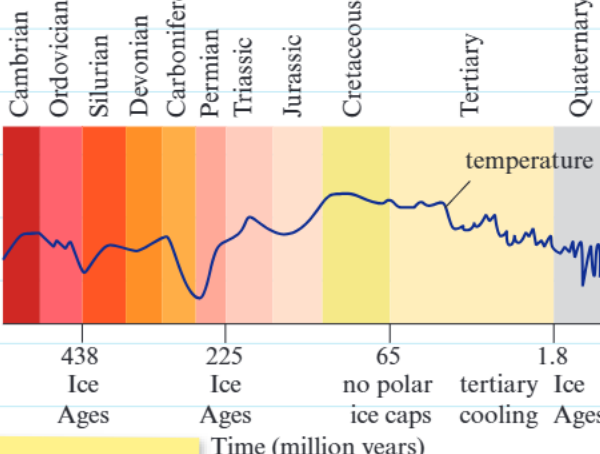
Note
The geological timeline above demonstrates how Earth's temperature has fluctuated dramatically over the past 440 million years, showing major ice ages and warm periods long before human influence became significant.
The Quaternary period
The Quaternary period represents the most recent 2.6 million years of Earth's history and is particularly important for understanding natural climate change. During this time, our planet has experienced:
- More than 60 cold periods featuring extensive ice advances, with each lasting approximately 100,000 years
- Warmer interglacial periods that typically persist for around 15,000 years
Important
Currently, we are living in an interglacial period, which means we're in one of the warmer phases between ice ages. This natural cycle of ice ages and interglacials has been the dominant pattern throughout the Quaternary period.
Recent temperature patterns
Over the past 250 years, Earth's temperature has increased notably compared to previous periods. During the middle of the last ice age, average temperatures were approximately 5°C lower than today's temperatures. This warming trend represents a significant shift in the natural climate pattern.
Note
This 5°C temperature difference may seem small, but it represents the difference between our current climate and a world dominated by massive ice sheets covering much of North America and Europe.
Milankovitch cycles
These cycles represent long-term variations in Earth's orbit and position relative to the sun, which directly influence how much solar radiation our planet receives. There are three main types of Milankovitch cycles:
Eccentricity cycle
This cycle occurs approximately every 100,000 years and involves changes in Earth's orbital shape. When Earth follows a more circular orbit, it experiences warmer periods. Conversely, when the orbit becomes more elliptical, cooler periods result.
Axial tilt cycle
Roughly every 40,000 years, Earth's axial tilt varies. When the tilt angle increases, it creates hotter summers and colder winters. This variation affects the intensity of seasonal differences across the planet.
Precession cycle
Earth experiences a "wobbling" motion on its axis approximately every 24,000 years, which changes the direction the axis faces. This wobbling motion can influence the differences between seasons and their timing.
Important
These three Milankovitch cycles work together to control the timing and intensity of ice ages. The 100,000-year eccentricity cycle is particularly important as it matches the pattern of major ice ages during the Quaternary period.
Other natural causes of climate change
Solar radiation variations
The amount of energy Earth receives from the sun naturally fluctuates over time. When solar radiation levels decrease, glacial periods become more likely to develop. Conversely, higher levels of solar radiation contribute to interglacial periods with warmer temperatures.
Volcanic activity
Large-scale volcanic eruptions can significantly impact global climate by ejecting massive amounts of ash and dust into the atmosphere. This volcanic material acts like a blanket around Earth, blocking incoming solar radiation and causing temperatures to drop for extended periods.
Important
Major volcanic eruptions can cause global cooling by reducing the amount of solar radiation reaching Earth's surface. The ash and dust particles can remain in the atmosphere for months or even years, creating a temporary but significant climate impact.
Evidence of climate change
Scientists use various methods to investigate past climate conditions and understand natural climate change patterns. Multiple sources of evidence are essential because they allow researchers to cross-check findings and build a comprehensive picture of past climates.
Historical sources
Written records such as diaries and historical documents provide valuable information about past weather patterns and climate conditions in different regions.
Ice cores
These contain trapped volcanic ash, microscopic organisms, and air bubbles that preserve information about the climate conditions present when the ice originally formed. Scientists can analyse these layers to reconstruct past climates.
Preserved pollen
Pollen grains preserved in sediments provide evidence about past vegetation, which indicates whether growing conditions were warm or cold during different periods.
Tree rings
When trees are cut down, scientists examine the width of their growth rings. Wider rings typically indicate warmer, wetter climate conditions that favoured growth, whilst thinner rings suggest colder, drier periods that limited tree development.
Note
Each type of evidence has its own strengths and limitations. By combining information from ice cores, tree rings, pollen, and historical records, scientists can create a more accurate and complete picture of how climate has changed naturally over time.
Summary
Key Points to Remember:
- Natural climate change occurs due to variations in Earth's orbit, solar radiation, and volcanic activity
- The Quaternary period has seen over 60 ice ages, each lasting about 100,000 years, separated by warmer interglacial periods of around 15,000 years
- Milankovitch cycles (eccentricity, axial tilt, and precession) control long-term climate patterns through changes in solar radiation received
- Volcanic eruptions can cause temporary global cooling by blocking solar radiation with ash and dust
- Scientists use multiple sources of evidence including ice cores, tree rings, pollen, and historical records to study past climates