Population and economic challenges (Edexcel GCSE Geography A): Revision Notes
📚Revision Notes
UK challenges: Population and economic challenges
Understanding the key concepts
When studying UK challenges, you need to understand several important geographical concepts that affect population and economic development. These challenges are interconnected and influence how the UK develops both economically and socially across different regions.
Note
These geographical challenges don't exist in isolation - they're deeply interconnected. Population changes affect economic development, while economic patterns influence where people choose to live and work. Understanding these connections is essential for analysing UK geography effectively.
The two-speed economy
The UK faces a significant challenge known as the two-speed economy. This describes how different regions of the country experience unequal economic growth, with the south-east of England developing much faster than other areas. This creates a widening gap between the prosperous south-east and the rest of the UK.
The uneven development creates several problems. Areas outside the south-east may struggle with lower investment, fewer job opportunities, and declining infrastructure. Meanwhile, the south-east experiences rapid growth but also faces issues like housing shortages and overcrowding.
Important
The two-speed economy creates a vicious cycle: as the south-east becomes more prosperous, it attracts more investment and skilled workers, while other regions fall further behind. This makes it increasingly difficult for northern and western areas to compete economically.
One potential solution to address this imbalance involves improving transportation connections between the north and south. Better transport links could encourage businesses to relocate or expand into northern regions, helping to distribute economic growth more evenly across the country.
UK migration patterns and trends
Migration plays a crucial role in shaping the UK's population and economy. Understanding migration patterns helps explain how population distribution changes over time and the challenges this creates.
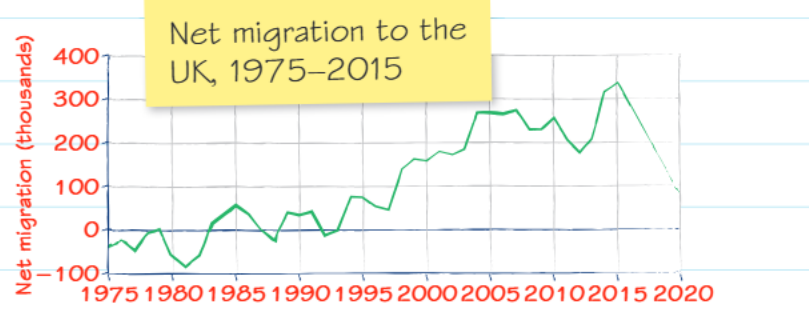
The data shows how net migration to the UK has changed dramatically over several decades. Starting near zero in 1975, migration actually became negative briefly around 1980, meaning more people left the UK than arrived. However, from the mid-1980s onwards, there was a steady increase in net migration that accelerated significantly from the 1990s.
The trend peaked at over 300,000 people around 2015, before declining sharply to approximately 100,000 by 2020. In 2015 specifically, net migration reached 336,000 people, representing a significant population change that year.
Note
Net migration refers to the difference between immigration (people moving into the UK) and emigration (people leaving the UK). A positive figure means more people are arriving than leaving, contributing to population growth.
Different perspectives on migration
Various stakeholders hold contrasting views about migration into the UK, creating ongoing debate about its impacts:
Local councils often express concerns about the pressure migration places on public services. They worry about their ability to provide adequate healthcare, education, and housing for growing populations, especially when government funding doesn't always increase proportionally.
Businesses generally welcome migrants because they help address skills shortages in various sectors. Many migrants possess skills that are in short supply in the UK labour market, helping businesses fill important roles and maintain productivity.
Some members of the public believe that migration reduces employment opportunities for existing residents. They argue that increased competition for jobs might drive down wages or make it harder for local people to find work.
Greenfield vs brownfield development sites
When addressing housing and economic development needs, planners must choose between different types of development sites, each with distinct advantages and challenges.
Greenfield sites
Greenfield sites refer to undeveloped land, often in rural or suburban areas. These sites offer certain advantages for developers, including typically lower land costs and greater flexibility for new construction projects. The absence of existing buildings means developers can design layouts from scratch without working around previous structures.
However, greenfield development raises significant environmental and planning concerns. Using these sites often means losing valuable agricultural land that could otherwise produce food. There's also the risk of damaging important wildlife habitats and disrupting established ecosystems. These environmental impacts must be carefully weighed against development benefits.
Example
Worked Example: Greenfield Development Analysis
Consider a proposed housing development on a 50-hectare greenfield site:
Advantages:
- Lower land acquisition costs (£10,000 per hectare vs £50,000 for brownfield)
- Complete design flexibility for optimal layout
- No demolition or contamination cleanup required
Disadvantages:
- Loss of 50 hectares of productive farmland
- Potential habitat destruction for local wildlife
- Increased urban sprawl and car dependency
Brownfield sites
Brownfield sites are previously developed areas that are no longer in use, such as former industrial sites or abandoned buildings. These locations offer several advantages for sustainable development.
Essential services like gas, water, and electricity supplies are typically already installed, which reduces both development costs and construction time. Using brownfield sites also helps improve areas that may have become eyesores or sources of urban decay, contributing to neighbourhood regeneration.
However, brownfield development faces its own challenges. The land is often more expensive than greenfield alternatives. Additionally, these sites may contain toxic substances or contaminated soil from previous industrial use, requiring expensive cleanup before development can begin. There may also be restrictions on what can be built, depending on the site's previous use and current condition.
Example
Worked Example: Brownfield Site Redevelopment
An old factory site in Manchester is being converted to residential housing:
Advantages:
- Existing gas, water, and electrical connections save £2 million in infrastructure costs
- Improves a derelict area, increasing surrounding property values by 15%
- Located near public transport, reducing car dependency
Challenges:
- Soil contamination cleanup costs £5 million
- Land purchase price 5x higher than equivalent greenfield site
- Building height restrictions due to nearby airport
Applying your knowledge
Understanding these concepts helps you analyse real geographical challenges. For example, when examining brownfield site development, you should consider how existing infrastructure reduces development costs and construction time. You might also discuss how redeveloping abandoned areas improves the visual appearance and economic prospects of neighbourhoods.
When analysing these issues, use specific geographical terminology and provide detailed explanations that demonstrate your understanding of the processes involved.
Summary
Key Points to Remember:
- The two-speed economy describes uneven regional development, with the south-east growing faster than other UK regions
- UK net migration has fluctuated significantly since 1975, peaking around 2015 at 336,000 before declining
- Different stakeholders have varying perspectives on migration - councils worry about service provision, businesses value skills, some public concern about job competition
- Greenfield sites offer development flexibility but risk environmental damage and agricultural land loss
- Brownfield sites provide existing infrastructure and improve derelict areas but may cost more and require contamination cleanup