The feudal hierarchy (Edexcel GCSE History): Revision Notes
📚Revision Notes
The feudal hierarchy
How feudalism developed in Norman England
Following William's victory at Hastings in 1066, establishing control over England required more than just military conquest. The feudal system emerged gradually over several decades as William's solution to governing his new kingdom effectively. He needed to replace the complex web of Anglo-Saxon landholding relationships with a system that would secure his political control while providing the military strength necessary to defend his conquest.
Note
This transitional period was crucial - William didn't implement feudalism overnight. Instead, he used several decades to systematically clear away existing arrangements and rebuild them according to Norman principles, allowing him to maintain stability while establishing his new order.
William used this transitional period to clear away existing land arrangements and rebuild them according to Norman feudal principles. This systematic approach allowed him to reward his followers, control potential rivals, and create lasting structures of power throughout England.
Military organisation through feudalism
The feudal system solved one of William's most pressing challenges - maintaining a professional military force. Creating and equipping knights was extraordinarily expensive, requiring horses, armour, weapons, and extensive training. Rather than bearing these costs himself, William transferred this responsibility to his major landholders through the system of knight service.
Under this arrangement, William granted large estates to his most trusted barons. In return, each baron owed the king a specific number of fully equipped knights for military campaigns and castle garrison duties. The barons then subdivided their lands among individual knights, who provided military service in exchange for their holdings.
Example
How Knight Service Worked in Practice:
Step 1: William grants a large estate to Baron Robert Step 2: In return, Baron Robert owes William 20 knights for military service Step 3: Baron Robert subdivides his estate among 20 individual knights Step 4: Each knight provides military service to Baron Robert, who can then fulfil his obligation to William Step 5: This creates a chain of military obligation flowing upward through the hierarchy
This created a military hierarchy where service flowed upward through the social structure. Knights served barons, barons served the king, and everyone understood their obligations within the system. The arrangement ensured William could summon substantial military forces across England without directly funding every warrior.
Importantly, William didn't completely abandon Anglo-Saxon military traditions. The fyrd - the existing system of local militia service - continued operating alongside Norman knight service. This blend of old and new military structures gave William access to both heavily armoured Norman cavalry and traditional English infantry forces when needed.
Political control through land distribution
Feudalism provided William with powerful tools for political control that went far beyond traditional monarchy. Since the king theoretically owned all land in England, he could grant estates to supporters and remove them from opponents. This system of forfeiture meant that even the most powerful nobles held their positions at royal pleasure.
The practice of reliefs further strengthened royal control. When landholders died, their heirs had to pay substantial sums to inherit their estates. This meant that land transfer always required royal approval, giving the king ongoing influence over noble families across generations.
Important
The Core Principle of Feudalism: "Land for Loyalty"
All feudal power ultimately flowed from this simple exchange - the king granted land in return for loyalty and service. This gave William unprecedented control over his nobles, as he could always threaten to redistribute their estates to more faithful followers.
William needed mechanisms to prevent his barons from becoming too independent or challenging royal authority. Feudalism created a structure where political power flowed downward from the crown, and any baron who accumulated too much influence could have their lands redistributed to more loyal followers. This flexibility allowed William to reward loyalty while punishing disloyalty effectively.
The system also meant that grants could be strategic - William could give lands to someone else as rewards for faithful service, creating ongoing incentives for nobles to maintain their allegiance to the crown.
The ceremony of homage
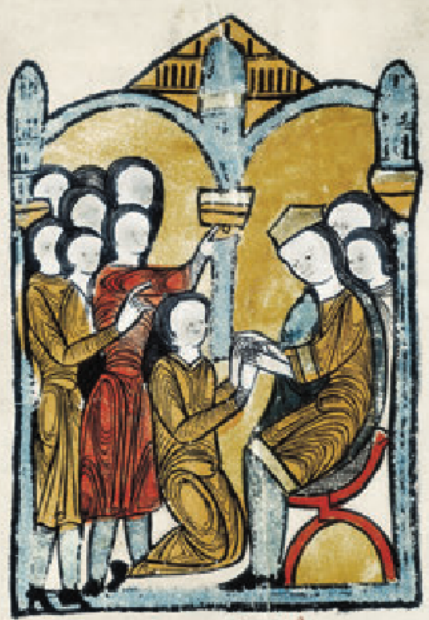
Feudal relationships became legally binding through elaborate ceremonies of homage. These formal rituals transformed personal agreements into sacred obligations recognised by both church and law. During homage ceremonies, vassals would kneel before their lord, place their hands between the lord's hands, and swear oaths of faithful service.
Example
The Homage Ceremony Step-by-Step:
Step 1: The vassal approaches his lord and kneels before him Step 2: The vassal places his hands between the lord's hands (called "immixtio manuum") Step 3: The vassal declares: "I become your man" and swears an oath of loyalty Step 4: The lord accepts the homage and promises protection in return Step 5: Often followed by the ceremony of investiture, where the lord grants a symbolic object representing the land
These ceremonies created mutual obligations that defined feudal society. Lords promised to protect their vassals and provide them with land, while vassals committed to military service and loyalty. The religious elements of these ceremonies meant that breaking feudal oaths was seen as both a legal violation and a sin against God.
Note
The formality of homage distinguished Norman feudalism from looser Anglo-Saxon arrangements. Where previous relationships might have been informal or temporary, feudal bonds created permanent, heritable obligations that structured society across generations.
Social control and peasant obligations
Feudalism fundamentally transformed life for ordinary English people. Unlike Anglo-Saxon peasants, who had generally been free to choose their lords and move between different estates, Norman feudalism bound peasants much more tightly to specific lords and locations.
The new system created a hierarchy of mutual obligations extending down to society's lowest levels. Peasants provided labour service on their lord's land - working his fields, maintaining his buildings, and contributing to various projects. In exchange, lords provided protection, justice, and the right to work small plots for peasant families' subsistence.
Note
This shift represented a significant loss of freedom for many English peasants. Where they had previously been able to negotiate working conditions or seek better opportunities elsewhere, they now found themselves bound to their lords through relationships similar to those binding lords to their superiors.
This represented a shift from relatively flexible work arrangements to a more rigid social structure. Peasants found it much harder to leave unsatisfactory situations or seek better opportunities elsewhere. Instead of being able to negotiate working conditions, peasants became bound to their lords through relationships similar to those binding lords to their superiors.
The system ensured that wealth and power remained concentrated among the nobility while creating a stable workforce tied to the land. This social organisation supported the military and political aspects of feudalism by ensuring that agricultural production could fund the expensive knightly class.
Changes from Anglo-Saxon England
While feudalism represented major changes in English society, some elements showed continuity with earlier practices. Many Anglo-Saxon peasants had already been bound to their lords through various obligations and relationships that resembled feudal arrangements. The Domesday Book's records suggest that Norman administrators built upon existing structures rather than creating entirely new systems.
However, Norman feudalism was more systematic and legally defined than previous arrangements. Where Anglo-Saxon relationships varied significantly between regions and individual lords, feudalism created standardised hierarchies applying across the entire kingdom.
Inheritance practices also became more formalised and controlled. Under Anglo-Saxon traditions, noble sons often inherited their fathers' positions automatically. Norman feudalism made inheritance dependent on formal ceremonies, royal approval, and the payment of reliefs, giving the crown much greater control over noble succession.
Important
Key Difference: Formalization
The most significant change wasn't necessarily the relationships themselves, but how formalised and controlled they became under Norman rule. What had been flexible, regional arrangements became standardised, kingdom-wide systems with legal and religious backing.
The ceremonial aspects of feudalism, particularly homage, represented genuine innovations in English society. These formal rituals created legal and religious bonds that were much stronger than earlier informal agreements between lords and followers.
Summary
Key Points to Remember:
- Feudalism developed gradually over decades after 1066, serving as William's systematic approach to controlling his new kingdom
- The system served three interconnected purposes: providing military forces through knight service, ensuring political control through strategic land grants, and organising society through rigid social hierarchies
- All feudal relationships were based on mutual obligations - land and protection given in exchange for military service and loyalty
- Formal ceremonies of homage made feudal bonds both legally and religiously binding, creating permanent obligations between lords and vassals
- While building on some Anglo-Saxon traditions, Norman feudalism was more systematic and gave the crown unprecedented control over both nobles and peasants