Anglo-Saxon resistance, 1069-71 (Edexcel GCSE History): Revision Notes
📚Revision Notes
Anglo-Saxon resistance, 1069-71
Overview of the resistance period
Important
The period 1069-71 represented the most significant challenge to William I's rule and marked the final major attempt by Anglo-Saxon nobles to resist Norman control. These coordinated rebellions would ultimately determine whether William could truly consolidate his power over England.
The most significant challenge to William I's rule came through a series of coordinated rebellions between 1069 and 1071. These uprisings represented the final major attempt by Anglo-Saxon nobles to resist Norman control, involving key figures such as Edgar the Aethling and Hereward the Wake. The resistance culminated with the last Anglo-Saxon rebellion at Ely in 1070-71, which marked the end of organised opposition to William's reign.

The northern uprisings (January-February 1069)
The year 1069 began with William attempting to establish Norman control over Northumbria by appointing Robert Cumin as the new Earl. However, this decision sparked immediate and violent resistance from the Anglo-Saxon population.
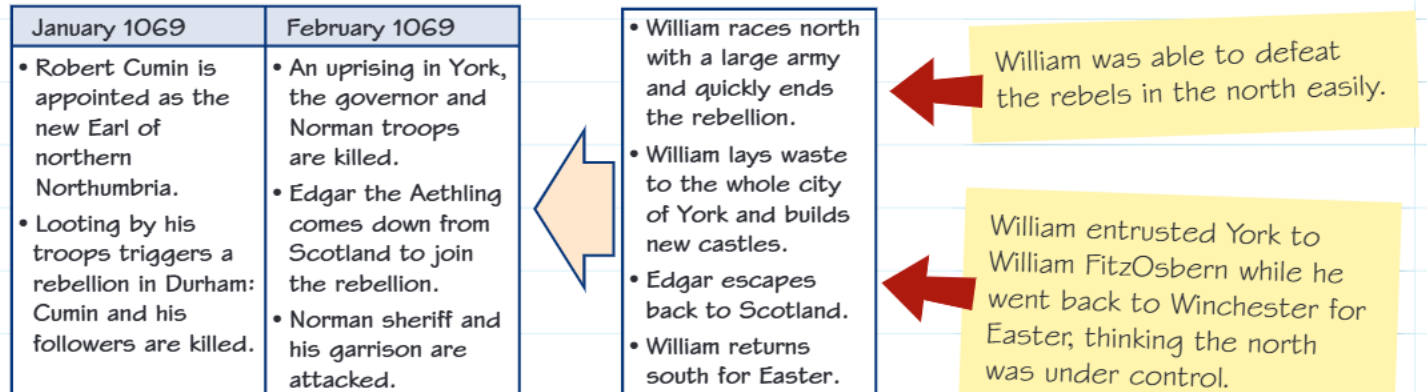
In January 1069, Robert Cumin arrived in Durham with a small force of Norman troops to take up his new position. The appointment was deeply unpopular with the local population, who viewed it as another example of Norman oppression. By February, the situation had deteriorated dramatically when an uprising erupted in York, during which both Robert Cumin and his Norman garrison were killed by rebel forces.
The rebellion gained significant momentum when Edgar the Aethling, the last remaining member of the Anglo-Saxon royal family, arrived from Scotland to join the resistance movement. Edgar's presence provided legitimacy to the uprising and encouraged more Anglo-Saxons to rebel against Norman rule. The rebels also attacked the Norman sheriff and his garrison, demonstrating their determination to drive out Norman authority entirely.
Note
William's response was characteristically swift and decisive. He immediately marched north with a large army to suppress the rebellion, successfully defeating the northern rebels and restoring Norman control. This demonstrated William's understanding that rapid action was essential to prevent rebellions from spreading.
However, recognising the ongoing threat in the region, William made a strategic decision to entrust York to William FitzOsbern, one of his most trusted lieutenants, while he returned to Winchester for Easter. This move showed William's understanding that the north required strong and reliable leadership to prevent further uprisings.
The Danish invasion and attack on York (September 1069)
The situation became far more serious in September 1069 when external forces joined the Anglo-Saxon resistance. Sweyn of Denmark dispatched a substantial invasion fleet to England, recognising an opportunity to exploit William's difficulties and potentially gain territory for himself.
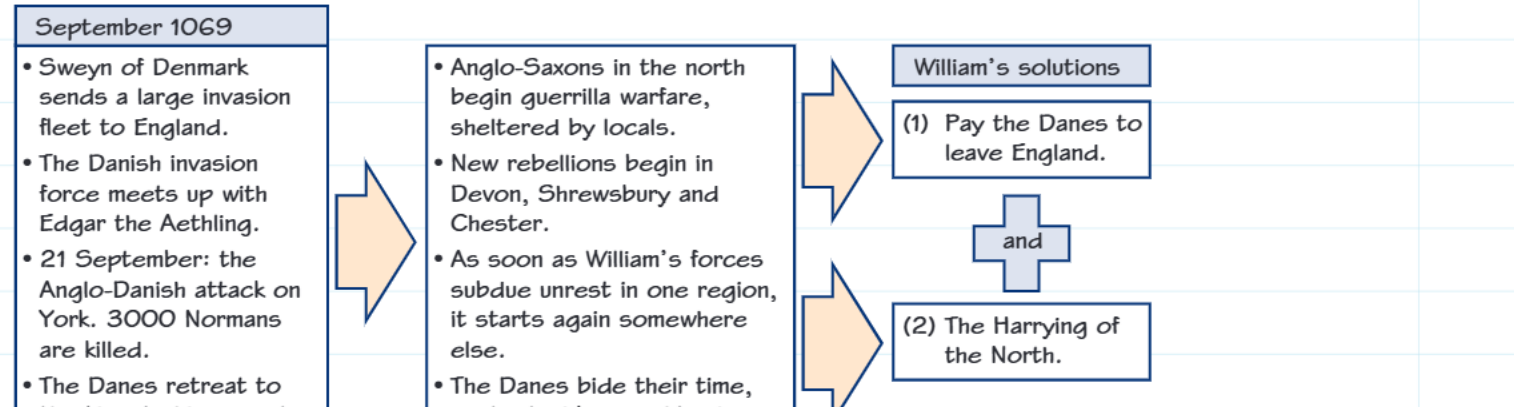
The Danish forces formed a powerful alliance with Edgar the Aethling and other Anglo-Saxon rebels, creating a formidable combined force. On 21 September 1069, this Anglo-Danish army launched a devastating attack on York, resulting in the deaths of approximately 3,000 Norman soldiers.
Important
The attack on York was one of the most significant military defeats William had suffered since Hastings. The loss of 3,000 Norman soldiers sent shockwaves throughout his kingdom and demonstrated that the resistance had evolved from local uprisings into a serious military threat capable of inflicting major casualties.
Following their victory at York, the Anglo-Saxons in the north adopted guerrilla warfare tactics, making effective use of the difficult terrain and their knowledge of the local area. Meanwhile, the success of the northern rebellion inspired further uprisings in other parts of England, with new rebellions breaking out in Devon, Shrewsbury, and Chester. This created a dangerous situation where William faced multiple threats across his kingdom simultaneously.
William responded with a carefully planned two-part strategy. First, he negotiated with the Danish forces, offering them substantial payments to abandon their Anglo-Saxon allies and return to Denmark. This diplomatic solution removed the foreign military threat and isolated the remaining Anglo-Saxon rebels. Second, and more controversially, William implemented what became known as the "Harrying of the North", a brutal campaign of destruction across northern England designed to permanently crush any remaining resistance and ensure such large-scale rebellions could never occur again.
Hereward the Wake and the Ely rebellion (1070-71)
The final phase of Anglo-Saxon resistance centred around Hereward the Wake, who had returned to England around 1069 after a period of exile. Hereward discovered that his lands had been confiscated and given to a Norman lord, which motivated him to organise resistance against William's rule.
Note
The marshlands of East Anglia provided natural protection for the rebels at Ely. The difficult terrain meant that Norman cavalry and heavily armoured troops struggled to pursue the rebels effectively, giving the Anglo-Saxons a significant tactical advantage in their guerrilla warfare campaign.
In 1070, the Danish forces returned and established a base at Ely in the marshlands of East Anglia. Hereward joined forces with them and launched a raid on Peterborough Abbey, hoping to prevent its treasures from falling into Norman hands. However, the Danes ultimately took all the monastery's wealth and sailed back to Denmark, leaving Hereward and his Anglo-Saxon followers to continue the fight alone.
The rebellion at Ely proved to be particularly challenging for William due to the difficult terrain of the marshlands, which provided natural protection for the rebels. Morcar, the former Earl of Northumbria, also joined Hereward's forces, adding credibility and experience to the resistance movement. The rebels were able to use the marshes effectively, launching surprise attacks and then retreating to areas where Norman cavalry and heavily armoured troops struggled to follow.
Eventually, however, William's superior resources and determination prevailed. The Normans successfully captured Morcar, while Hereward managed to escape but was never heard from again, likely indicating that he died during the conflict or shortly afterward. This marked the end of organised Anglo-Saxon military resistance to Norman rule.
Summary and significance of the resistance period
Summary
Key Outcomes of the Resistance Period:
- Strategic shift: William moved from ruling through consent to systematic replacement of Anglo-Saxon aristocracy
- Military lessons: The resistance revealed the need for stronger control over the north and the danger of external alliances
- Political consolidation: The defeat of the rebellions established William's authority more firmly than ever before
- Social transformation: The period marked the beginning of comprehensive Norman replacement of Anglo-Saxon institutions
The Anglo-Saxon resistance of 1069-71 revealed several important aspects of William's consolidation of power. Initially, many Anglo-Saxon nobles who had submitted to William were allowed to retain their positions, as William preferred to rule through consent rather than purely through force. However, the sustained nature of the resistance, combined with the external Danish threat, convinced William that more drastic measures were necessary.
As a direct result of these rebellions, William made the crucial decision to replace the remaining Anglo-Saxon aristocracy with Norman nobles entirely. This represented a fundamental shift in his approach to governing England and marked the beginning of a more systematic replacement of Anglo-Saxon institutions with Norman ones. The resistance also highlighted William's underestimation of northern independence and the continuing appeal of Edgar the Aethling as a legitimate alternative ruler.
The period demonstrated that while William had won the Battle of Hastings, securing his kingdom required ongoing military and political effort. The Danish invasion, in particular, showed how external powers could exploit internal resistance to threaten Norman control. William's ultimate success in crushing these rebellions established his authority more firmly than ever before, but at the cost of devastating much of northern England and permanently alienating any remaining Anglo-Saxon support.
Timeline of major events
Note
Chronological Sequence of Resistance (1069-71):
- January 1069: Robert Cumin appointed as Earl of Northumbria
- February 1069: Uprising in York kills Robert Cumin and Norman garrison; Edgar the Aethling joins the rebellion
- September 1069: Sweyn of Denmark sends invasion fleet; Anglo-Danish alliance attacks York, killing 3,000 Normans
- Late 1069: William pays Danes to leave and begins the Harrying of the North
- 1070: Danes return and establish base at Ely; Hereward the Wake raids Peterborough Abbey
- 1070-71: Final siege of Ely; capture of Morcar and disappearance of Hereward the Wake
Remember!
Summary
Essential Points to Remember:
-
The Anglo-Saxon resistance of 1069-71 represented the last major challenge to William's rule, involving both domestic rebels and foreign invasion
-
Key figures included Edgar the Aethling (providing royal legitimacy), Sweyn of Denmark (external military support), and Hereward the Wake (final resistance leader)
-
The Danish alliance made the resistance particularly dangerous, culminating in the devastating attack on York that killed 3,000 Normans
-
William's responses included both diplomatic solutions (paying the Danes to leave) and brutal military campaigns (the Harrying of the North)
-
The ultimate outcome was William's decision to completely replace the Anglo-Saxon aristocracy with Norman nobles, fundamentally changing English society and ensuring no future large-scale resistance could occur