Key factors of the conflict (Edexcel GCSE History): Revision Notes
📚Revision Notes
Key factors of the conflict
The War of Independence (1775-83) wasn't just a struggle between Britain and its American colonies. Several crucial factors combined to weaken Britain's position and ultimately led to American victory. Understanding these key elements helps explain how a colonial rebellion became a successful revolution.

International involvement transforms the conflict
The most significant factor that changed the course of the war was international involvement, particularly from France and Spain. What began as a colonial revolt evolved into a global conflict that stretched British resources far beyond their limits.
Note
The transformation from a local colonial rebellion to an international war was perhaps the single most important factor in determining the outcome of the American War of Independence.
French alliance of 1778
In February 1778, the French government made a decisive move by signing formal treaties with the American rebels. This alliance was revolutionary because it provided the Americans with a major European power as an ally. France's involvement was motivated by their desire to weaken their traditional enemy, Britain, and potentially regain territory lost in previous wars.
The French didn't just offer moral support - they provided crucial military resources, financial aid, and naval power that the Americans desperately needed. This alliance effectively declared war on Britain, forcing the British to fight on multiple fronts rather than focusing solely on suppressing the American rebellion.
Spanish support from 1779
In April 1779, Spain joined the conflict as allies of the French. While Spain was more cautious than France in their approach, their involvement further stretched British military resources. Both countries became important because they forced Britain to defend not just America, but also protect its other colonies and territories around the world.
How Britain's efforts were weakened
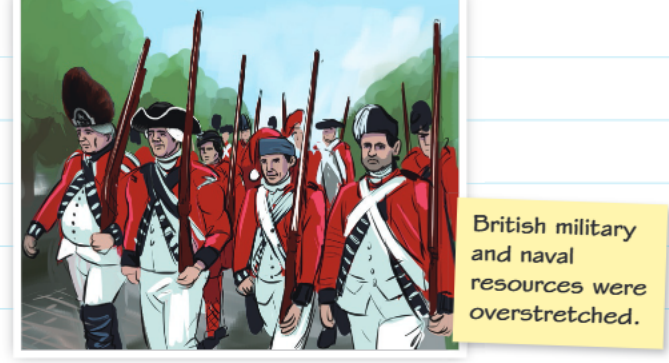
The international dimension of the conflict created several serious problems for Britain that undermined their ability to win the war in America.
Military resources spread too thin
Britain found itself needing military protection for multiple territories simultaneously. The war was no longer confined to America, which meant British troops had to be diverted to defend other colonies and fight France and Spain elsewhere. This division of forces meant fewer troops were available to fight the Americans, weakening Britain's military effectiveness in the crucial American theatre.
Royal Navy decline
Perhaps most critically, Britain's naval supremacy - traditionally their greatest strength - was severely compromised. The statistics tell a striking story: in 1772, an impressive 41% of the Royal Navy was stationed in American waters, giving Britain strong control over supply lines and coastal areas.
However, by 1780, only 13% of the Royal Navy remained in American waters. This dramatic decline occurred because British ships were needed to fight French and Spanish fleets in other parts of the world.
Important
The consequences of this naval weakness became painfully clear in 1781, when the British navy was unable to provide crucial aid to General Cornwallis at Yorktown, directly contributing to his surrender and American victory.

French support for the rebel war effort
France provided comprehensive support to the American cause, offering assistance in multiple crucial areas that proved decisive for American success.
Military advice and leadership
French military expertise proved invaluable to the American cause. The Marquis de Lafayette became an advisor to George Washington as early as July 1777, bringing European military knowledge and strategic thinking to the Continental Army. French officers helped train American troops and plan military campaigns, significantly improving the effectiveness of rebel forces.
Troops and direct military involvement
Example
Worked Example: French Military Commitment
France didn't limit itself to advice and supplies. In February 1780, the Comte de Rochambeau received orders to take 6,000 French troops to America. These professional soldiers joined Washington's forces and played a vital role in forcing the British surrender at Yorktown. The presence of experienced French troops gave the Americans crucial support in key battles.

Financial and material support
The French provided enormous financial backing to the American war effort, sending approximately £40 million worth of supplies and weapons. Spain also contributed supplies and money to support the rebellion. This material support was essential because the Continental Congress struggled to finance the war effort, and French aid helped keep American forces equipped and in the field.
Naval support

Example
Worked Example: French Naval Impact
The French fleet played a decisive role even before major battles began. In June 1778, the British abandoned Philadelphia partly because they feared French naval power would cut off their supplies. Admiral de Grasse's French fleet created a successful blockade at Yorktown, preventing British naval support from reaching Cornwallis and contributing directly to the British surrender there.
Timeline of key events
- July 1777: Marquis de Lafayette becomes advisor to Washington
- February 1778: France signs formal alliance with American rebels
- June 1778: British abandon Philadelphia due to French naval threat
- April 1779: Spain joins the conflict as French ally
- February 1780: Comte de Rochambeau ordered to America with 6,000 troops
- 1781: British navy unable to aid Cornwallis at Yorktown due to overstretch
Summary
Key Points to Remember:
-
International involvement was crucial: The French alliance of 1778 transformed a colonial rebellion into a global war that Britain couldn't handle effectively.
-
British resources became overstretched: Fighting France and Spain simultaneously meant fewer troops and ships available for America, weakening Britain's position.
-
Naval power shifted dramatically: Britain's Royal Navy presence in America dropped from 41% to just 13%, losing crucial maritime control.
-
French support was comprehensive: France provided military advisors, troops, massive financial aid (£40 million), and decisive naval support.
-
Yorktown demonstrated the consequences: Britain's inability to support Cornwallis due to overextended resources directly led to surrender and American victory.