The Stamp Act, 1765 (Edexcel GCSE History): Revision Notes
📚Revision Notes
The Stamp Act, 1765
Introduction to British taxation policies
The Stamp Act of 1765 represented a significant escalation in British efforts to generate revenue from the American colonies. Building upon the earlier Sugar Act of 1764, this new legislation sparked intense debates about Parliament's authority to impose taxes on colonial subjects and fundamentally changed the relationship between Britain and its American territories.

What was the Stamp Act?
Terms and requirements of the act
Note
The Stamp Act - Key Requirements (March 22, 1765)
The British Parliament enacted comprehensive legislation requiring colonists to purchase specially marked paper for numerous official documents. All printed materials - from newspapers and almanacks to legal documents and playing cards - had to be produced on stamped paper that carried an official government seal.
The enforcement mechanism proved particularly controversial. Payment for these stamps could only be made using British coins, which were already in short supply throughout the colonies. Furthermore, anyone suspected of violating the act would face trial in vice-admiralty courts rather than local colonial courts with juries of their peers.
The principle of "no taxation without representation"
Important
Constitutional Foundation of Colonial Opposition
Colonial opposition crystallised around the fundamental principle that since American colonists possessed no voting rights in the British Parliament and could not elect representatives to speak for their interests, Parliament lacked legitimate authority to impose taxes upon them.
This principle gained increasing support from 1769 onward as colonists insisted that only their own colonial assemblies - where they did have representation - should have the power to levy taxes on their communities.
Why was the Stamp Act significant?
Important
A Crucial Shift in British Colonial Policy
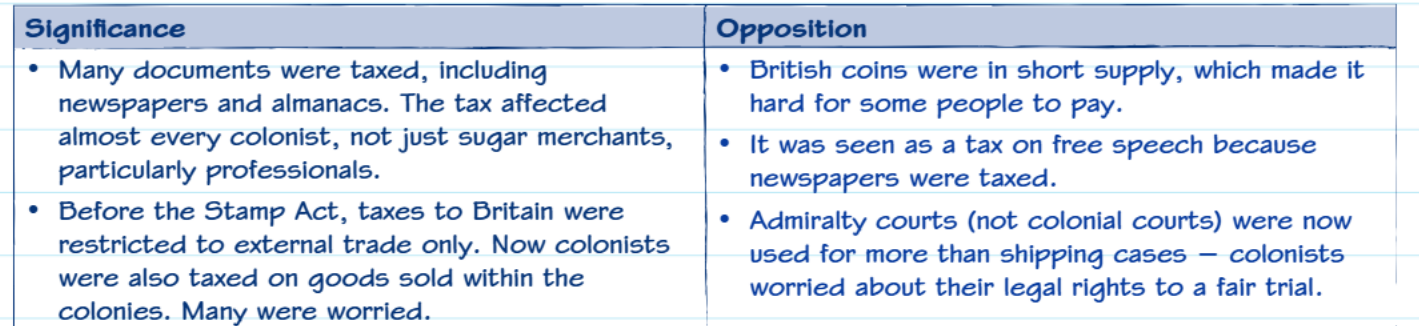
The Stamp Act marked a crucial shift that affected virtually every aspect of colonial life. Unlike previous taxation measures that primarily impacted merchants involved in overseas trade, this legislation touched almost every colonist who needed to use printed materials.
Key Change: British taxes expanded from external trade duties to internal taxes on goods and services sold within the colonies themselves.
Before this act, British taxes on colonial goods had been restricted to external trade - duties on items entering or leaving colonial ports. This change meant that professionals such as lawyers, newspaper publishers, and clerks found themselves directly affected by British taxation for the first time.
The widespread nature of the tax created a much broader coalition of opposition than previous measures had generated, extending beyond the merchant classes to include educated professionals and ordinary citizens who relied on printed materials in their daily lives.
Colonial opposition to the Stamp Act
Colonial resistance emerged on multiple fronts, combining constitutional arguments with practical concerns about economic hardship. Many colonists faced genuine difficulty obtaining the British coins required for payment, as these were scarce throughout the American territories.
The taxation of newspapers provoked particular outrage, as colonists viewed this as an attack on free speech and the press. Publishers and readers alike saw newspaper taxes as a deliberate attempt to suppress information and debate about British policies.
Note
Legal Concerns About Vice-Admiralty Courts
Perhaps most troubling to many colonists was the use of vice-admiralty courts for enforcement. These courts operated without juries and handled cases involving maritime law and shipping disputes. Extending their jurisdiction to cover Stamp Act violations raised serious concerns about colonists' traditional rights to trial by jury and fair legal proceedings in their local communities.
Impact of colonial resistance
The effectiveness of colonial opposition became apparent through multiple channels. British traders and businesses, particularly those in major port cities, experienced significant losses in trade and commerce as colonists reduced their economic activities rather than comply with the stamp requirements.
The British government collected far less revenue than anticipated - only £3,292 between November 1, 1765, when the act took effect, and March 1766, when it was repealed. This represented a fraction of expected income and demonstrated the practical impossibility of enforcing the legislation against widespread colonial resistance.
Violence against stamp tax collectors escalated to the point where nearly all collectors had resigned their positions by November 1, 1765. Those few who remained in Georgia resigned shortly thereafter, leaving the British government without effective means of enforcement.
Methods of colonial opposition
Example
Organized Colonial Resistance - The Stamp Act Congress
Representatives from nine colonies convened in October 1765 to coordinate their response to British taxation policies. This congress marked an important step towards unified colonial action, as delegates agreed on a common set of objections and presented a united front against British policies.
Example
Direct Action - Violent Protests and Intimidation
Colonial resistance groups, particularly the organisation that became known as the Sons of Liberty, orchestrated campaigns of intimidation against royal officials and stamp collectors. These actions began in Boston with attacks on the homes and workplaces of tax officials and spread throughout British America, creating an atmosphere where few were willing to enforce the unpopular legislation.
Example
Economic Warfare - Strategic Boycotts
From October 1765 onward, leading merchants in major cities including New York, Philadelphia, and Boston organised systematic boycotts of British goods. Colonists refused to pay debts owed to British traders and significantly reduced their purchases of imported items, creating economic pressure on British businesses to lobby for policy changes.
Outcomes and consequences
In March 1766, the British Parliament voted to repeal the Stamp Act in response to the sustained colonial opposition and economic pressure from British merchants. However, this victory proved incomplete for the colonists, as Parliament simultaneously passed the Declaratory Act, which reasserted Parliament's right to govern and tax the colonies "in all cases whatsoever."
The British government attempted to address some colonial concerns through the Free Port Act of 1766, which encouraged trade and allowed traders to earn metal coins needed for other transactions. This measure represented recognition that the shortage of British currency had created genuine hardships for colonists attempting to comply with British requirements.
Timeline of major events
- March 22, 1765: Parliament passes the Stamp Act
- October 1765: Stamp Act Congress convenes with representatives from nine colonies
- November 1, 1765: Stamp Act takes effect; widespread colonial resistance begins
- October 1765 - March 1766: Economic boycotts of British goods intensify
- By November 1, 1765: Nearly all stamp collectors resign due to intimidation and violence
- March 1766: Parliament repeals the Stamp Act but passes the Declaratory Act
Summary
Key Points to Remember
-
The Stamp Act of 1765 expanded British taxation from external trade duties to internal colonial commerce, affecting nearly every colonist who used printed materials
-
The principle of "no taxation without representation" became the central constitutional argument against British taxation policies, as colonists had no voting rights in Parliament
-
Colonial opposition took multiple forms including organised congresses, violent intimidation of officials, and economic boycotts that significantly reduced British trade revenues
-
The act's repeal in March 1766 represented a colonial victory, but the simultaneous passage of the Declaratory Act maintained Parliament's claim to authority over colonial taxation
-
The widespread nature of opposition to the Stamp Act created unprecedented unity among diverse colonial groups and established patterns of resistance that would continue throughout the revolutionary period