The Declaration of Independence, 1776 (Edexcel GCSE History): Revision Notes
📚Revision Notes
The Declaration of Independence, 1776
The shift towards independence
After fighting began in 1775, the goals of the rebel colonists changed dramatically. Rather than seeking to reform their relationship with Britain, they now pursued complete separation and independence. Two key influences helped shape this transformation: Thomas Paine's pamphlet Common Sense and the formal Declaration of Independence itself.
The influence of Thomas Paine's Common Sense
Thomas Paine, an Englishman who had relocated to Philadelphia in 1774, became one of the most influential voices for American independence. After meeting Benjamin Franklin, Paine wrote a powerful pamphlet called Common Sense, which was published on 10 January 1776.
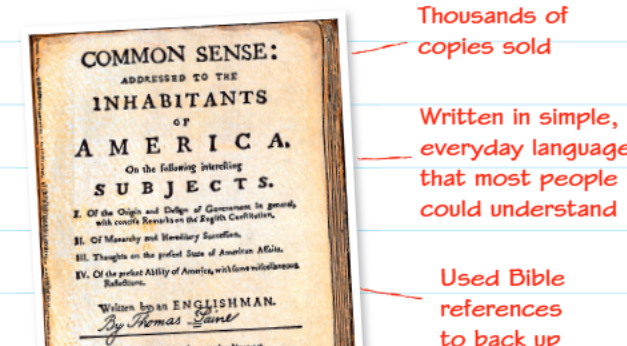
This pamphlet proved extremely important in changing the minds of many colonists who had been uncertain about supporting the war. Paine's writing helped calm people's concerns about what independence might bring and convinced many that breaking away from Britain was their only viable option.
Note
Paine made three main arguments in Common Sense:
- The British monarchy restricted Parliament's ability to govern effectively
- Independence would bring greater freedom to America and attract support from other nations
- A republic (a government elected by the people and led by a president) represented the best form of governance for any country
The pamphlet's success came from several factors: it sold thousands of copies throughout the colonies, used simple everyday language that ordinary people could easily understand, and included Biblical references to support its arguments for independence.
The role of Thomas Jefferson
When the Continental Congress decided to move forwards with independence, they established a Declaration Committee. This five-member group included Benjamin Franklin and was tasked with creating a formal statement of independence.
Note
Thomas Jefferson, a wealthy lawyer from Virginia, received the responsibility of writing the initial draught of the Declaration. After Jefferson completed his work, the committee reviewed and modified his draught before presenting it to Congress.
Remarkably, Jefferson's original writing formed the foundation of the final approved document, with much of his language remaining unchanged.
The significance of the Declaration of Independence
The Continental Congress (the new name for the Second Continental Congress) created the Declaration Committee after colonial representatives received permission from their home colonies to vote for independence. Once the committee completed their work, Congress officially approved the final version on 4 July 1776.
The Declaration proved significant for several important reasons:
A radical departure from previous statements: Unlike earlier colonial political declarations, this document demanded complete independence from Britain and introduced the term "United States of America" for the first time.
Based on Enlightenment principles: The arguments in the Declaration drew heavily from Enlightenment ideas, particularly the concept that all people possess natural rights that governments must protect.
Inspired widespread support: The Declaration provided colonists with clear reasons to join the war effort against Britain, offering the promise of self-governance as the reward for victory.
Important
The Declaration was revolutionary because it argued that governments exist to protect people's rights, and when they fail to do so, people have the right to form new governments.
The structure of the Declaration
The Declaration of Independence contained three main sections, each serving a specific purpose:
1. The Introduction: This opening section became the most famous part of the Declaration. It established the fundamental principle that all people are created equal and possess certain rights that governments should protect.
2. List of Grievances: This middle section detailed the various ways King George III and the British government had failed to protect the colonists' rights, providing specific examples of British misconduct.
3. The Conclusion: The final section declared that the United States of America should be free from British rule because the British government had failed to protect the natural rights of the colonists.
Timeline of key events
- 1774: Thomas Paine moves to Philadelphia and meets Benjamin Franklin
- 10 January 1776: Common Sense is published
- Spring 1776: Colonial assemblies begin authorising their representatives to vote for independence
- Summer 1776: Continental Congress establishes Declaration Committee
- 4 July 1776: Congress officially approves the Declaration of Independence
Summary
Key Points to Remember:
- Thomas Paine's Common Sense was crucial in persuading colonists to support independence - published in January 1776, it used simple language and Biblical references to argue for breaking away from Britain
- Thomas Jefferson wrote the first draught of the Declaration - though a committee reviewed it, much of Jefferson's original writing remained in the final version
- The Declaration was approved on 4 July 1776 - this date marks America's formal break from British rule
- The document introduced the term "United States of America" - marking a shift from thinking of separate colonies to one unified nation
- Enlightenment ideas about natural rights formed the philosophical foundation - the Declaration argued that governments exist to protect people's rights, and when they fail to do so, people have the right to form new governments