Crimes against the person and property (Edexcel GCSE History): Revision Notes
📚Revision Notes
Crimes against the person and property c1700-c1900
Introduction
During the period from 1700 to 1900, there were few completely new types of crimes against people or property, but the ways these crimes were committed changed dramatically. The crime rate increased significantly during this period, leading to major changes in laws and punishments. This was largely due to social and economic changes that created new opportunities for criminal activity.
Note
Rather than inventing entirely new forms of crime, this period saw dramatic changes in how traditional crimes were committed and the scale at which they occurred.
Factors causing increased crime
The period from 1700 to around 1850 witnessed a notable rise in various criminal activities. Several interconnected factors contributed to this increase in crime rates across Britain.
Social changes and urbanisation played a crucial role in rising crime levels. As more people began travelling and moving into growing towns and cities, traditional community bonds weakened. People knew fewer of their neighbours personally, and communities became less tightly connected. This anonymity made it easier for criminals to operate without being recognised or caught.
Note
The shift from small, close-knit rural communities to larger, more anonymous urban areas fundamentally changed the social environment in which crime occurred.
Economic opportunities for crime also expanded during this period. Larger towns created new possibilities for criminals to escape detection after committing offences. The increased movement of people and goods created more targets for theft and robbery.
Professional criminal networks began to emerge as some criminals organised themselves into gangs or groups of thieves. These organised criminals could plan more sophisticated crimes and had better knowledge of how to avoid capture.
Poverty and survival remained significant drivers of crime. Extreme poverty forced many people to commit what became known as 'survival crimes', such as stealing food to feed their families. These desperate circumstances pushed law-abiding people into criminal activity simply to survive.
Changes in highway robbery - a crime against the person
Highway robbery became one of the most notorious crimes of the 18th century, though it eventually disappeared completely by the 1830s. Understanding why it flourished and then declined reveals much about how social changes affected crime patterns.
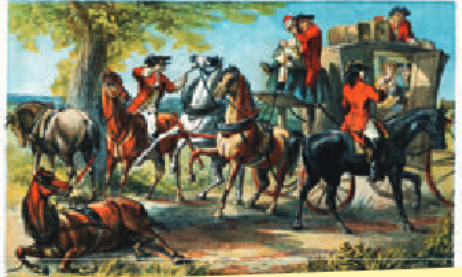
Why highway robbery increased in the 18th century:
The growth of highway robbery was directly linked to improvements in transportation and trade. Better roads meant more people were travelling between towns and cities than ever before. This increased movement created perfect opportunities for highway robbers, who could target wealthy travellers on predictable routes.
Economic factors also contributed to the rise of highway robbery. Increased trade between towns meant that more goods and money were being transported by road. Merchants, wealthy travellers, and stagecoaches carrying valuable cargo became attractive targets for desperate or opportunistic criminals.
Geographic advantages favoured highway robbers during this period. Many roads remained isolated and poorly patrolled, making it relatively easy for robbers to attack travellers and then escape into the countryside. The lack of effective law enforcement on roads outside major towns created an environment where highway robbery could flourish.
The decline of highway robbery:
Highway robbery began to disappear for several practical reasons. In 1772, the government made highway robbery a capital crime, meaning it was punishable by death. This severe penalty was intended to deter potential robbers.
Important
Making highway robbery punishable by death represented one of the harshest legal responses to crime during this period, reflecting the government's determination to protect trade and travel routes.
More importantly, the authorities introduced mounted patrols on major roads, making it much more dangerous for highway robbers to operate. These patrols could respond quickly to attacks and pursue fleeing criminals on horseback.
The growth of the railway system in the 1830s dealt the final blow to highway robbery. As railways replaced road travel for many journeys, there were simply fewer targets available for highway robbers to attack.
Changes in poaching - a crime against property
Poaching underwent significant legal changes during this period, reflecting tensions between social classes and different attitudes towards property rights.
The Waltham Black Act of 1723 represented a major turning point in how poaching was treated by the law. This legislation made poaching a capital crime, meaning poachers could face the death penalty. The act also made it illegal to carry snares or own hunting dogs in poaching areas.
Important
The Waltham Black Act was so harsh that stealing a single rabbit could result in execution, creating widespread resentment among the working classes who saw this as fundamentally unjust.
Social attitudes towards poaching laws were complex and often conflicted with official legal positions. Many people, particularly from working-class backgrounds, viewed the harsh poaching laws as fundamentally unfair. They argued that wildlife should be available to feed hungry families, especially during times of hardship.
The severity of punishment for poaching seemed disproportionate to many people, especially when compared to other crimes. The fact that stealing a rabbit to feed one's family could result in execution struck many as unjust, particularly when wealthy landowners could hunt the same animals freely on their own property.
Note
This disparity in treatment between social classes created significant tensions and contributed to the perception that the legal system favoured the wealthy over the poor.
Poaching as organised crime also developed during this period, with some groups working on a large scale to supply black markets with game meat and other valuable items from private estates.
Changes in smuggling - a crime against property
Smuggling became increasingly common and sophisticated between 1740 and 1850, driven primarily by economic factors rather than simple criminal intent.
Why smuggling increased:
The primary cause of increased smuggling was the extremely high taxes imposed on imported goods. The government taxed items like tea, tobacco, alcohol, and luxury items so heavily that legal prices became prohibitively expensive for ordinary people.
Smugglers responded to public demand by bringing these goods into the country without paying taxes, then selling them at much lower prices than legal merchants could offer. This created a thriving black market that many people supported.
Example
Example: The Hawkhurst Gang
The Hawkhurst Gang operated a sophisticated smuggling network in Kent and Sussex during the 1740s. They could move large quantities of tea, tobacco, and alcohol from France, using local knowledge of coastal routes and cave systems to avoid customs officers. The gang employed dozens of people and had the support of many local communities who benefited from cheaper goods.
Large-scale smuggling operations developed to meet this demand. Groups like the Hawkhurst Gang organised sophisticated smuggling networks that could handle huge volumes of goods. These operations required careful planning, local knowledge, and often involved many people in coastal communities.
Challenges for law enforcement made smuggling difficult to prevent. Mounted customs officers tried to prosecute smugglers, but they found it extremely challenging due to the large areas of coastline that needed patrolling. Many coastal communities actively supported smugglers or remained silent about their activities.
Public attitudes towards smuggling were generally sympathetic. Many people considered smugglers to be heroes who brought them affordable goods that the government had made artificially expensive through taxation. The smugglers were seen as serving the community rather than harming it.
Note
This popular support for smuggling made law enforcement particularly difficult, as communities would often warn smugglers of approaching customs officers and refuse to cooperate with investigations.
The decline of smuggling:
Smuggling decreased significantly after the 1840s when the government finally recognised that high taxes were counterproductive. By reducing taxes on imported goods, the government removed the main economic incentive for smuggling, as legal goods became competitively priced with smuggled alternatives.
Timeline of key events
- 1723: Waltham Black Act makes poaching a capital crime
- 1740-1850: Peak period for smuggling due to high import taxes
- 1772: Highway robbery becomes a capital crime
- 1830s: Highway robbery disappears completely due to mounted patrols and railways
- 1840s: Taxes on imported goods reduced, leading to decline in smuggling
Summary
Key Points to Remember:
-
Crime patterns changed dramatically between 1700-1900, with social and economic factors creating new opportunities for criminal activity rather than entirely new types of crimes.
-
Highway robbery flourished then vanished - it increased due to better roads and more travel, but disappeared by the 1830s due to mounted patrols, harsh punishments, and the railway system.
-
Harsh laws didn't always work - making poaching and highway robbery capital crimes was intended to deter criminals, but social attitudes and economic pressures often outweighed fear of punishment.
-
Economic factors drove smuggling - high taxes on imported goods created a black market that many people supported, and smuggling only declined when taxes were reduced in the 1840s.
-
Public attitudes mattered - people often sympathised with smugglers and some poachers, viewing them as heroes rather than criminals, which made law enforcement more difficult.