Pentonville Prison (Edexcel GCSE History): Revision Notes
📚Revision Notes
Pentonville Prison and the separate system
Introduction to Pentonville Prison
Pentonville Prison represented a revolutionary approach to criminal punishment when it opened in 1842. This institution became the model for what was known as the "separate system" - a completely new philosophy about how prisons should operate and how prisoners should be treated. Rather than simply warehousing criminals together, Pentonville introduced the radical idea that isolation and individual reflexion could reform offenders.
Note
The separate system marked a significant departure from earlier prisons where inmates lived together in often chaotic and corrupt conditions. Pentonville was designed as a deliberate experiment in social engineering, where every aspect of the building and daily routine supported the goal of keeping prisoners completely separated from one another.
Physical design and architecture
The architectural design of Pentonville Prison was carefully planned to support the separate system's goals. The building featured a distinctive radial layout that allowed for maximum supervision while maintaining complete prisoner isolation.
Example
Detailed Cell Design: The Individual Living Space
Each cell was precisely designed to be a complete living environment:
- Dimensions: Exactly
- Furnishings: Bed with mattress and blanket, wash basin, toilet
- Work area: Individual loom for monotonous labour
- Light source: Small barred window
- Isolation features: Exceptionally thick walls to prevent communication
The wings of the prison housed dozens of individual cells, each measuring exactly 4 metres by 2 metres. These cells were designed to be completely self-contained living spaces where prisoners would spend the vast majority of their time. The walls between cells were built exceptionally thick to prevent any communication between inmates, reinforcing the principle of total separation.
Even when prisoners left their cells for exercise or fresh air, the separate system was maintained. Special areas were designated for this purpose, but prisoners were required to wear masks to prevent them from seeing or communicating with other inmates. This ensured that the isolation remained complete at all times.
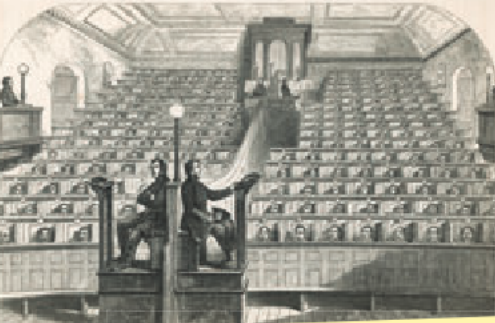
The prison chapel, completed in 1862, demonstrated the thoroughness with which the separate system was applied. Rather than allowing prisoners to worship together, the chapel was fitted with individual cubicles that prevented inmates from seeing each other even during religious services. This arrangement meant that prisoners could participate in worship while maintaining their complete isolation from fellow inmates.
The philosophy behind the separate system
The separate system was built on three core principles that shaped every aspect of prison life. Prison reformers believed this approach would be far more effective than traditional methods of punishment.
Note
The Three Core Principles of the Separate System
The reformers designed the system around three key goals that they believed would transform criminal justice:
- Rehabilitation through solitude: Isolation provided the best opportunity for deep reflexion and genuine repentance
- Retribution through isolation: Complete isolation served as appropriate psychological punishment for criminal behaviour
- Deterrence: The prospect of years of isolation would discourage others from committing crimes
The first principle was rehabilitation through solitude. Reformers argued that solitude provided prisoners with the best possible opportunity to reflect deeply on their crimes and genuinely repent for their wrongdoing. Without the negative influence of other criminals or the distractions of social interaction, inmates would be forced to confront their behaviour and hopefully emerge as reformed individuals.
The second principle was retribution through isolation. The separate system ensured that criminals would truly "pay" for their crimes through the psychological punishment of complete isolation. The boredom and loneliness of solitary confinement were considered appropriate consequences for criminal behaviour, making the punishment fit the severity of breaking society's rules.
The third principle was deterrence. The separate system was intended to be such a serious and unpleasant punishment that it would deter others from committing crimes. The prospect of years of complete isolation was designed to make potential criminals think twice before breaking the law.
Evaluation of the separate system
Strengths of the approach
The separate system at Pentonville did demonstrate several significant improvements over previous prison conditions. Most notably, the new prison was remarkably clean compared to earlier institutions, and the isolation of prisoners led to far less disease transmission. In traditional prisons where inmates lived together in overcrowded conditions, infectious diseases could spread rapidly through the entire population.
Note
Many contemporary observers felt that Pentonville provided exactly the right level of punishment - it was clearly harsh and unpleasant, serving as appropriate retribution for criminal behaviour, but it was not excessively brutal or inhumane by the standards of the time. The system appeared to offer a more civilised and scientific approach to criminal justice.
Weaknesses and unintended consequences
However, the separate system also revealed serious flaws that became apparent as the prison operated over time.
Important
Critical Problems with the Separate System
The continuous isolation had devastating consequences that reformers had not anticipated:
- Mental health crisis: Widespread psychological problems developed among prisoners
- High suicide rates: Many inmates could not cope with complete lack of human contact
- No practical preparation: The system provided no education or skills training for life after release
- Limited rehabilitation: Monotonous work developed no useful employment skills
While the theory suggested that solitary reflexion would lead to moral reformation, in practice, prisoners emerged from Pentonville no better equipped to live law-abiding lives than when they entered. The monotonous work they performed in their cells developed no useful skills for employment after release.
Timeline of key developments
- 1842: Pentonville Prison built and opened as the first model prison using the separate system
- 1844: Prison fully operational with its distinctive radial design
- 1862: Prison chapel completed with individual cubicles to maintain separation during worship
Summary
Key Points to Remember:
- Pentonville Prison (1842) introduced the "separate system" - a revolutionary approach based on complete prisoner isolation
- Physical design supported separation through individual cells, thick walls, and masked exercise areas
- Three key principles drove the system: rehabilitation through solitude, retribution through isolation, and deterrence of future crime
- Strengths included improved cleanliness and reduced disease compared to earlier prisons
- Major weaknesses were severe mental health problems, high suicide rates, and lack of practical skills training for prisoners