Conscientious objectors (Edexcel GCSE History): Revision Notes
📚Revision Notes
Conscientious objectors in modern Britain

Introduction
During the modern period of British history, the issue of conscientious objection became particularly significant during the two world wars. Conscientious objectors, often abbreviated as COs, were individuals who refused military service based on deeply held beliefs. For a brief period in the 20th century, this stance was actually considered a criminal act, highlighting how dramatically attitudes towards war service have shifted over time.
Note
The term "conscientious objector" encompasses people from various backgrounds - religious pacifists, political activists, and individuals with strong moral convictions against warfare. Their shared characteristic was the willingness to face legal consequences rather than compromise their beliefs.
What were conscientious objectors?
Conscientious objectors were people who held strong religious, moral, or political beliefs that prevented them from participating in warfare. These individuals faced a difficult moral dilemma when their country demanded military service - they had to choose between their personal convictions and their legal obligations as citizens.
The concept became particularly relevant when Britain introduced conscription laws, which legally required eligible citizens to serve in the armed forces. Anyone who was called up for service but refused to fight could potentially be charged with a crime, making their position both morally principled and legally dangerous.
Important
The introduction of conscription transformed conscientious objection from a personal choice into an act of legal defiance, with serious consequences including imprisonment and social ostracism.
Conscription laws and their impact
Conscription represented a fundamental shift in how Britain approached military recruitment. These laws mandated that all fit and healthy individuals of the appropriate age must serve in the armed forces when called upon. The introduction of conscription meant that refusing to fight was no longer simply a personal choice - it became an act of legal defiance.
Britain implemented conscription twice during this period: first during the First World War starting in 1916, and again during the Second World War beginning in April 1939 for men and extending to women in December 1941. In both cases, the law included provisions that allowed conscientious objectors to make their case before tribunals, though the treatment they received varied dramatically between the two conflicts.
Note
The inclusion of women in conscription during WWII was unprecedented in British history, reflecting the total war effort required during this conflict. This expansion meant that conscientious objection became an issue affecting both men and women.
Changing attitudes towards conscientious objectors
The way authorities and the general public treated conscientious objectors reveals much about changing social attitudes during the 20th century. While both world wars saw similar levels of public hostility towards COs, the official government response evolved significantly between the conflicts.
During both wars, many people viewed conscientious objectors with suspicion and anger. The general public often saw them as cowards or traitors who were abandoning their duty while others made the ultimate sacrifice. This hostile attitude manifested in various ways, from social shunning to physical confrontations.
However, there were notable differences in how the authorities handled conscientious objectors between the two wars, reflecting a gradual shift towards more understanding and fair treatment.
Comparison of treatment between the world wars
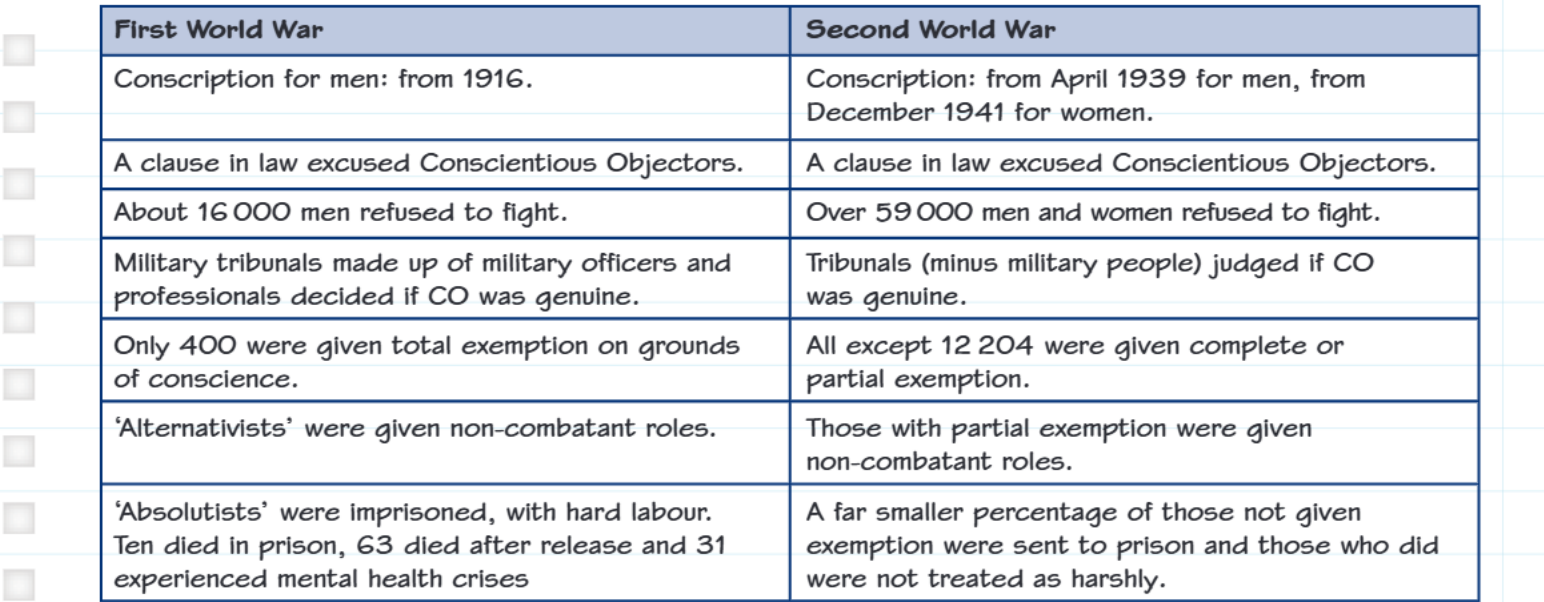
The treatment of conscientious objectors varied dramatically between the First and Second World Wars, showing a significant evolution in official attitudes and procedures.
First World War (1916 onwards)
During WWI, approximately 16,000 men refused military service after conscription began in 1916. The system established to deal with these cases proved to be quite harsh and unforgiving. Military tribunals, composed of military officers and professionals, were responsible for determining whether someone's objection was genuine.
These tribunals were notably strict in their decisions. Out of the 16,000 who refused service, only 400 individuals received complete exemption from military duties. The system recognised two main categories of objectors: 'alternativists' who were willing to serve in non-combatant roles, and 'absolutists' who refused any form of military involvement whatsoever.
Important
The treatment of absolutists was particularly severe. Those who maintained their complete refusal to participate were imprisoned and subjected to hard labour. The conditions were brutal - 10 conscientious objectors died while in prison, and 63 others died after their release. Additionally, 31 individuals experienced serious mental health crises as a result of their treatment.
Second World War (1939-1945)
The Second World War saw a markedly different approach to handling conscientious objectors. Over 59,000 men and women refused military service during this conflict - a significant increase from WWI numbers. Crucially, the tribunal system was reformed to exclude military personnel, creating what were seen as more impartial civilian tribunals.
The results of this reformed system were dramatically different. Of all those who applied for exemption, only 12,204 were refused complete or partial exemption - meaning the vast majority of applications were approved. Those who received partial exemption were still assigned to non-combatant roles, but the overall approach was far more lenient.
Note
The success rate for conscientious objector applications during WWII was approximately 80%, compared to less than 3% during WWI. This dramatic improvement reflected both better procedures and changing attitudes towards conscientious objection.
The treatment of those who weren't granted exemptions was also considerably more humane. A much smaller percentage were sent to prison, and those who were incarcerated did not face the harsh conditions experienced by their WWI counterparts.
Public attitudes and social consequences
While official treatment improved between the wars, public attitudes remained largely hostile in both conflicts. Conscientious objectors faced significant social consequences regardless of the war period.
During both conflicts, COs were frequently branded as cowards and traitors by their communities. Many experienced social ostracism, with former friends turning against them and families sometimes disowning them. Finding employment became extremely difficult, and some COs were dismissed from their jobs simply because of their stance.
Physical confrontations were not uncommon, with some COs being shouted at in the streets or even physically assaulted. The symbolic gesture of handing out white feathers - traditionally a symbol of cowardice - to young men not in military uniform became a particularly powerful form of public shaming during the First World War.
Note
The white feather campaign was organised by groups who believed that public shaming would encourage men to enlist. However, this practice often targeted men who were actually serving in civilian roles essential to the war effort or who had been medically discharged from service.
However, there were some differences between the two wars. During WWII, the press coverage was somewhat less harsh, and there were fewer organised campaigns specifically targeting conscientious objectors compared to WWI. This suggests that while individual hostility remained high, there was perhaps slightly more understanding at an institutional level.
Timeline of key events
- 1916: Conscription introduced for men in Britain during WWI; approximately 16,000 refuse service
- 1916-1918: Military tribunals handle CO cases harshly; only 400 receive total exemption
- 1918: End of WWI; severe treatment of absolutists results in deaths and mental health crises
- April 1939: Conscription reintroduced for men at start of WWII
- December 1941: Conscription extended to women
- 1939-1945: Over 59,000 refuse military service; civilian tribunals prove more lenient
- 1945: End of WWII with significantly improved treatment of COs compared to previous war
Remember!
Summary
Key Points to Remember:
- Conscientious objectors were people who refused military service due to religious, moral, or political beliefs
- Britain introduced conscription during both world wars, making refusal to serve a potential crime
- Treatment improved dramatically between WWI and WWII - from 16,000 refusals with only 400 exemptions in WWI, to 59,000 refusals with most receiving exemptions in WWII
- Military tribunals in WWI were harsh and resulted in imprisonment with hard labour for 'absolutists', while civilian tribunals in WWII were much more understanding
- Public attitudes remained hostile during both wars, with COs facing social ostracism, job loss, and physical confrontation throughout the period