Law enforcement in modern Britain (Edexcel GCSE History): Revision Notes
📚Revision Notes
Law enforcement in modern Britain
Introduction
Modern law enforcement in Britain represents a significant evolution from earlier periods, combining both community-based initiatives and professional police authority. While local communities continue to play an important role in crime prevention, it is the police force that has taken on the primary responsibility for solving and preventing criminal activity across the country.
Note
This dual approach reflects Britain's unique policing philosophy, which maintains traditional community involvement while embracing modern professional law enforcement methods.
Changes in modern policing
The nature of policing has undergone dramatic transformations since 1900, adapting to new challenges and embracing technological advances to become more effective in fighting crime.
Modernisation of police methods
One of the most visible changes has been the introduction of motorised transport for police forces. This development allows officers to respond more quickly to incidents and cover larger areas more efficiently. However, this change has also meant that fewer police officers are visible on the streets walking their beats, which some members of the public view as a negative development.
Note
The shift from foot patrols to motorised units represents a classic trade-off in modern policing - increased efficiency and response times versus reduced community visibility and personal interaction.
Armed police units
A significant development in modern British policing has been the introduction of armed police officers who carry firearms and wear military-style tactical equipment. These officers often look similar to soldiers and are deployed in situations involving serious threats to public safety.

Important
This represents a major shift from traditional British policing, where officers were historically unarmed and relied on other methods to maintain law and order. The introduction of armed units marks one of the most significant departures from the traditional British policing model.
Diversity in the police force
Modern police forces now actively recruit officers from all backgrounds and groups within society. This change reflects broader social developments and aims to create a police service that better represents the communities it serves, potentially improving relations between law enforcement and different communities.
Specialised police units
The complexity of modern crime has led to the creation of specialised police units, each focusing on particular types of criminal activity:
Note
The development of specialised units reflects how criminal activity has become increasingly sophisticated and diverse, requiring expert knowledge and dedicated resources to combat effectively.
National Crime Agency (NCA): This unit concentrates on detecting and preventing serious organised crime, including major drug trafficking operations that often span multiple countries.
Economic Crime Unit: These specialised officers investigate large-scale financial fraud cases. Officers working in this unit require extensive training and specialist knowledge of complex financial systems to understand sophisticated economic crimes.
Police Central e-crime Unit (PCeU): This unit addresses the growing problem of cybercrime, tackling the most serious online criminal activities while also working to educate the public about internet safety.
Special Branch: Each local police force maintains a Special Branch unit dedicated to preventing all forms of terrorism, reflecting the ongoing security challenges facing modern Britain.
Community-based approaches
Neighbourhood Watch
Since 1982, Neighbourhood Watch schemes have played an important role in crime prevention across British communities. These voluntary groups work to increase vigilance within neighbourhoods and provide education about crime prevention methods. The schemes also aim to reduce fear of crime among residents.

Important
The success of Neighbourhood Watch has been mixed, with some areas reporting significant improvements in community safety while others have seen limited impact. This variation highlights the importance of local community engagement and leadership in crime prevention initiatives.
The shift towards prevention
Modern policing philosophy increasingly emphasises preventing crime before it occurs, rather than simply responding after crimes have been committed. This approach recognises that stopping criminal activity before it happens is more effective than dealing with the consequences afterward.
Police Community Support Officers (PCSOs): Introduced in 2002, these officers work specifically within local communities to prevent crime. They collaborate with schools and community organisations, including Neighbourhood Watch groups, to educate residents about protecting themselves and their property.
The police also participate in the government's Prevent programme, which specifically targets extremism and radicalization, working to identify and intervene before individuals become involved in terrorist activities.
Note
This preventive approach represents a fundamental shift in policing philosophy - from reactive law enforcement to proactive community safety management.
Science and technology in law enforcement
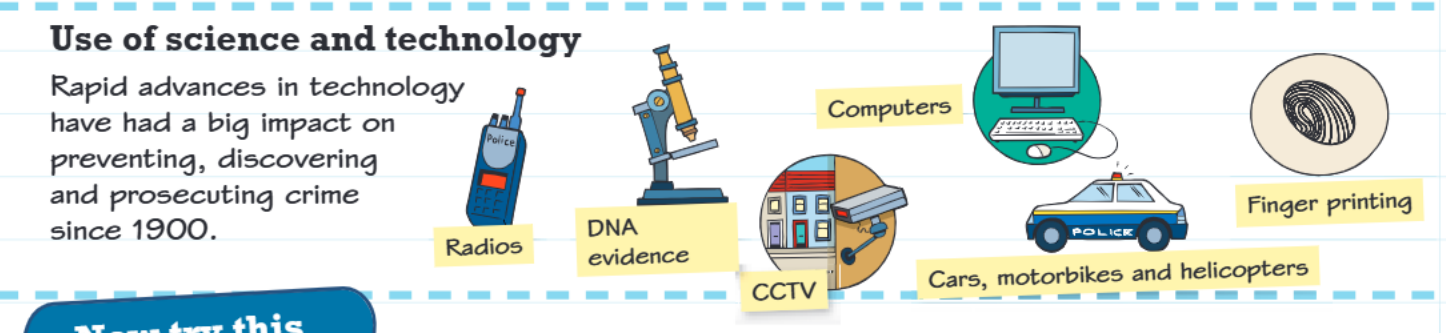
Since 1900, rapid technological advancement has revolutionised how police prevent, discover, and prosecute crimes. These developments have dramatically improved the effectiveness of law enforcement.
Key technological developments
Radio communications: Police radios transformed coordination between officers and control centres, allowing for much faster response times and better coordination of resources.
DNA evidence: The development of DNA analysis has revolutionised criminal investigations, providing scientific evidence that can definitively link suspects to crimes or exclude innocent individuals from investigations.
CCTV surveillance: Closed-circuit television systems now monitor public spaces, deterring criminal activity and providing crucial evidence for prosecutions.
Computer systems: Advanced computer databases allow police to store, search, and analyse vast amounts of information, helping to identify patterns in criminal behaviour and link related crimes.
Fingerprinting: While fingerprinting existed before 1900, modern technology has made the process much more sophisticated and reliable, creating comprehensive databases for comparison.
Enhanced transportation: Police now use cars, motorcycles, and helicopters, dramatically improving their ability to respond quickly to incidents and pursue criminals across different types of terrain.
Example
Technological Integration in Modern Investigations
A modern criminal investigation might involve:
- CCTV footage analysis to track suspect movements
- DNA collection and database comparison
- Computer system searches for criminal history patterns
- Radio coordination between multiple specialised units
- Helicopter support for pursuit operations
This integrated approach demonstrates how multiple technologies work together to solve complex crimes.
Timeline of key developments
Note
Key Milestones in Modern British Policing
These dates mark significant turning points in the evolution of British law enforcement, showing the gradual modernisation and specialisation of police services.
- 1900: Beginning of major technological advances in policing
- 1982: Introduction of Neighbourhood Watch schemes
- 2002: Police Community Support Officers (PCSOs) established
Summary
Key Points to Remember:
- Modern British law enforcement combines professional police authority with community-based crime prevention initiatives
- Specialised police units have developed to tackle specific types of modern crime, including cybercrime, terrorism, and organised crime
- The introduction of armed police represents a significant change from traditional British policing methods
- Technology has transformed every aspect of police work since 1900, from communication and transportation to evidence gathering and analysis
- Community involvement through schemes like Neighbourhood Watch and the work of PCSOs reflects a shift towards preventing crime rather than simply responding to it