The local context of Whitechapel (Edexcel GCSE History): Revision Notes
📚Revision Notes
The local context of Whitechapel
Whitechapel's challenging environment
Whitechapel was located just east of the City of London and became notorious during the late 1800s for its extremely harsh living conditions. The area suffered from widespread poverty, terrible working conditions, and overcrowded housing, creating a perfect storm that contributed to exceptionally high crime rates. Understanding these local conditions is essential for grasping why crime flourished in this part of Victorian London.
Note
The geographical position of Whitechapel made it a natural destination for the working poor, as it was close enough to London's commercial centre for employment opportunities, but far enough away to have much cheaper housing costs.
Housing conditions and overcrowding
Lodging houses and squalid conditions
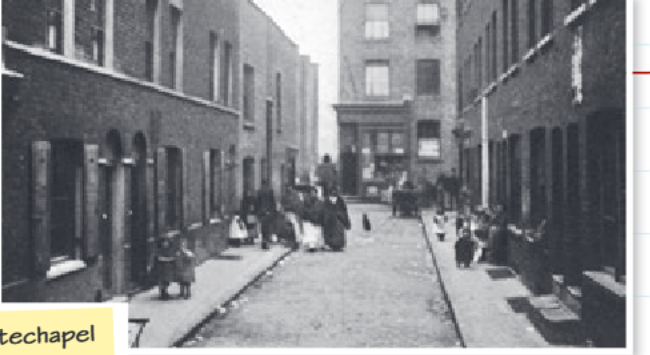
Many of Whitechapel's residents lived in lodging houses, where people paid a small nightly fee for access to a bed and basic kitchen facilities. These establishments were notoriously overcrowded and filthy, offering only the most basic shelter. The conditions were so poor that approximately one-quarter of Whitechapel's entire population was forced to rely on this type of accommodation, highlighting just how desperate the housing situation had become.
Note
Lodging houses were often the only option for casual workers, immigrants, and those unable to afford proper rent. The nightly payment system meant that residents had no security and could be turned out onto the streets if they couldn't pay.
The rookeries
The most deprived areas of Whitechapel were known as 'rookeries' - densely packed neighbourhoods where housing was extremely overcrowded and sanitation was practically non-existent. These areas became breeding grounds for disease and social problems, as families were crammed into tiny spaces without proper facilities.
Attempts at housing improvement
Despite the overwhelming problems, there were some efforts to improve living conditions. George Peabody, a wealthy philanthropist, funded the construction of 11 blocks of flats in what had previously been one of the most deprived areas. The Peabody Estate opened in 1881 and offered tenants much better accommodation at reasonable rents, representing a significant step forwards in social housing.
Example
Case Study: The Peabody Estate
The Peabody Estate demonstrated how targeted investment could transform living conditions:
- Before: Deprived rookery with overcrowded, unsanitary housing
- Investment: George Peabody funded construction of 11 modern apartment blocks
- Result: Clean, affordable housing with proper sanitation and reasonable rents
- Impact: Showed that social housing could work as an alternative to slums
Support for the most vulnerable
The workhouse system
For those who had absolutely nowhere else to turn, workhouses served as the last resort. These institutions provided basic food and shelter in exchange for hard physical labour, but conditions were deliberately made harsh to discourage people from relying on them. Families were separated upon entry, inmates had to wear uniforms, and the daily routine was designed to be unpleasant and demoralising.
Important
The workhouse system was designed around the principle of "less eligibility" - conditions had to be worse than the poorest paid work available. This meant that entering a workhouse was genuinely seen as a fate worse than death by many of the working poor.
The workhouse population consisted mainly of older people, those who were sick or disabled, orphaned children, and unmarried mothers - essentially anyone who couldn't support themselves through work.
Barnardo's homes
After 1880, conditions began to improve slightly for some of the most vulnerable residents. Dr. Barnardo established homes specifically for young orphans, providing much better living conditions than the workhouses. These homes offered children proper care, education, and a chance at a better future, though they could only help a fraction of those in need.
Environmental factors driving crime
Economic desperation and survival crimes
The connection between Whitechapel's harsh environment and high crime rates was direct and devastating. People living in extreme poverty often turned to stealing simply to survive, especially when the alternative was entering the dreaded workhouse. Low income levels and unreliable employment meant many residents faced constant hunger and homelessness.
Important
The Poverty-Crime Connection
Economic desperation created a direct pathway to criminal behaviour. When faced with starvation or homelessness, many residents viewed theft as their only viable option for survival, regardless of the legal consequences.
Unemployment and social problems
The lack of steady work created additional problems beyond poverty. People with too much time on their hands and no legitimate income often turned to alcohol, which led to disruptive behaviour and violence. The stress of unemployment and poverty created a cycle of social breakdown that was difficult to escape.
Overcrowding and social tensions
The extremely overcrowded conditions in Whitechapel's housing created constant friction between residents. Tensions were particularly high between local-born inhabitants and immigrant communities, especially Irish and Jewish migrants. These conflicts frequently turned violent, adding to the area's reputation for lawlessness.
Note
Immigration patterns in the late 19th century brought waves of people fleeing poverty and persecution from Ireland and Eastern Europe. Competition for jobs and housing in an already strained area created significant social tensions.
Vulnerable populations and exploitation
High levels of prostitution in Whitechapel often represented a desperate means of survival for women with no other options. This made them extremely vulnerable to violence, including sexual assault and rape. The dangerous streets and lack of police protection meant these crimes often went unpunished.
Political radicals and revolutionaries
Whitechapel also attracted political revolutionaries from across Europe, including socialists and anarchists who opposed organised government. While not all were violent, their presence added to the sense that Whitechapel was a place where normal social rules didn't apply.
Timeline of key developments
- c1870-1900: Period of extreme poverty and high crime in Whitechapel
- 1880: Improvements begin for orphaned children with expansion of Barnardo's homes
- 1881: Peabody Estate opens, providing better quality housing at reasonable rents
Remember!
Summary
Key Points to Remember:
- Whitechapel's location east of the City of London made it a hub for the working poor with limited opportunities for improvement
- Around 25% of residents lived in squalid lodging houses, while the worst areas (rookeries) had virtually no sanitation
- The workhouse system deliberately created harsh conditions to discourage reliance, affecting the most vulnerable members of society
- Crime was directly linked to economic desperation, with theft and assault being common survival strategies
- Social tensions between different communities, combined with overcrowding and unemployment, created a volatile environment where violence flourished