The Metropolitan Police (Edexcel GCSE History): Revision Notes
📚Revision Notes
The Metropolitan Police
Introduction
The Metropolitan Police Force, commonly known as the 'Met', was established as Britain's first professional police force. Unlike local constabularies, the Met operated under direct government control and was responsible for policing the entire London area, except for the separate City of London which maintained its own police force.
Note
The Metropolitan Police's jurisdiction covered all of London except the City of London, which had its own separate police force. This meant that major investigations often required cooperation between the two forces when crimes crossed these boundaries.
The national and regional context
The Metropolitan Police represented a significant shift in how law and order was maintained in Britain's capital. As a government-directed organisation, the Met needed to work closely with the City of London police force when crimes crossed jurisdictional boundaries. This cooperation became particularly important during major investigations that affected multiple areas of London.
The Home Secretary directly controlled the Met, appointing a commissioner to oversee daily operations. This centralised approach differed from many other police forces across Britain, which often had more local control. However, there were concerns that socialist members of the London County Council might try to influence the Met's operations, leading the government to maintain tight control over the force.
Important
The government maintained strict control over the Metropolitan Police specifically because they feared that socialist members of the London County Council might try to influence police operations if given any local authority over the force.
Police recruitment and composition
The Met's recruitment patterns revealed interesting social and geographical trends during this period. Most new police officers came from outside London, drawn by the relatively attractive pay that the position offered. This external recruitment meant that many officers were unfamiliar with local London communities and customs when they began their duties.
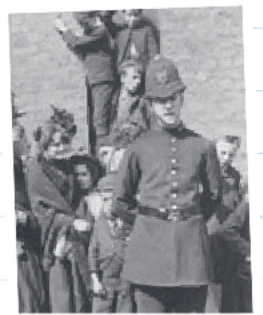
The force included officers from diverse backgrounds, though some common patterns emerged. Many recruits had previously worked as soldiers, bringing military discipline and training to police work. However, the majority came from civilian occupations, particularly labouring or farm work. This background sometimes created challenges, as officers occasionally struggled with problems like absenteeism and drinking while on duty.
By 1885, the Metropolitan Police had grown to 13,319 officers serving a population of over five million people. However, this meant that only 1,383 officers were typically on duty at any given time, highlighting the significant challenge of maintaining order across such a large urban area with relatively limited manpower.
Note
The ratio of police to population was extremely challenging - with only about 1 in 10 officers on duty at any given time, the Met had to cover over 5 million people with fewer than 1,400 active officers during each shift.
Development of the Criminal Investigation Department
The Criminal Investigation Department (CID) was established within the Met in 1878, marking an important evolution in police work. Before this development, there had been some detective work within the force, but it was relatively disorganised and often ineffective.
The creation of the CID brought greater clarity to police roles and responsibilities. While the CID focused specifically on detecting and investigating crimes that had already occurred, the rest of the police force concentrated on preventing crime and maintaining public order. This division of labour was designed to improve the overall effectiveness of law enforcement in London.
Initially, however, the CID achieved limited success. The department struggled to solve major crimes, as demonstrated by its investigation into the murders committed by the notorious serial killer known as 'Jack the Ripper' in Whitechapel during 1888. These failures highlighted the challenges facing early detective work and the need for better investigative techniques and training.
Important
Despite being created to improve crime detection, the CID's early years were marked by significant failures, most notably their inability to solve the Jack the Ripper murders, which severely damaged public confidence in police investigative capabilities.
Leadership under Commissioner Sir Charles Warren
Sir Charles Warren's appointment as Metropolitan Police Commissioner in 1886 brought military-style leadership to the force. Warren, a former army general, implemented strict disciplinary measures and took a hardline approach to public order situations.
Warren's leadership style became particularly controversial during his handling of unemployment protests. In November 1887, he banned a planned unemployment demonstration in Trafalgar Square. When protesters defied this ban on November 13th, Warren deployed thousands of police officers, supported by hundreds of troops and cavalry. The resulting confrontation was violent - many protesters were injured and one later died from their wounds. Warren directed the entire operation from horseback, demonstrating his hands-on but militaristic approach to policing.
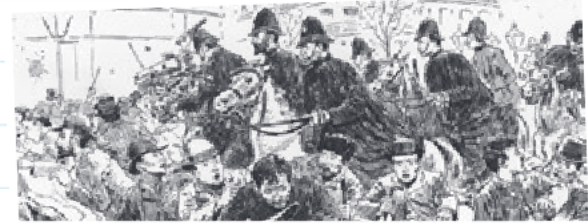
The aftermath of this incident, which became known as 'Bloody Sunday', significantly damaged Warren's reputation and the Met's relationship with working-class communities. The brutal response to what many saw as legitimate protest created lasting resentment towards the police.
Warren's difficulties continued with the Jack the Ripper murders in Whitechapel during 1888. Despite ordering increased patrols and dedicating significant resources to catching the murderer, the investigation failed completely. This failure ultimately cost Warren his position, as public confidence in his leadership collapsed.
Important
Warren's military background and authoritarian approach to policing created two major crises: the violent Bloody Sunday riot in 1887 and the failure to catch Jack the Ripper in 1888. These failures ultimately led to his resignation and severely damaged police-community relations.
Public attitudes towards the police
Attitudes towards the Metropolitan Police varied significantly across different social classes and geographical areas during this period. The police generally enjoyed more support and trust among middle and upper-class communities, who saw them as protectors of property and social order.
However, working-class attitudes were much more complex and often hostile. Many working-class people viewed the police as representatives of the establishment who worked primarily to serve the interests of the wealthy rather than ordinary citizens. Events like the Trafalgar Square riot of 1887 reinforced these negative perceptions, as working-class communities witnessed police violence against protesters demanding better economic conditions.
The economic depression and widespread poverty of the period contributed significantly to this distrust. When people were struggling to survive, they often saw the police as enforcers of an unfair system rather than protectors of their communities. This tension was particularly acute in areas like Whitechapel, where poverty was extreme and residents felt abandoned by authorities.
Note
The sharp divide in public opinion reflected broader social class tensions of the period. While the wealthy saw police as protectors of their interests, the working class often viewed them as oppressors enforcing an unfair social system.
Major challenges faced by the Metropolitan Police
The Metropolitan Police encountered numerous significant problems during the 1870-1900 period that tested their effectiveness and public credibility. These challenges included:
Manpower shortages: With only about 1,400 officers on duty at any time to cover over five million people, the force was severely understaffed for effective policing of London.
Public order problems: Large-scale protests, particularly those related to unemployment and economic hardship, required massive police responses that often resulted in violence and negative publicity.
Serious crime investigation failures: The inability to solve high-profile cases like the Jack the Ripper murders exposed weaknesses in detective work and criminal investigation techniques.
Social and class tensions: The force struggled to maintain legitimacy among working-class communities while serving the interests of middle and upper-class society, creating ongoing conflicts about the police's role and priorities.
Timeline of key events
- 1878: Criminal Investigation Department (CID) established within the Metropolitan Police
- 1886: Sir Charles Warren appointed as Metropolitan Police Commissioner
- 13 November 1887: Trafalgar Square riot (Bloody Sunday) - police and military clash violently with unemployment protesters
- 1888: Jack the Ripper murders terrorise Whitechapel; Met investigation fails to identify or catch the killer
- 1888: Warren resigns as Commissioner following criticism over handling of major incidents
Summary
Key Points to Remember:
- The Metropolitan Police was a government-controlled force covering London except the City, requiring cooperation across jurisdictions
- Most officers were recruited from outside London and came from working-class backgrounds, often former soldiers or labourers
- The CID was created in 1878 to improve detective work but initially struggled with major investigations like Jack the Ripper
- Commissioner Warren's military approach led to violent confrontations, particularly the Bloody Sunday riot in 1887
- Working-class communities often distrusted the police, seeing them as protectors of the wealthy rather than ordinary people