Whitechapel's inhabitants (Edexcel GCSE History): Revision Notes
📚Revision Notes
Whitechapel's inhabitants, c1870-c1900
Introduction to Whitechapel's population
During the late Victorian period, c1870-c1900, Whitechapel experienced constant population changes that shaped its character as one of London's most notorious districts. The area attracted a diverse mix of people, including temporary residents and migrants from Ireland and Eastern Europe. This ever-changing population created a complex social environment where different communities struggled to establish themselves while facing significant economic and social challenges.
The temporary nature of much of Whitechapel's housing meant that many residents lived in lodging houses and pubs, creating little sense of permanent community. This constant movement of people contributed to the area's reputation for instability and social problems.
Note
The transient nature of Whitechapel's population was a defining characteristic that distinguished it from more stable working-class areas of London. This constant turnover made it difficult to establish lasting community networks or support systems.
Irish migrants and their experiences
Irish migration to Whitechapel occurred primarily as a result of economic hardship in Ireland. During the 1840s, many Irish people had originally planned to emigrate to America but lacked the resources to complete the journey, instead settling in London's cheapest areas like Whitechapel.
The economic circumstances of Irish migrants forced them into specific types of work. Most found employment as navvies, which involved the physically demanding job of building roads, railways, and canals. Others worked as dockers in the nearby London docks. These occupations were often dangerous and poorly paid, but they were among the few opportunities available to unskilled workers.
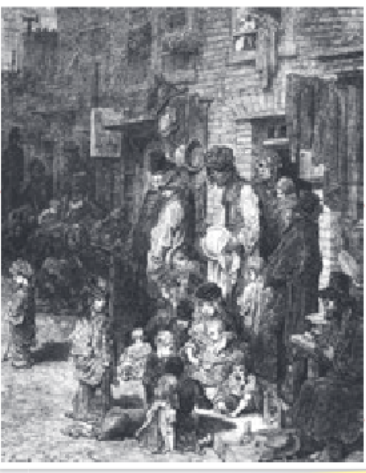
Irish migrants in Whitechapel faced significant prejudice and stereotyping from the wider community. They developed a reputation for being drunk and violent, which, whether accurate or not, made their integration into London society more difficult. The situation became even more complicated due to political tensions surrounding Irish independence.
Important
The Fenians, who were Irish activists fighting for independence from British rule, were viewed by many as dangerous terrorists. Although most Irish migrants in Whitechapel had no connection to the Fenian movement, they were often unfairly associated with these political activities, making their already difficult lives even harder and increasing suspicion against the entire Irish community.
Eastern European migrants and community formation
The 1880s saw a significant influx of Eastern European migrants, predominantly Russian and Polish Jews, who came to Whitechapel seeking refuge from persecution. This migration was largely triggered by the assassination of Tsar Alexander II in 1881, after which antisemitic violence and persecution intensified dramatically throughout the Russian Empire.
These new arrivals faced severe economic constraints that limited their housing options to the cheapest parts of London. Like other migrant groups, poverty determined where they could afford to live, concentrating them in areas like Whitechapel where accommodation was most affordable.
Note
Eastern European Jewish migrants developed distinctive settlement patterns, tending to cluster together within specific streets and areas. This clustering occurred for several practical and cultural reasons: it provided mutual support, helped maintain religious and cultural practices, and offered some protection against the prejudice they faced from other residents.
By 1888, this concentration had become so pronounced that some parts of Whitechapel had a 95% Jewish population. This remarkable demographic shift transformed entire neighbourhoods and created distinct cultural enclaves within the broader Whitechapel area.
Employment challenges and economic hardship
Whitechapel's inhabitants faced severe employment difficulties during this period, largely due to an ongoing economic depression that created widespread unemployment. The limited job opportunities available often came with exploitative conditions and inadequate pay.
Those fortunate enough to find work typically encountered two main types of employment. Factory work in the "sweated" trades involved long hours for minimal pay in cramped and unsanitary conditions. These sweatshops became notorious for their poor working environment and exploitation of workers who had few alternatives.
Construction and dock work offered another employment option, particularly building railways and working in the dockyards. While the pay could be marginally better than factory work, these jobs were unreliable, with the number of workers needed varying constantly. This meant that weekly incomes fluctuated dramatically, making it impossible for families to plan their finances or achieve any sense of security.
Important
For women, employment opportunities were even more limited, and the economic desperation became so severe that many were forced into prostitution simply to survive. This stark reality highlighted the depth of poverty and lack of legitimate opportunities available to Whitechapel's most vulnerable residents.
Social tensions and their underlying causes
The constant changes in Whitechapel's population created numerous sources of tension and conflict between different groups of residents. These tensions were not simply the result of cultural differences but were rooted in practical competition for scarce resources.
Competition for housing and employment created friction between established residents and new migrants. Local-born inhabitants often viewed newcomers as threats to their already limited opportunities, leading to resentment and hostility between communities.
The situation was particularly complex regarding Jewish migrants, who were often willing to accept lower wages and longer working hours in sweatshops out of desperation. While this willingness to work under poor conditions was driven by necessity, other workers and business owners unfairly blamed Jewish people for driving down wages and working conditions for everyone else.
Cultural misunderstandings further complicated these economic tensions. Unfamiliar customs, religions, and languages created barriers between different communities and fuelled prejudice. The rise of antisemitism became particularly pronounced, with violence against Jewish residents increasing rapidly during this period.
Important
The atmosphere of suspicion was so intense that anyone with an unfamiliar accent might be suspected of being a dangerous revolutionary. This paranoia was exacerbated when migrants were blamed, without any evidence, for serious crimes such as the infamous "Ripper" murders. Such scapegoating increased racial hatred and violence, creating a cycle where fear and prejudice reinforced each other.
Timeline of key events
- 1840s: Irish migrants originally intended for America settle in London instead
- 1881: Assassination of Tsar Alexander II triggers increased persecution of Jews in Russian Empire
- 1880s: Large-scale migration of Eastern European Jews to Whitechapel begins
- 1888: Some areas of Whitechapel reach 95% Jewish population
- Late 1880s: "Ripper" murders intensify scapegoating of migrant communities
Summary
Key Points to Remember:
- Whitechapel's population was constantly changing, with temporary residents and migrants from Ireland and Eastern Europe creating a diverse but unstable community
- Economic hardship forced Irish migrants into dangerous, low-paid work as navvies and dockers, while they faced prejudice due to unfair association with Irish independence movements
- Eastern European Jewish migrants fled persecution after 1881 and clustered together in Whitechapel for cultural, practical, and protective reasons, with some areas becoming 95% Jewish by 1888
- Limited employment opportunities led to exploitation in sweatshops and unreliable dock work, with many women forced into prostitution to survive
- Social tensions arose from competition for jobs and housing, cultural misunderstandings, and scapegoating of migrants for local problems, including serious crimes like the "Ripper" murders