The 'problem' of the poor (Edexcel GCSE History): Revision Notes
📚Revision Notes
The 'problem' of the poor
During Elizabeth I's reign (1558-1588), poverty became an increasingly serious issue that concerned both local communities and the government. Understanding what constituted poverty during this period and who was affected helps explain why it was seen as such a significant 'problem' by Elizabethan society.
Note
The issue of poverty during Elizabeth I's reign was not just a social concern but became a matter of national importance, requiring government intervention and new legislation to address the growing crisis.
What defined poverty in Elizabethan England?
Poverty during Elizabeth's reign was characterised by specific economic hardships that made basic survival difficult. The Elizabethan understanding of poverty was quite practical and focused on people's ability to meet their most basic needs.
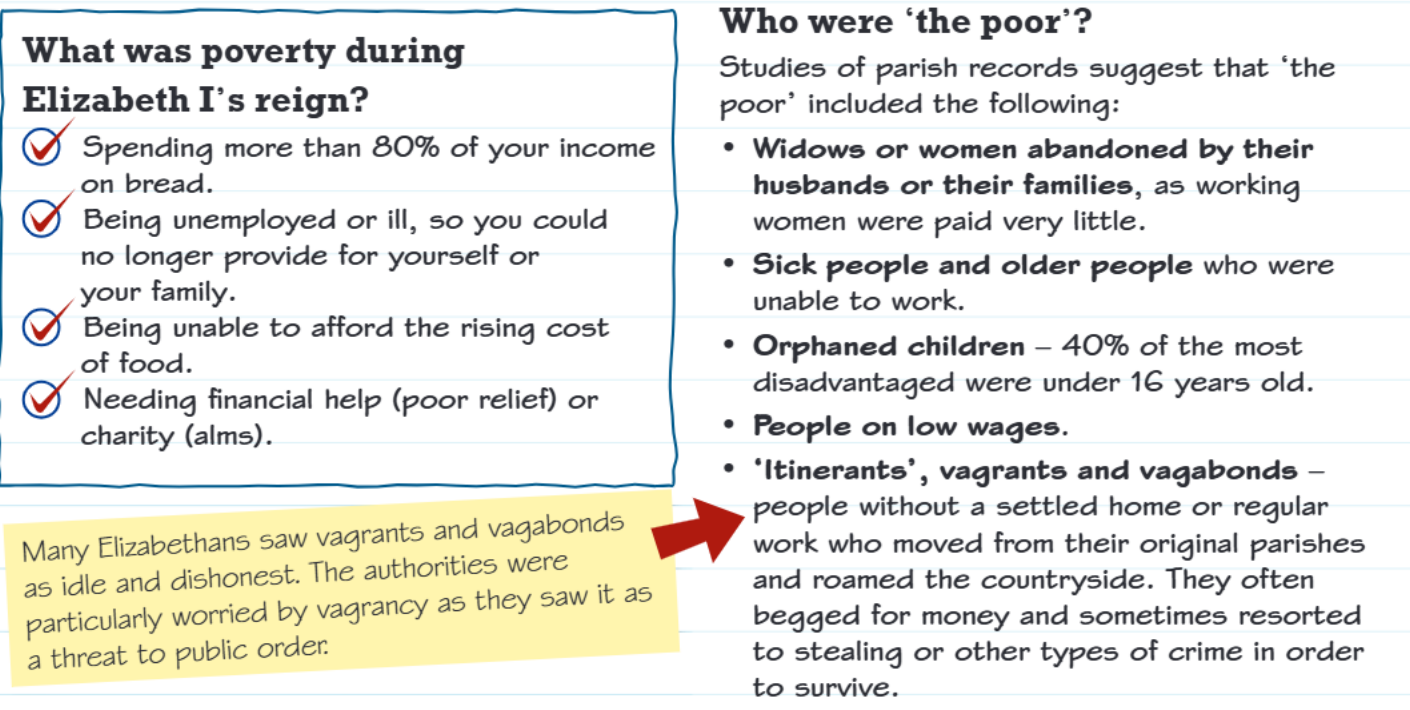
People were considered poor if they found themselves spending more than four-fifths of their income just on bread, which was the most essential food item. This left virtually nothing for other necessities like clothing, shelter repairs, or fuel. Additionally, those who became unemployed or too ill to work faced immediate poverty since there were no state benefits or social safety nets as we know them today.
The rising cost of food presented another major challenge. When food prices increased faster than wages, many working people found themselves unable to afford adequate nutrition. This forced them to seek financial assistance through poor relief systems or charitable donations from wealthier community members.
Important
The harsh reality of Elizabethan poverty meant that spending over 80% of income on bread alone left families with no resources for housing, clothing, fuel, or medical care - making survival extremely precarious.
Who were 'the poor'?
Elizabethan society included several distinct groups among 'the poor', each facing different challenges that led to their impoverished state.
Widows and women who had been abandoned by their husbands or families formed a significant portion of the poor. Since women were generally paid much less than men for work, and had fewer employment opportunities, losing male financial support often meant immediate poverty.
Sick and elderly people who could no longer work represented another vulnerable group. Without the ability to earn wages and with no pension systems in place, age and illness frequently led directly to destitution.
Orphaned children were particularly disadvantaged, with studies of parish records revealing that about 40% of the most disadvantaged people were under 16 years old. These children had no family support and limited ways to earn money for basic survival.
People earning very low wages also struggled with poverty, even when employed. Many jobs paid so little that workers could barely afford food, let alone other necessities.
Perhaps most concerning to authorities were the 'itinerants', vagrants, and vagabonds - people without settled homes who moved around the countryside seeking work or begging for survival. These groups often resorted to stealing or other crimes when desperate, which made them seem particularly threatening to public order and social stability.
Note
The diversity of people affected by poverty - from widows and orphans to the elderly and working poor - shows that poverty in Elizabethan England was not limited to one particular group but affected people across different circumstances and ages.
Causes of increased poverty
Population growth and its consequences
One of the fundamental causes behind increasing poverty was England's rapidly growing population. The country's population expanded from approximately 3 million people in 1551 to 4.2 million by 1601, representing a significant increase in just fifty years.
This population growth created intense pressure on available resources and employment opportunities. More people meant greater demand for food, which drove up prices, while simultaneously increasing the supply of workers, which tended to keep wages low. Many people found they could no longer provide adequately for themselves or their families under these changing conditions.
The growth of towns, particularly London and Norwich, contributed to rising living costs. As urban areas expanded, rent prices increased, while food had to be transported in from rural areas, making it more expensive. This urban growth put additional strain on those with limited incomes.
Agricultural problems and bad harvests
Elizabethan England experienced several devastating harvest failures that contributed significantly to poverty and suffering. Bad harvests occurred in 1562, 1565, 1573, and 1586, hitting subsistence farmers particularly hard.
These harvest failures meant that people who normally grew just enough food for their families suddenly faced starvation. Poor harvests also reduced the overall food supply, driving up prices throughout the country. This created a double burden - less food available and higher costs for what remained.
Subsistence farmers who lost their crops often had no choice but to leave their land and seek help elsewhere, sometimes joining the ranks of the wandering poor that so concerned the authorities.
Important
The Cycle of Harvest Failure: Poor harvests created a devastating cycle - reduced food supply led to higher prices, while farmers who lost crops had less money to buy food at these inflated prices, forcing many into destitution and vagrancy.
Economic disruption and trade problems
Economic recessions caused by international trade disputes created unemployment and hardship for many English workers. Trade embargoes, such as those involving Spain and the Netherlands, disrupted normal commercial activities and left many people without work.
These economic disruptions particularly affected craftspeople, merchants, and workers in industries dependent on international trade. When trade routes were blocked or restricted, entire communities could find themselves without their usual sources of income.
Enclosure and changes in farming
The practice of enclosure - dividing common land into private fields for more intensive farming - contributed significantly to rural poverty. Landowners increasingly converted arable farming land into sheep pasture because wool production was more profitable than growing food crops.
This change in land use had serious consequences for rural communities. Sheep farming required fewer workers than traditional crop farming, so many agricultural labourers lost their jobs. Additionally, when common lands were enclosed, ordinary people lost their traditional rights to graze animals or gather fuel, removing important resources for survival.
Many farmers who had worked the same land for generations found themselves displaced, with nowhere to live or work. These people were forced to become 'itinerants' and vagrants, travelling in search of employment or charity.
Note
Enclosure represented a fundamental shift in English agriculture that prioritised profit over traditional community rights, creating a new class of displaced rural poor who had to seek survival elsewhere.
Loss of monastic support
The dissolution of monasteries under Henry VIII in the 1530s removed an important source of help for the most disadvantaged members of society. Before their closure, monasteries had provided food, shelter, and care for the poor, sick, and elderly.
After the monasteries were dissolved, there was no immediate replacement for this charitable support system. This left many vulnerable people without the assistance they had traditionally relied upon, forcing them to seek help elsewhere or face destitution.
The loss of monastic support was particularly significant because it had been a reliable, organised form of poor relief that operated across the country. Without this network, local communities struggled to cope with increasing numbers of people in need.
The threat of vagrancy
Elizabethan authorities viewed vagrants and vagabonds with particular suspicion and concern. These wandering poor were seen as potentially idle and dishonest, with officials worrying that they threatened public order and social stability.
The authorities' fear was not entirely unfounded - when people became desperate for survival, some did turn to stealing or other criminal activities. However, this created a cycle where people who were already suffering from poverty and displacement were further marginalised and criminalised by society.
Many Elizabethans saw vagrancy as particularly threatening because it challenged the idea that everyone should have a fixed place in society. The sight of people wandering without homes or regular work suggested a breakdown in the traditional social order that made authorities deeply uncomfortable.
Important
The Criminalization Cycle: Vagrancy created a vicious cycle - poverty forced people to wander seeking work or charity, but this wandering was seen as criminal behaviour, making it even harder for these people to find legitimate help or employment.
Summary
Key Points to Remember:
-
Poverty was defined practically - spending over 80% of income on bread alone, being unable to work, or needing charity to survive
-
Multiple vulnerable groups existed - widows, orphans (40% of the most disadvantaged were under 16), the sick and elderly, and low-wage workers all struggled with poverty
-
Population growth intensified the problem - England's population grew from 3 million (1551) to 4.2 million (1601), increasing competition for resources and jobs
-
Economic and agricultural disruptions were major causes - bad harvests in 1562, 1565, 1573, and 1586, plus trade embargoes, created widespread hardship
-
Vagrancy was seen as a threat to social order - authorities particularly feared wandering poor people who might turn to crime, viewing them as dangerous to public stability