Causes of the Third Crusade (Edexcel GCSE History): Revision Notes
📚Revision Notes
Causes of the Third Crusade
What was a crusade?
A crusade was a holy war fought between Christians and Muslims for control of the Holy Land during the mediaeval period. The Holy Land referred to the area of the Middle East connected to Jesus Christ, including parts of what are now Israel, Jordan, Syria, Lebanon and the Palestinian territories.
Note
The Holy Land held immense religious significance for both Christians and Muslims, as it contained Jerusalem and other sites sacred to both faiths. This shared reverence for the same geographical area was a fundamental source of conflict during the mediaeval period.
The concept of crusading began when Muslim Seljuk Turks gained control of the Holy Land, which had previously been part of the Christian Byzantine Empire. By 1095, the Pope claimed that Muslims were persecuting Christians living in these territories and preventing them from visiting Jerusalem. This led to appeals for Christians across Europe to join a crusade to travel to the Holy Land and win back control from the Seljuk Turks.
The First Crusade was successful - thousands of European knights travelled to the Holy Land and captured territory that became known as 'crusader states', including the important city of Jerusalem. However, many Muslims and Jews were killed during this conquest.
Religious motivation: indulgences
The Church offered powerful religious incentives to encourage participation in crusades. Pope Urban II, and later Pope Gregory VIII, promised Christians who joined crusades a full indulgence.
Important
Understanding Indulgences
A full indulgence meant complete forgiveness for sins committed on Earth and immediate entry to heaven after death, bypassing the usual time spent in purgatory for purification. This was an extraordinarily powerful promise in mediaeval Christian society, where fear of damnation and purgatory dominated religious thinking.
The Church regularly sold indulgences to people worried about reducing their punishment for sins, making this offer particularly appealing to mediaeval Christians.
The five key causes leading to the Third Crusade
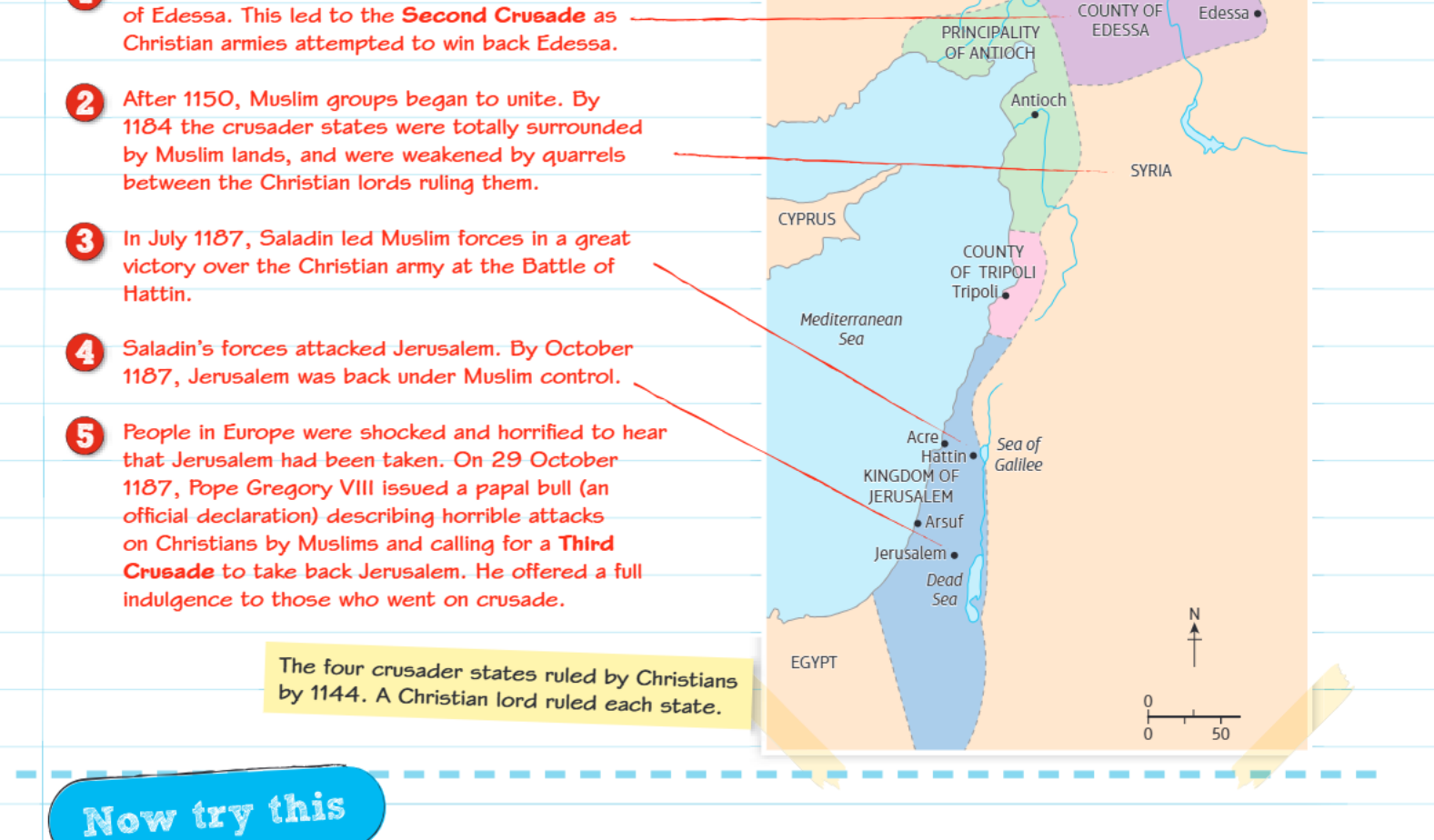
The Third Crusade became necessary due to a series of events between 1144 and 1187 that saw Muslim forces regain control of the Holy Land:
1. The fall of Edessa (1144)
In 1144, Muslim forces recaptured parts of Edessa, one of the four crusader states established after the First Crusade. This loss prompted the Second Crusade as Christian armies attempted to win back the territory, but they were unsuccessful.
2. Muslim unification (after 1150)
Following 1150, various Muslim groups began to unite under strong leadership. By 1164, the remaining crusader states found themselves completely surrounded by Muslim territories, significantly weakening their defensive position. The crusader states were now isolated and vulnerable, with quarrels between the Christian lords who ruled them further reducing their effectiveness.
3. The Battle of Hattin (July 1187)
In July 1187, the Muslim leader Saladin achieved a decisive victory over Christian forces at the Battle of Hattin. This crushing defeat severely weakened Christian military power in the region and opened the way for Saladin to recapture key territories.
Example
The Significance of Hattin
The Battle of Hattin was particularly devastating because Saladin managed to capture most of the Christian nobility and military leaders, including Guy of Lusignan (King of Jerusalem) and Reynald of Châtillon. This single battle effectively eliminated the organised Christian military presence in the region, leaving the crusader states defenceless.
4. The recapture of Jerusalem (October 1187)
Following his victory at Hattin, Saladin's forces attacked and successfully recaptured Jerusalem in October 1187. The loss of Christianity's most holy city sent shockwaves throughout Europe and represented the most significant blow to Christian control of the Holy Land since the First Crusade.
5. Pope Gregory VIII calls for crusade (29 October 1187)
People across Europe were shocked and horrified to learn that Jerusalem had fallen back under Muslim control. On 29 October 1187, Pope Gregory VIII issued a papal bull (an official declaration) describing the terrible attacks on Christians by Muslims and calling for a Third Crusade to recapture Jerusalem. He offered full indulgences to anyone who participated in this holy war.
Note
The speed of Pope Gregory VIII's response demonstrates how significant the loss of Jerusalem was to mediaeval Christian society. The papal bull was issued just days after news of Jerusalem's fall reached Rome, showing the urgency felt by Church leadership.
Timeline of major events
- 1095: First Crusade begins
- 1099: Jerusalem captured by Christian forces
- 1144: Fall of Edessa to Muslim forces
- 1147-1149: Second Crusade (unsuccessful)
- After 1150: Muslim groups begin unifying
- 1164: Crusader states surrounded by Muslim territory
- July 1187: Battle of Hattin - decisive Muslim victory
- October 1187: Saladin recaptures Jerusalem
- 29 October 1187: Pope Gregory VIII calls for Third Crusade
- 1189-1192: Third Crusade takes place
Summary
Key Points to Remember:
- The Third Crusade was caused by the gradual loss of Christian territory in the Holy Land between 1144-1187
- Saladin's unification of Muslim forces and victories at Hattin and Jerusalem were the immediate triggers for the crusade
- The fall of Jerusalem in October 1187 shocked Christian Europe and prompted Pope Gregory VIII's call for a new holy war
- Religious incentives like full indulgences motivated Christians to participate in dangerous and expensive crusading expeditions
- The four crusader states (Edessa, Antioch, Tripoli, and Jerusalem) had become increasingly isolated and vulnerable by the 1180s