Rural medieval England (Edexcel GCSE History): Revision Notes
📚Revision Notes
Rural mediaeval England
Introduction to mediaeval life
During the mediaeval period (1189-1216), England was primarily a farming-based society where the vast majority of people lived in rural areas rather than towns. This agricultural way of life was organised around a system called the manorial system, which shaped how people lived, worked, and interacted with one another.
The average person's life expectancy was quite short during this time, and most people spent their entire lives working on the land within small village communities. Understanding how this rural society functioned helps us see how ordinary people lived during the reigns of Richard I and John.
Note
Life expectancy during this period was dramatically shorter than today, with most people living only to their 30s or 40s due to disease, poor nutrition, and harsh working conditions.
The manorial system
The foundation of rural mediaeval England was the manor - a large estate that included farmland, a village, and various buildings. Each manor was controlled by a lord who could be a baron, lesser noble, or knight. The lord either held his land directly from the king or as an under-tenant from a more powerful noble.
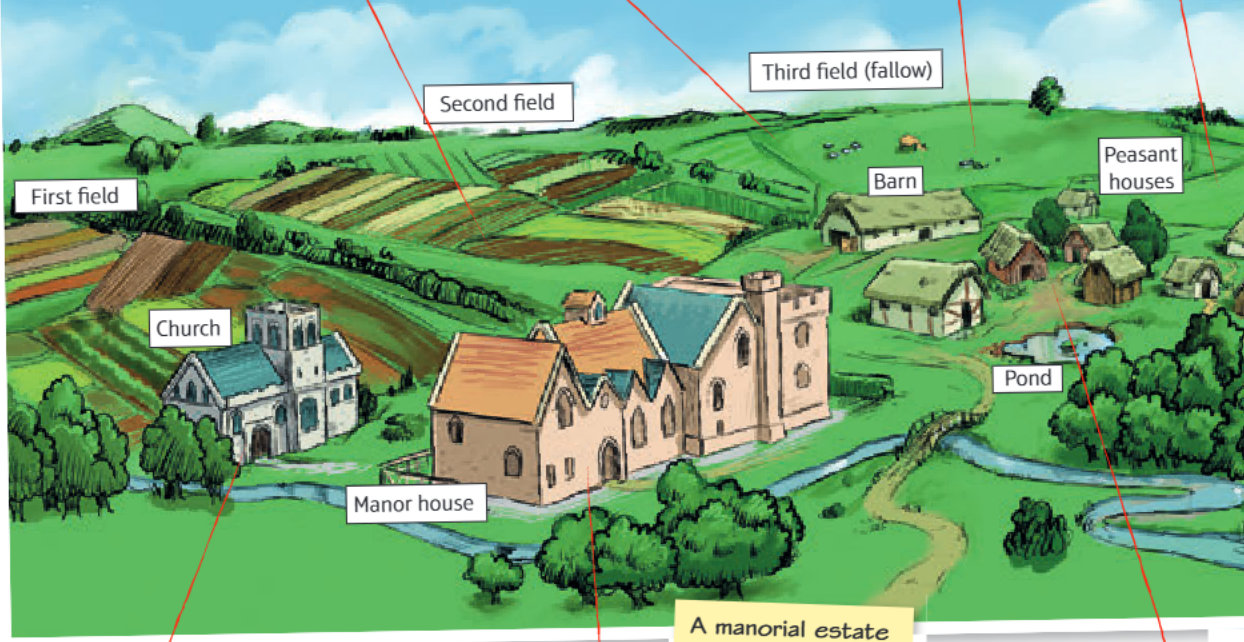
The manorial estate was carefully organised with distinct areas serving different purposes. At the centre stood the impressive manor house where the lord and his family lived. Nearby was the village church, which played a central role in community life. The lord's administrative building, called a bailiff's house, helped manage the estate's daily operations.
Surrounding these central buildings were the peasant houses, arranged throughout the village area. These humble dwellings were quite different from the grand manor house, reflecting the clear social divisions of mediaeval society.
Note
The physical layout of a manor wasn't random - it was carefully designed to demonstrate social hierarchy and ensure efficient agricultural production. The lord's house dominated the landscape, while peasant dwellings were clustered for easy supervision.
The three-field farming system
Mediaeval agriculture relied on a clever farming technique called the three-field system, which helped maintain soil fertility and ensure consistent food production. The farmland around each manor was divided into three large fields, each serving a specific purpose in the agricultural cycle.
In any given year, the first field would be planted with a crop like wheat or barley. The second field might grow a different crop such as oats, which was particularly important for feeding horses and other livestock. The third field was deliberately left fallow, meaning no crops were planted there at all.
This fallow period was crucial because it allowed the soil to rest and recover its nutrients. After a year or two, the crops would rotate to different fields, ensuring that each piece of land had time to restore its fertility. This system helped prevent the soil from becoming completely exhausted, which would have led to crop failures and famine.
Example
Worked Example: Three-Field Rotation Cycle
Year 1:
- Field A: Wheat
- Field B: Oats
- Field C: Fallow (resting)
Year 2:
- Field A: Fallow (resting)
- Field B: Wheat
- Field C: Oats
Year 3:
- Field A: Oats
- Field B: Fallow (resting)
- Field C: Wheat
This rotation continued indefinitely, ensuring each field had regular rest periods.
Daily life and working conditions
Life for mediaeval peasants was extremely demanding, with work beginning at dawn and continuing until dusk. The seasonal nature of farming meant that different times of year brought different challenges and tasks. During planting and harvest seasons, the entire community would be mobilised to ensure crops were properly tended and gathered.
Peasant families typically lived in simple one-room houses built with basic materials. These homes had thatched roofs made from straw or reeds, and walls constructed from wattle-and-daub - a mixture of wooden strips and clay. Unlike the stone manor house, these dwellings offered basic shelter but little comfort or privacy.
Everyone in a peasant household, including women and children, was expected to contribute to the agricultural work. This might include planting seeds, tending crops, harvesting grain, or caring for livestock. The physical demands were enormous, and there was little time for rest or leisure activities.
Important
The harsh working conditions meant that peasant families had no choice but to involve every family member, including young children, in agricultural labour. There was no concept of childhood as a protected period of education and play as we understand it today.
Animals and food production
Livestock played a vital role in sustaining mediaeval rural communities. Peasants kept various animals including cows, sheep, and pigs, which provided both food and essential materials for daily life. These animals were valuable resources that needed careful management throughout the year.
During daylight hours, animals would graze on common land around the village or in designated areas. However, at night they were brought into barns or even into peasants' houses for protection from wolves, thieves, and harsh weather. This practice also helped ensure that valuable livestock wouldn't wander off or be stolen.
Wool from sheep was particularly profitable and could be traded in towns for other necessities. The animals also provided leather, milk, eggs, and meat, making them essential for survival. Proper animal care was a skill that every peasant family needed to master.
Note
Animals were so valuable that peasants often shared their living space with livestock during harsh winters. This arrangement provided mutual warmth and protection, though it also meant living in unsanitary conditions by modern standards.
Social hierarchy and obligations
The manorial system created a clear social hierarchy with specific obligations for each level. At the top was the lord of the manor, who owned the land and had significant power over the peasants living there. Below him were different categories of peasants, each with varying degrees of freedom and responsibility.
Most peasants were either villeins or serfs, meaning they were not free to leave the manor without permission. They had to work on the lord's land for a certain number of days each week, typically three days, and could only work their own strips of land during their remaining time. This labour service was called "week work".
Peasants also had to pay various fees and taxes to their lord. They were required to use the lord's mill to grind their grain and his ovens to bake their bread, paying fees for these services. Additionally, they had to give the lord a portion of their crops and pay special taxes for important life events like marriages.
Some peasants, called freemen, had more privileges and could move between manors if they chose. However, they still owed certain obligations to their lord and had to pay rent for their land rather than providing labour service.
Important
The distinction between different types of peasants was crucial in mediaeval society. Villeins and serfs were essentially bound to the land and had very limited personal freedom, while freemen enjoyed considerably more rights and mobility, though they still owed obligations to their lords.
The role of religion and community
The village church was not just a place of worship but the centre of community life in mediaeval England. Religion provided structure to people's lives through regular services, feast days, and seasonal celebrations that marked the agricultural calendar.
Sunday was the only official day of rest for peasants, when they were expected to attend church services and participate in community activities. The church also provided education for those few who could afford it, and the local priest often served as the village's main source of literacy and learning.
Religious festivals and holidays offered rare opportunities for celebration, entertainment, and social gathering. These events might include drinking ale, enjoying music and dancing, or watching sports like wrestling. Such occasions provided brief respites from the harsh realities of daily agricultural labour.
Christian festivals also helped organise the agricultural year, with certain saints' days marking important farming activities like planting or harvesting. This religious calendar gave rhythm and meaning to the otherwise repetitive cycle of rural work.
Note
For most peasants, Sunday church services weren't just about religious devotion - they were the primary social gathering of the week, providing opportunities to share news, conduct business, and maintain community bonds that were essential for survival.
Timeline of rural life
- 1189-1199: Reign of Richard I - rural England continues traditional manorial system while king focuses on Crusades
- 1199-1216: Reign of John - rural communities face increased taxation demands to fund wars
- Throughout period: Gradual population growth puts pressure on agricultural land and resources
- Seasonal cycle: Spring planting → Summer tending → Autumn harvest → Winter preparation (repeated annually)
Summary
Key Points to Remember:
- Mediaeval England was primarily an agricultural society organised around manors, with most people living as peasants working the land under a lord's control
- The three-field system was essential for maintaining soil fertility and ensuring consistent food production across the agricultural year
- Peasant life was extremely hard, with long working hours, basic living conditions, and numerous obligations to pay taxes and provide labour to their lord
- The village church served as both a religious centre and the heart of community social life, providing structure through festivals and holy days
- Social mobility was very limited, with most peasants bound to their manor and unable to leave without their lord's permission