China in 1945 (Edexcel GCSE History): Revision Notes
📚Revision Notes
China in 1945

The year 1945 marked a critical turning point in Chinese history as the Chinese Civil War began between two major political forces. Following Japan's defeat in World War II, China found itself divided between Chiang Kai-shek's Guomindang (GMD), also known as the Nationalist Party, and Mao Zedong's Chinese Communist Party (CCP). Understanding the relative strengths and weaknesses of these two parties helps explain how the communists would eventually establish their rule over China.
The GMD's position in 1945
The Nationalist Party appeared to hold a commanding position at the war's beginning. They had gained significant popular support by successfully overseeing China's victory against Japan in 1945, which gave them credibility as defenders of the nation. The GMD controlled China's major cities and industrial centres, including crucial weapons factories that could supply their military forces.
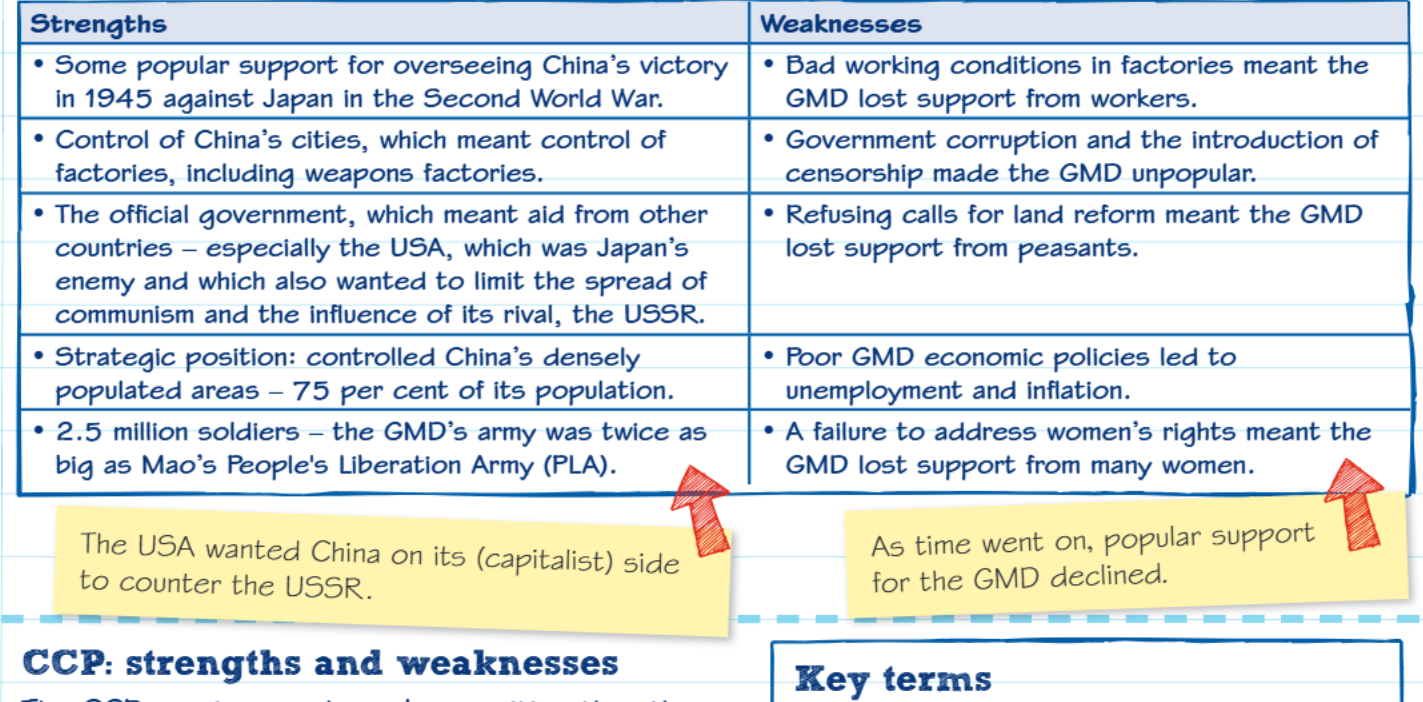
As the official government of China, the GMD received substantial international support, particularly from the United States. America viewed the GMD as a capitalist ally that could help contain the spread of communism and counter Soviet influence in the region. This strategic partnership provided the Nationalists with vital resources and diplomatic backing.
Note
The GMD's international recognition as China's official government gave them access to foreign aid, weapons, and diplomatic support that would be crucial in the early stages of the civil war.
The GMD also held important strategic advantages through their control of densely populated areas, governing approximately 75% of China's population. Their military force was impressive, with 2.5 million soldiers - twice the size of Mao's People's Liberation Army (PLA). These factors suggested the Nationalists were well-positioned to maintain control of China.
However, the GMD faced serious underlying problems that would ultimately undermine their position. Poor working conditions in factories led to the loss of support from urban workers, while government corruption and censorship made the party increasingly unpopular with ordinary citizens. The GMD's refusal to implement land reform alienated the peasant population, who made up the majority of Chinese society.
Important
The GMD's failure to address land reform was a critical mistake that cost them the support of China's vast peasant population, who desperately wanted their own farmland.
Economic mismanagement created additional challenges, as poor GMD policies resulted in widespread unemployment and inflation that hurt living standards. The party also failed to address women's rights, causing them to lose support from half the population. These weaknesses meant that despite their initial advantages, popular support for the GMD steadily declined over time.
The CCP's strategic position
While the Communist Party appeared much weaker than the GMD in 1945, they possessed several key advantages that would prove decisive. The CCP had fewer soldiers, less equipment, no aircraft, and controlled fewer cities than their nationalist rivals. However, they had built their strength in areas that would matter most for a prolonged conflict.
The most important CCP advantage was their support for land reform. This policy promised to redistribute farmland from wealthy landlords to poor peasants, which resonated strongly with rural communities who desperately wanted their own land to farm. Since peasants formed the vast majority of China's population, this gave the communists a massive potential support base.
Note
Land reform was not just an economic policy for the CCP - it was a powerful tool for winning the loyalty of rural communities who had been oppressed by wealthy landlords for generations.
The Soviet Union provided crucial backing to the CCP due to their shared communist ideology. For example, in 1945 the USSR allowed the People's Liberation Army to acquire 100,000 guns that had been abandoned in Manchuria by retreating Japanese forces. This Soviet support helped compensate for the CCP's initial military disadvantages.
The Communist Party also held a strong strategic position by controlling rural northern China and the countryside. This gave them a secure base of operations and allowed them to influence entire regions. Additionally, their military forces were highly experienced guerrilla fighters who had developed effective tactics while fighting against the Japanese occupation. These soldiers knew how to hide among the rural population and launch surprise attacks against enemy forces.
Important
The CCP's guerrilla warfare experience gave them a crucial tactical advantage - they knew how to fight effectively even when outnumbered and outgunned by conventional forces.
Importantly, the CCP combined communist ideology with nationalist goals, presenting themselves as champions of an independent China that would benefit all its people.
Key terms
Understanding these important concepts will help you analyse this period effectively:
A civil war occurs when different groups within the same country fight each other to gain political control, rather than fighting against foreign enemies.
Land reform involves redistributing farmland so that more people can own property, rather than allowing just a few wealthy individuals to control almost all agricultural land.
Censorship refers to government controls over what newspapers, radio, and other media can report, typically used to prevent criticism of those in power.
A communist believes in creating a completely equal society where private property is abolished and everyone works collectively for the common good.
A nationalist supports their country's independence and believes government policies should primarily benefit their own people rather than foreign interests.
Timeline of key events
- 1945: Japanese surrender ends World War II; Chinese Civil War begins between GMD and CCP
- 1945: USSR allows CCP to acquire abandoned Japanese weapons in Manchuria
- 1945-1949: Period of civil war as both parties compete for control of China
Remember!
Summary
Key Points to Remember:
-
The GMD initially appeared stronger with international support, control of cities, and a larger army, but faced serious problems with corruption and unpopular policies.
-
The CCP's support for land reform gave them crucial backing from China's peasant majority, even though they started from a weaker military position.
-
Foreign support played a key role, with the USA backing the GMD and the USSR supporting the CCP due to ideological alignments.
-
The CCP's guerrilla warfare experience and control of rural areas provided strategic advantages that would prove decisive in the coming conflict.
-
Popular support shifted over time, with the GMD losing credibility while the CCP gained support through policies that addressed ordinary people's needs.