The Civil War (Edexcel GCSE History): Revision Notes
📚Revision Notes
The Civil War (1945-1949)
Introduction
The Chinese Civil War from 1945 to 1949 was a decisive conflict that determined China's political future. Under Mao Zedong's leadership, the Chinese Communist Party (CCP) transformed from near-destruction in May 1947 to complete victory by October 1949. This remarkable turnaround was achieved through the People's Liberation Army (PLA) defeating the Guomindang (GMD) forces led by Chiang Kai-shek.
Note
The CCP's transformation from the brink of defeat to total victory in just two years represents one of the most dramatic military and political reversals in modern history.
The importance of Manchuria
Background and initial control
Following Japan's surrender in August 1945, Soviet troops invaded Manchuria to defeat the remaining Japanese forces. This development posed a significant threat to the GMD because Soviet support might help the CCP gain control of this strategically important region.
To prevent Communist expansion, Chiang Kai-shek negotiated with both the USSR and USA. By November 1945, American forces flew 110,000 GMD troops into the region to establish control. Initially, this strategy appeared successful - by May 1947, the GMD controlled all major cities except one in northern Manchuria.
Why Manchuria became crucial
Important
Manchuria's significance extended far beyond its geographical location. The region contained substantial industrial wealth and modern infrastructure left by Japanese occupiers, along with large stockpiles of weapons and equipment.
However, the GMD's control proved fragile due to widespread corruption, which made them deeply unpopular among local Manchurians.
The CCP capitalised on this discontent by implementing popular land reform policies. By October 1948, their support had grown so significantly that 1.6 million peasants joined the PLA. The strategic importance of Manchuria became clear when GMD troops and equipment became trapped in northern cities and were systematically captured by Communist forces. The GMD's defeat in Manchuria was so devastating that they lost a third of their total military strength.
The decisive Huai-Hai Campaign
The Huai-Hai Campaign represented the final major battle of the Civil War, lasting from November 6, 1948, to January 10, 1949. This confrontation demonstrated the dramatic shift in military capabilities between the two sides. While the GMD fielded 600,000 troops, the PLA countered with 600,000 guerrilla fighters supported by an additional one million peasants who provided crucial logistical support.
The campaign's outcome marked a complete reversal of fortunes. The PLA achieved total victory, fundamentally changing the war's trajectory and sealing the GMD's fate.
Three critical impacts of Huai-Hai
Important
The Huai-Hai Campaign created a cascading series of problems for the GMD that proved insurmountable.
First, morale among GMD forces collapsed completely, with thousands of soldiers deserting to join the PLA ranks. This mass defection severely weakened the Nationalist military capacity.
Second, by January 1949, the GMD had lost 500,000 troops, leaving them with no effective means to halt the PLA's advance into southern China. This represented a catastrophic military defeat from which recovery was impossible.
Third, the psychological impact proved equally devastating. Chiang Kai-shek resigned from leadership after the PLA's victory, effectively signalling the end of organised GMD resistance and the collapse of Nationalist government authority.
Reasons for CCP success in the Civil War
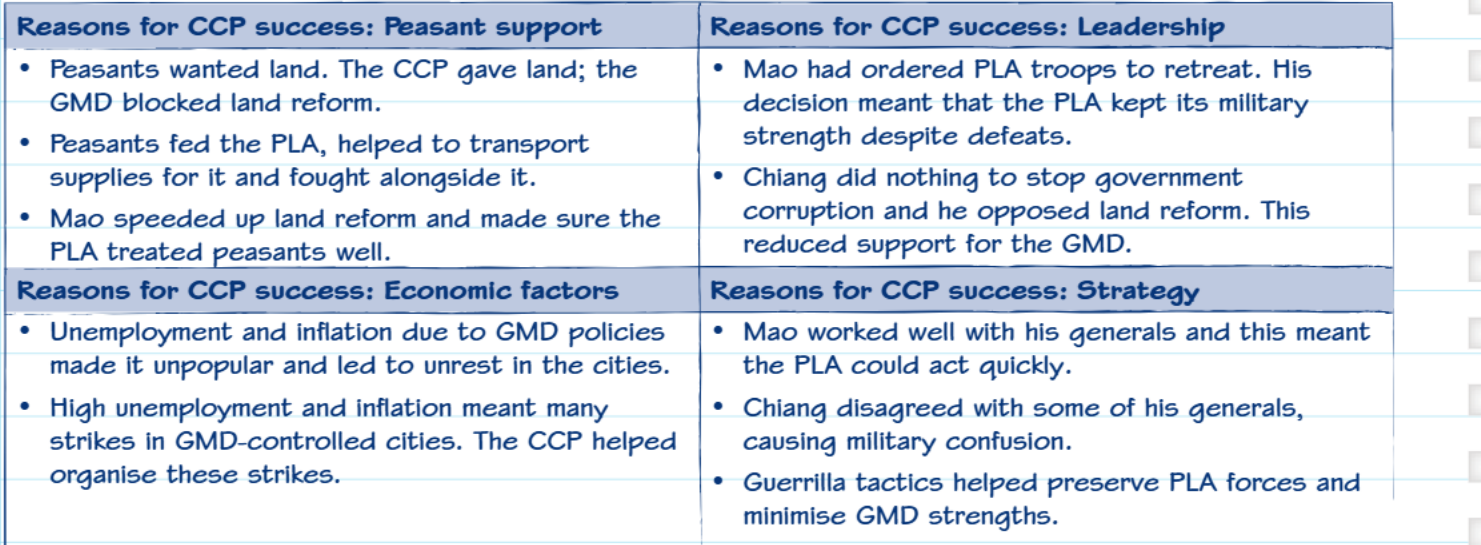
The CCP's victory resulted from their superior performance across four key areas: peasant support, leadership quality, economic management, and military strategy.
Winning peasant support
The foundation of Communist success lay in securing rural populations' loyalty through meaningful land reform. Peasants desperately wanted land ownership, which the CCP provided while the GMD actively blocked such reforms. This policy difference had immediate practical consequences - peasants not only fed PLA forces but also helped transport supplies and fought alongside Communist troops.
Example
Practical Example: Land Reform Impact
When the CCP implemented land redistribution in liberated areas, peasants received their own plots of land for the first time. In return, they provided:
- Food supplies for PLA troops
- Transportation and logistics support
- Intelligence about GMD troop movements
- Direct military service in PLA ranks
Mao Zedong personally accelerated land reform implementation and ensured the PLA treated peasants with respect and dignity. This approach contrasted sharply with GMD behaviour, creating a stark choice for rural populations between Communist promises of land ownership and Nationalist maintenance of existing inequalities.
Superior leadership
Mao's leadership decisions proved far more effective than Chiang Kai-shek's approach. When facing military setbacks, Mao ordered strategic PLA retreats that preserved his army's fighting strength despite temporary defeats. This tactical flexibility allowed Communist forces to regroup and fight another day.
Meanwhile, Chiang Kai-shek's leadership style created significant problems. His government's corruption alienated potential supporters, while his opposition to land reform reduced GMD popularity among the crucial peasant population. Additionally, Chiang frequently disagreed with his own generals, creating military confusion and reducing operational effectiveness at critical moments.
Economic factors
Economic conditions heavily favoured the CCP throughout the conflict. GMD policies created severe unemployment and inflation in cities under their control, making their government increasingly unpopular with urban populations. These economic problems led to widespread strikes and civil unrest in GMD-controlled territories.
The CCP effectively exploited this discontent by helping organise strikes and presenting themselves as the solution to economic hardship. Their ability to manage resources more effectively and maintain popular support provided a significant advantage over the economically struggling GMD administration.
Military strategy
The CCP's military approach proved far superior to GMD tactics. Mao worked closely with his generals, ensuring coordinated military operations and quick decision-making processes. This cooperation allowed PLA forces to respond rapidly to changing battlefield conditions.
Note
The contrast in military leadership styles was stark: while Mao maintained close coordination with his commanders, Chiang's disagreements with his military leadership caused confusion and delayed critical decisions.
Conversely, Chiang's disagreements with his military leadership caused confusion and delayed critical decisions. The CCP's use of guerrilla warfare tactics helped preserve their forces while minimising GMD military advantages. These flexible military strategies allowed smaller Communist forces to effectively combat larger GMD armies through superior coordination and local knowledge.
Timeline of major events
- August 1945: Soviet troops invade Manchuria; Japanese surrender
- November 1945: USA flies 110,000 GMD troops into Manchuria
- May 1947: GMD controls most Manchurian cities; PLA near destruction
- October 1948: 1.6 million peasants join PLA; GMD loses Manchuria
- November 1948: Huai-Hai Campaign begins
- January 1949: Huai-Hai Campaign ends with PLA victory; Chiang resigns
- October 1949: CCP achieves complete victory; People's Republic established
Summary
Key Points to Remember:
- The CCP's transformation from near-defeat in 1947 to total victory in 1949 demonstrates the importance of popular support in civil conflicts
- Manchuria's loss cost the GMD one-third of their military strength and marked the turning point of the war
- The Huai-Hai Campaign was decisive because it destroyed GMD morale and eliminated their remaining military capacity
- CCP success resulted from superior performance in four key areas: peasant support through land reform, effective leadership under Mao, better economic management, and flexible military strategy
- The Civil War's outcome was determined by which side could win the support of China's vast peasant population - the CCP succeeded where the GMD failed