Social and economic effects (Edexcel GCSE History): Revision Notes
📚Revision Notes
Social and economic effects of the Cultural Revolution
The Cultural Revolution brought massive upheaval to Chinese society between 1966 and 1976. Its impacts touched every aspect of life, from education and industry to farming and social relationships. Understanding these effects helps us see how this period fundamentally changed China's development path.
Note
The Cultural Revolution represents one of the most significant social and political upheavals in modern Chinese history, affecting virtually every aspect of Chinese life and society.
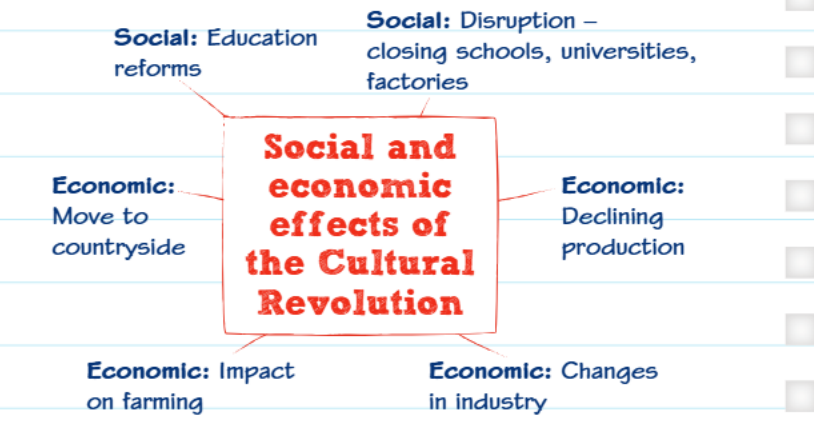
Social effects of the Cultural Revolution
Social disruption and violence
The Cultural Revolution unleashed unprecedented social chaos across China. The human cost was enormous, with around 400,000 people losing their lives during Red Guard attacks. The violence wasn't limited to deaths - millions of Chinese citizens faced torture, imprisonment, or were sent away for re-education and forced labour in remote areas.
Important
The psychological impact lasted for decades. Many Red Guards later experienced deep guilt when they realised they had been wrong to persecute their teachers and other authority figures. This guilt became a lasting burden that affected Chinese society long after the Cultural Revolution ended.
Disruption to education and learning
Education suffered devastating setbacks during this period. Most universities remained closed until 1972, creating a lost generation of students who couldn't complete their studies. Thousands of university teachers were sent for re-education, while many schools shut down entirely. Millions of students never finished their education, and the Red Guards were encouraged to work in rural areas rather than continue learning.
However, Mao also introduced significant education reforms during and after the Cultural Revolution. The government provided more funding to help poor students in rural areas access education, while reducing support for better-off urban students. This policy aimed to create more equality in educational opportunities.
Note
Educational Expansion Results:
By 1976, there were 15 times more rural primary schools compared to 1965. The government made schooling compulsory for five years, meaning more children in poorer areas could attend school. These changes contributed to a significant improvement in literacy rates.
Changes to university admission
Before 1972, universities selected students based purely on test scores. After 1972, this system changed completely. Universities now had to consider references about students' political attitudes and background. This helped students from poorer families gain university places, as they often performed less well in traditional tests but were viewed as more politically reliable.
Economic effects of the Cultural Revolution
Chaos and decline in industry
Chinese industry faced severe disruption during the Cultural Revolution. Millions of technicians, experts, and managers were persecuted, killed, imprisoned, or sent to labour camps in remote rural areas. This brain drain left industries without essential skilled workers and leadership.
The chaos resulted in a major decline in industrial output. By 1967, industrial production had dropped by 13 percent compared to previous years. Factories struggled to operate effectively without their experienced workforce, and the focus on political activities rather than productive work further hampered industrial development.
Industrial reforms and their limitations
In 1969, the government attempted to address these problems by introducing reforms to create more equal conditions for workers. They introduced bonuses and overtime payments, and managers were required to spend one-third of their time doing factory work alongside regular workers rather than just administration.
Note
However, these changes proved short-lived. By 1972, the Chinese Communist Party recognised the need to promote economic growth more effectively. Managers received higher pay once again, showing that the egalitarian reforms couldn't sustain industrial productivity.
Impact on farming and agriculture
The Cultural Revolution significantly affected China's agricultural sector. Around two-thirds of privately farmed land was returned to communes in 1966, reversing previous policies that had allowed some private farming. The government also banned private trade in farm products, forcing all agricultural commerce through state-controlled channels.
The policy of sending urban youth to work in the countryside meant that more small industries moved to rural areas. This included workshops that repaired farm machinery and small fertiliser factories, which provided some industrial development in agricultural regions.
Key outcomes and statistics
Example
Statistical Overview: Measuring the Cultural Revolution's Impact
Human Cost:
- Approximately 400,000 deaths from Red Guard violence
- Millions persecuted, imprisoned, or sent for re-education
Economic Impact:
- 13% decline in industrial production by 1967
- Two-thirds of private farmland returned to communes
Educational Changes:
- 15 times more rural primary schools in 1976 vs 1965
- Most universities closed from 1966-1972
- Literacy rate rose to 65% by 1982
The education reforms, despite the chaos, produced some positive long-term results. The expansion of rural education and the focus on educating poorer populations contributed to the dramatic improvement in literacy rates across China.
Summary
Key Points to Remember:
- The Cultural Revolution caused massive social disruption with around 400,000 deaths and millions persecuted
- Education suffered severe disruption but also saw important reforms that expanded access for rural and poor students
- Industrial production dropped 13% due to persecution of skilled workers and managers
- Agricultural policy reversed towards collective farming and banned private trade
- Despite the chaos, literacy rates improved significantly, reaching 65% by 1982