Student rebellion (Edexcel GCSE History): Revision Notes
📚Revision Notes
Student rebellion during the Cultural Revolution
The launch of student rebellion
In May 1966, the Chinese Communist Party's Politburo made a decision that would transform China for the next decade. They agreed to launch what became known as the Cultural Revolution. Chairman Mao Zedong deliberately appealed to China's young people, asking them to challenge and attack what he called "revisionist opponents" within the Communist Party itself. This created a massive student rebellion that the CCP leadership found impossible to control.
Important
This decision marked the beginning of one of the most turbulent periods in modern Chinese history, demonstrating how political leaders could mobilise youth movements to achieve their own objectives, often with unintended and devastating consequences.
Why students embraced radical change
Young Chinese people had several compelling reasons to support Mao's call for revolutionary action. Their motivations were complex and deeply rooted in both idealism and practical concerns about their lives and futures.
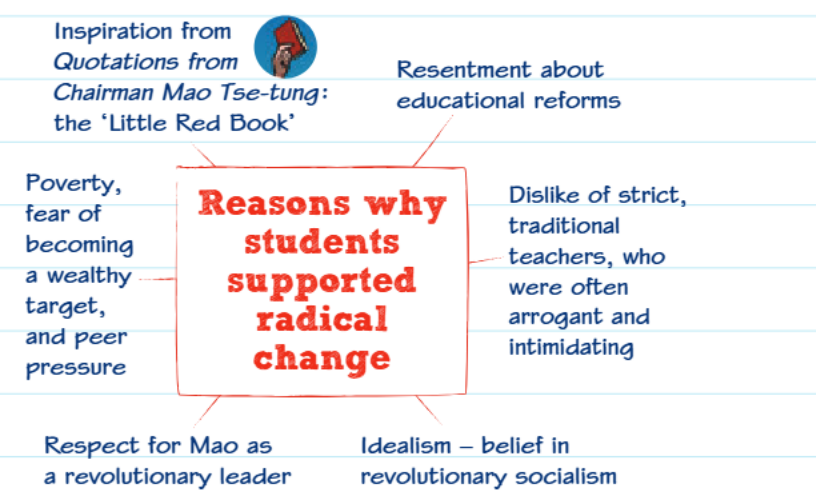
Students felt inspired by Chairman Mao through his famous "Little Red Book", which contained his revolutionary thoughts and ideas. Many young people developed a deep respect for Mao as the leader who had successfully overthrown the old system and established Communist China. This gave them confidence that radical change could work again.
Educational issues also played a crucial role in student anger. The Communist Party's education reforms had made it much easier for the children of elite Party officials to gain admission to prestigious schools and universities. Meanwhile, ordinary young people faced increased barriers to educational advancement, creating widespread resentment among students who felt the system was becoming unfair.
Note
The education system reforms created a two-tier system that contradicted the Communist ideals of equality, making it a particularly sensitive issue for young people who believed in revolutionary principles.
Many students also harboured strong dislike for their strict, traditional teachers, who often used intimidating and harsh methods. The prospect of challenging these authority figures appealed to young people who felt oppressed by the rigid educational system.
Economic pressures added another layer of motivation. Poverty, fear of becoming wealthy targets during political campaigns, and peer pressure all contributed to students' willingness to embrace radical change. Finally, many young people genuinely believed in the idealistic vision of revolutionary socialism that Mao promoted, seeing it as a way to create a more just and equal society.
The formation of the Red Guards
The student movement quickly organised itself into militant groups known as the Red Guards. These groups emerged from universities and schools in cities and towns across China, representing a new kind of revolutionary force that operated outside the normal Communist Party structure.
The very first Red Guard group formed at a middle school in Beijing during 1966. These pioneering students were particularly angry about a play called "Hai Rui Dismissed from Office," which they saw as criticism of Chairman Mao. In response, they created an organisation and proudly called themselves "Chairman Mao's Red Guards".
Note
Red Guard groups adopted a military-style organisation, structuring themselves like army battalions. Members wore distinctive military-style uniforms and red armbands that identified their allegiance to Mao and the revolutionary cause. The People's Liberation Army (PLA) provided inspiration for the Red Guards, sharing the army's commitment to revolutionary socialism and dedication to Chairman Mao's leadership.
The primary mission of the Red Guards was to identify and attack "capitalist roaders" within the Communist Party - officials who the Red Guards believed were leading China away from true socialist principles and back towards capitalism. They saw themselves as defenders of Mao Zedong Thought and protectors of the revolutionary ideals that had created Communist China.
Attacks on universities and intellectuals
The Red Guards' campaign began with dramatic confrontations at China's most prestigious educational institutions. In May 1966, students at Beijing University organised protests specifically targeting their lecturers and professors. By June, these initially peaceful protests had escalated into violent physical attacks against academic staff.
Example
Historical Example: Beijing University Protests
The protests at Beijing University began as criticism sessions where students publicly denounced their professors for "bourgeois thinking." Within weeks, these sessions escalated to physical violence, with professors forced to wear dunce caps, carry signs confessing their "crimes," and endure public humiliation. This pattern spread rapidly to universities across China.
Students were particularly angry that university lecturers positioned themselves as intellectual experts and authorities. The Red Guards saw this as arrogance and elitism that contradicted the principles of revolutionary equality. They believed that ordinary workers and peasants possessed more genuine wisdom than highly educated academics who might harbour bourgeois ideas.
However, the Red Guard movement soon faced internal divisions. Liu Shaoqi, one of China's most senior leaders, attempted to control the situation by ordering the formation of rival Red Guard groups that would support the existing Communist Party leadership rather than attacking it. These competing groups were specifically instructed to defend Party officials from attacks by the Mao-supporting Red Guards.
Important
Recognising the threat these rival groups posed to his plans, Mao moved quickly to eliminate this opposition. In August 1966, he issued his famous "16 Articles" decree, which officially gave the Red Guards complete freedom to "overthrow capitalist roaders" wherever they discovered them. This effectively shut down the rival groups and gave Mao's supporters unlimited authority to attack Party officials.
The massive rallies of 1966
August 1966 marked a turning point when Mao decided to demonstrate the massive scale of support for his Cultural Revolution. He organised a series of enormous rallies in Beijing's Tiananmen Square, with the largest single gathering bringing together over one million Red Guards. Throughout 1966, eight separate mass rallies took place, with a total attendance of approximately 12 million young people from across China.
These rallies served multiple purposes for Mao's campaign. Most importantly, they allowed him to deliver his message directly to millions of young supporters, bypassing the regular Communist Party communication channels that he no longer trusted. Mao used these occasions to "bombard the headquarters" - his dramatic phrase for attacking the Party leadership that opposed him.
Note
The rallies also demonstrated the overwhelming popular support Mao could mobilise among China's youth. By showing that millions of young people were willing to travel to Beijing and publicly commit themselves to his cause, Mao pressured moderate Communist Party leaders to support his Cultural Revolution or risk being overwhelmed by the mass movement.
Jiang Qing's role in directing the campaign
Behind the scenes, much of the Red Guards' activity was coordinated by Jiang Qing, who held the position of deputy director of the Central Cultural Revolution Group and was also Mao's wife. She used her control over China's propaganda ministry to systematically encourage Red Guard attacks on specific Communist Party officials whom Mao wanted to eliminate.
Important
Jiang Qing's influence was crucial because she could identify which officials should be targeted as "capitalist roaders" and then use state media to spread this information to Red Guard groups throughout the country. This gave the apparently spontaneous student rebellion a hidden level of central coordination and political direction.
The consequences and purges
The student rebellion ultimately achieved Mao's goal of removing his rivals from power within the Communist Party. Liu Shaoqi and Deng Xiaoping, who had been identified as the primary "capitalist roaders," were systematically purged from their positions. Liu Shaoqi, who had been president of the People's Republic of China and was considered the third most important leader in the country after Mao and Premier Zhou Enlai, was completely removed from power by the end of 1968.
The success of the student rebellion in destroying Mao's opponents demonstrated the enormous power that could be unleashed when China's youth were mobilised for political purposes. However, it also showed how easily idealistic young people could be manipulated to serve the political ambitions of their leaders, often with devastating consequences for Chinese society.
Summary
Key Historical Lessons:
The Cultural Revolution student rebellion revealed both the potential and the dangers of youth political movements:
- Young people's idealism made them powerful agents of change
- Political leaders could manipulate student movements for personal gain
- Educational grievances could fuel broader political upheaval
- Mass mobilisation could rapidly transform entire political systems
- The consequences often extended far beyond the original participants' intentions
Summary
Key Points to Remember:
-
Student rebellion began in May 1966 when Mao launched the Cultural Revolution by appealing directly to young people to attack "revisionist opponents" in the Communist Party
-
Red Guards formed from universities and schools nationwide, organising themselves like military units and targeting "capitalist roaders" within the Party leadership
-
Educational resentment fuelled student anger as Party reforms made it easier for elite officials' children to access top schools while ordinary students faced greater barriers
-
Mass rallies in 1966 involved 12 million participants across eight separate events, demonstrating the massive scale of youth support for Mao's campaign
-
The rebellion successfully purged key leaders including Liu Shaoqi and Deng Xiaoping, showing how student movements could be used to achieve high-level political goals