Change in care and treatment (Edexcel GCSE History): Revision Notes
📚Revision Notes
Change in care and treatment (c1500-c1700)
Medical training developments during the Renaissance
During the Renaissance period, while many aspects of medical practice remained unchanged, significant improvements occurred in how medical professionals were trained. These changes varied considerably between different types of medical practitioners and would eventually lead to better care and treatment after 1700.
Evolution of medical professions
The Renaissance period saw important developments in how different medical professionals acquired their skills and knowledge, though social hierarchies within medicine persisted.
Note
The medical profession during the Renaissance maintained a strict social hierarchy, with physicians at the top, followed by surgeons, and apothecaries at the bottom. This hierarchy influenced training opportunities and social status throughout the period.
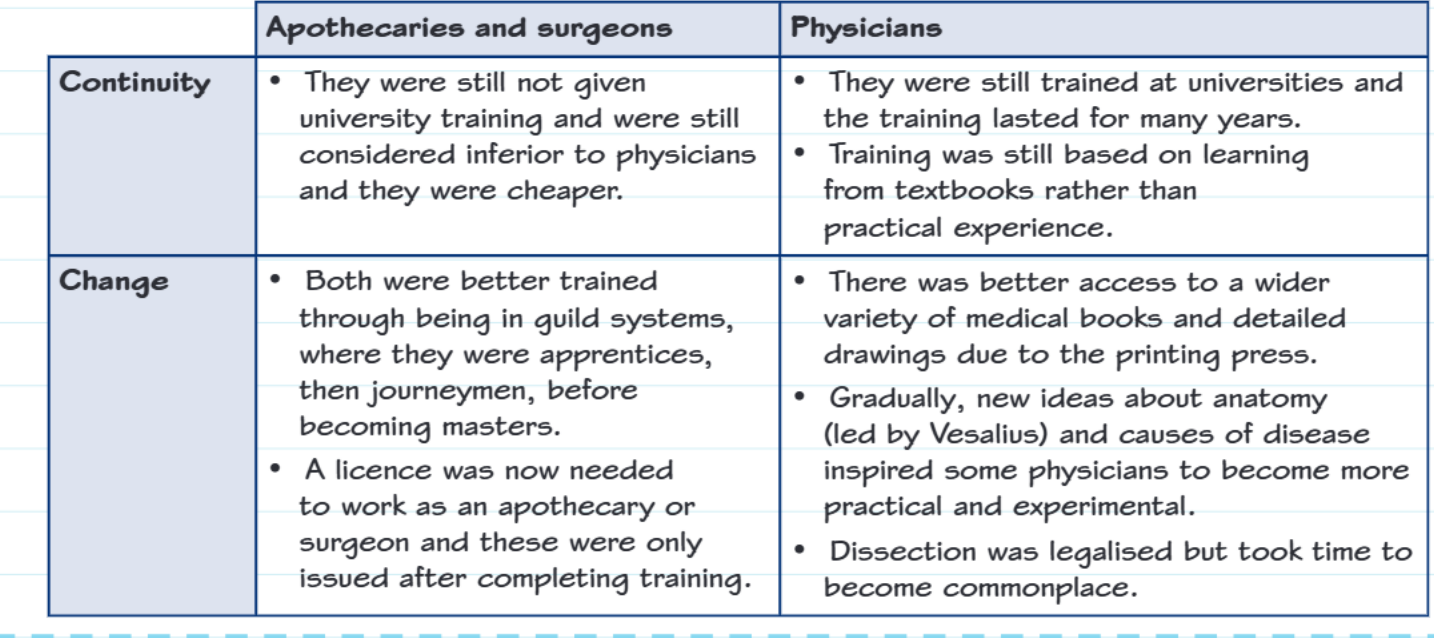
Apothecaries and surgeons remained at the bottom of the medical social ladder throughout this period. They continued to be excluded from prestigious university education and were still viewed as inferior to physicians, though they offered more affordable healthcare options for ordinary people. However, their training did improve significantly through enhanced guild apprenticeship systems, where they learned practical skills by working alongside experienced practitioners before advancing to journeymen status and eventually becoming masters of their craft. A crucial development was the introduction of licensing requirements - both apothecaries and surgeons now needed official licenses to practice, which were only granted after completing proper training.
Important
Licensing Revolution
The introduction of mandatory licensing for apothecaries and surgeons was a major step forwards in ensuring medical competency. This requirement meant that practitioners could only work legally after proving their skills and completing proper training, which helped improve the overall quality of medical care.
Physicians maintained their elite status by continuing their university-based education, which often lasted many years. Their training remained heavily focused on studying medical textbooks rather than gaining hands-on practical experience with patients. However, physicians benefited enormously from the printing press revolution, which gave them access to a much wider variety of medical books and detailed anatomical drawings than ever before. This expanded knowledge base gradually encouraged some physicians to become more practical and experimental in their approach to medicine. The legalisation of human dissection was particularly significant, though it took time for this practice to become commonplace in medical training.
Vesalius and the anatomical revolution
Andreas Vesalius: pioneer of anatomical study
Andreas Vesalius became one of the most influential figures in Renaissance medicine through his groundbreaking approach to understanding the human body. After studying medicine in Paris in 1533, he became a surgery professor in Padua, Italy, where he revolutionised medical education by conducting numerous dissections on human bodies and making detailed observations about how the body actually worked.
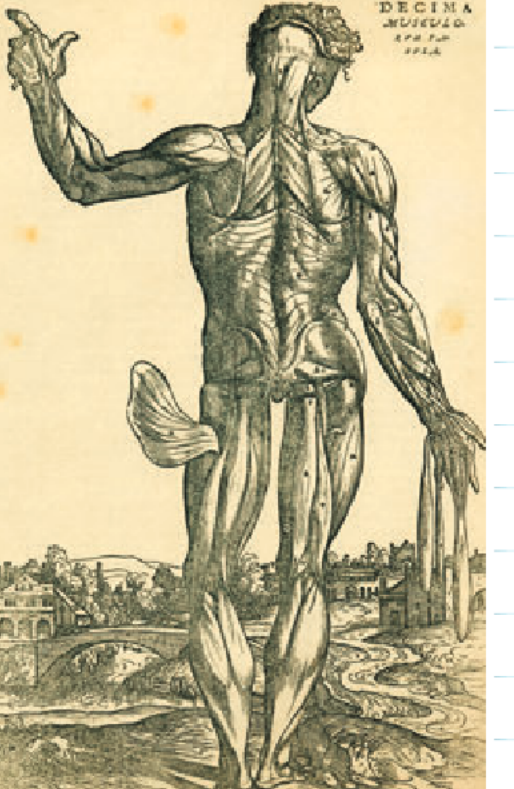
Vesalius's most famous achievement was publishing "On the Fabric of the Human Body" in 1543, a comprehensive anatomical textbook that became essential reading for medical training and significantly improved physicians' understanding of human anatomy. This work was widely distributed throughout England and Europe, and its detailed illustrations were copied into many other medical textbooks.
The importance of Vesalius's contributions
Vesalius's work marked a fundamental shift in medical thinking that would have lasting effects on care and treatment. He transformed anatomy from a theoretical subject into something based on direct observation and evidence, making the study of anatomy fashionable and central to medical education.
Perhaps most importantly, Vesalius proved that some of Galen's ancient theories about the human body were incorrect. This was revolutionary because Galen's ideas had been accepted without question for over a thousand years. By demonstrating that long-held beliefs could be wrong, Vesalius encouraged other medical professionals to question traditional theories and conduct their own investigations through dissection and experimentation.
Example
Worked Example: Challenging Galen's Theories
One of Vesalius's most significant discoveries was proving that Galen was wrong about the human jaw. Galen claimed humans had a two-part lower jaw (like dogs and apes), but Vesalius's dissections showed that humans actually have a single-piece jawbone. This discovery demonstrated that Galen had based his theories on animal dissections rather than human bodies, encouraging others to question accepted medical knowledge.
His work inspired a new generation of medical practitioners to carry out dissections and make further discoveries about human anatomy and physiology. The detailed anatomical knowledge that Vesalius provided became the foundation for more effective medical treatments that would develop in later centuries.
Timeline of key developments
- 1533: Andreas Vesalius begins studying medicine in Paris
- 1543: Vesalius publishes "On the Fabric of the Human Body"
- After 1543: Vesalius's anatomical illustrations are copied into medical textbooks across Europe
- Throughout Renaissance: Guild systems improve training for apothecaries and surgeons
- Throughout Renaissance: Licensing becomes mandatory for medical practitioners
Summary
Key Points to Remember:
- Medical training improved during the Renaissance, but different professions developed in different ways - physicians kept their university education while apothecaries and surgeons learned through guild apprenticeships
- Andreas Vesalius revolutionised anatomy by conducting human dissections and publishing detailed anatomical drawings in 1543
- The printing press was crucial for spreading medical knowledge and making detailed anatomical illustrations available to more medical practitioners
- Galen's theories were challenged for the first time in over a thousand years, encouraging a more experimental approach to medicine
- These changes laid the foundation for more significant improvements in care and treatment that would come after 1700