Early modern England (Edexcel GCSE History): Revision Notes
📚Revision Notes
Early modern England (c.1500-c.1700)
Introduction
The period between 1500 and 1700 represents one of the most transformative eras in English history. This was an age of tremendous change that reshaped England's social structures, economy, trade relationships, and religious identity. These dramatic shifts affected virtually every aspect of English society and had lasting consequences for the nation's development.
Note
Understanding this period is crucial for grasping how England evolved into the country that would later become a major global power. The changes during these two centuries laid the foundation for England's later emergence as a dominant force in world politics and trade.
Major changes during the early modern period
Changes in government
The early modern period witnessed a fundamental shift in the balance of power between the monarchy and Parliament. During the 1500s, Parliament began meeting more regularly and started to assert greater influence over government decisions. This growing parliamentary power created significant tension with the Crown, as MPs increasingly challenged royal authority and sought to limit the monarch's powers.
The conflict between Parliament and the Crown reached its climax during the 17th century, culminating in a devastating civil war between 1642 and 1651. This bloody conflict pitted supporters of King Charles I against parliamentary forces, ultimately resulting in the king's execution in 1649. Following Charles I's death, England temporarily became a republic under Oliver Cromwell's leadership, known as the Protectorate, which lasted from 1649 to 1660.
Important
The English Civil War was one of the most significant events in the nation's history. It marked the first time in Europe that a monarch was formally tried and executed by his own people, sending shockwaves across the continent and establishing the principle that even kings were not above the law.
The monarchy was restored in 1660 when Charles II returned to the throne, but with significantly reduced powers. The final major constitutional change came in 1689 when Parliament passed the Bill of Rights, which formally increased Parliament's authority and established clearer limits on royal power. This legislation marked a crucial step towards the constitutional monarchy that would define Britain's political system.
Changes in religion
England's religious landscape underwent dramatic and often violent transformations during this period. At the beginning of the 1500s, England was firmly Catholic, recognising the Pope's authority over religious matters. However, this changed dramatically when Henry VIII (1509-1547) broke with Rome in 1534, making himself head of the Church of England and establishing England as a Protestant nation.
The religious situation remained unstable as different monarchs imposed their own religious preferences on the country. Edward VI (1547-1553) continued his father's Protestant reforms, but Mary I (1553-1558) attempted to restore Catholicism, earning the nickname "Bloody Mary" for her persecution of Protestants. Finally, Elizabeth I (1558-1603) established England permanently as a Protestant country, removing papal authority entirely and creating a more stable religious settlement.
Important
These religious changes had profound social consequences that extended far beyond theology. The dissolution of monasteries and nunneries left many monks and nuns without work or homes, while the poor lost important sources of charitable support that had operated for centuries.
The constant religious upheaval also created opportunities and challenges for different communities, including the arrival of Protestant refugees from continental Europe, who brought valuable skills and cultural influences to English society.
Timeline of key events
- 1534: Henry VIII becomes head of the Church of England, breaking with Rome
- 1547-1553: Edward VI transforms England into a Protestant country
- 1553-1558: Mary I attempts to restore England as a Catholic country
- 1558-1603: Elizabeth I establishes England as a fully Protestant nation
- 1642-1651: Civil War between Charles I and Parliament
- 1649: Execution of Charles I
- 1649-1660: England becomes a republic under Oliver Cromwell
- 1660: Parliament invites Charles II to return as king with limited powers
- 1685: James II becomes king, but his Catholicism makes him unpopular
- 1688: Parliament asks Protestant William of Orange to invade England
- 1689: William and Mary sign the Bill of Rights, increasing Parliament's power
Factors driving change
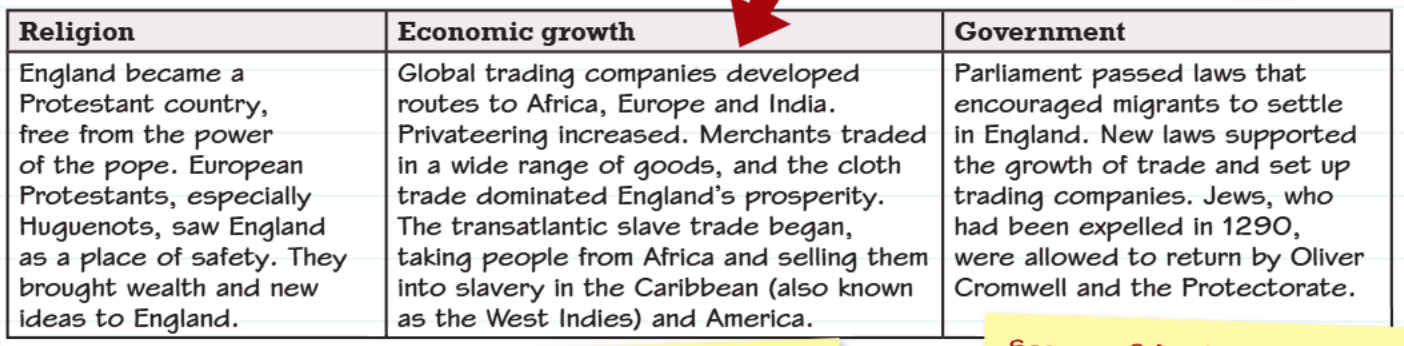
The transformation of early modern England resulted from three interconnected forces that reinforced and accelerated each other's impact. These factors worked together to create the conditions for England's dramatic evolution during this period.
Note
Understanding these interconnected factors helps explain why change happened so rapidly and comprehensively during this period. Each factor reinforced and amplified the effects of the others, creating a cycle of transformation that reshaped English society.
Religious transformation fundamentally altered English society when the country broke free from papal authority and became Protestant. This religious revolution attracted European Protestant refugees, particularly the Huguenots from France, who brought valuable skills and knowledge to England. These religious migrants contributed significantly to England's economic and cultural development, introducing new technologies and trade connections.
Economic expansion drove much of the period's dynamism through the development of global trading companies that established routes to Africa, Europe, and India. The rise of privateering allowed England to challenge Spanish dominance of the seas while generating wealth through licensed piracy. Most significantly, England became heavily involved in the transatlantic slave trade, which brought enormous profits but also established the country's participation in one of history's most brutal systems of human exploitation. The cloth trade dominated England's commercial prosperity during this period, with English textiles becoming highly sought after across Europe.
Government policies actively supported these economic and religious changes through parliamentary legislation that encouraged migration and trade. Laws were passed to attract skilled migrants to settle in England, while new regulations established trading companies and supported commercial expansion. The government also played a crucial role in religious policy, with Parliament passing laws that determined the country's religious direction and affected which communities could settle in England.
Key terms
Protestants: Christians who disagreed with the teachings and practices of the Catholic Church and established their own separate churches and religious communities.
Privateers: Sailors who received official government licenses to attack enemy ships and seize their cargo, essentially operating as legal pirates in service of the state.
Huguenots: French Protestant refugees who fled religious persecution in Catholic France and settled in Protestant England, bringing valuable skills in crafts, trade, and manufacturing.
Remember!
Summary
Key Points to Remember:
- England transformed from a Catholic to a Protestant nation through the religious policies of Tudor monarchs, with this change becoming permanent under Elizabeth I
- Parliament gradually gained power at the expense of the Crown, leading to civil war and ultimately establishing constitutional limits on royal authority
- Economic growth was driven by global trading companies, privateering, and involvement in the transatlantic slave trade, which brought both wealth and moral compromise
- Religious changes attracted Protestant refugees like the Huguenots, who contributed significantly to England's economic development
- The period established England as a major European power with global trading connections and a more balanced system of government