Liverpool (Edexcel GCSE History): Revision Notes
📚Revision Notes
Migration in Liverpool c1700-c1900

Liverpool underwent a remarkable transformation during the 18th and 19th centuries. The city evolved from one built on the profits of the transatlantic slave trade into one of Britain's most important trading ports. This economic change attracted thousands of migrants from across Britain and around the world, creating diverse communities that would permanently shape Liverpool's character.
Note
Liverpool's transformation represents one of the most dramatic urban changes in British history, showing how cities could completely reinvent their economic foundations while attracting diverse migrant populations from around the world.
Liverpool's economic transformation
Liverpool had initially prospered through its central role in the transatlantic slave trade. Wealthy traders had built fortunes from plantations that relied on enslaved people working in horrific conditions. However, this foundation changed dramatically when the transatlantic slave trade ended in England in 1807, followed by the complete abolition of slavery throughout the British Empire in 1833.
Important
The end of the slave trade in 1807 and slavery in 1833 forced Liverpool to completely reinvent its economic foundation. This wasn't just a minor adjustment - it was a fundamental transformation that required the city to find entirely new sources of wealth and trade.
Following these changes, Liverpool merchants adapted by importing and exporting a much wider range of goods. By the 19th century, Liverpool had developed into a flourishing port where migrant communities from many different backgrounds established themselves.
The growth of Liverpool's port
Liverpool's strategic position facing the Atlantic Ocean made it ideally located for merchants to trade primarily with America. They imported raw materials from across the Atlantic and exported finished manufactured goods, creating a profitable two-way trading system.
Raw cotton became Liverpool's most crucial import during this period. This cotton was essential for meeting the enormous demand from the rapidly expanding spinning and weaving mills in nearby Manchester. Around 80% of Britain's cotton imports arrived from the United States, with most passing through Liverpool's expanding port facilities.
Example
Port Expansion Statistics: Liverpool's Remarkable Growth
The scale of Liverpool's port expansion demonstrates the city's incredible economic transformation:
1845: Liverpool's docks handled 2.5 million tons of goods 1900: The port expanded to 4 miles of docks processing 10.5 million tons annually
This represents more than a four-fold increase in just 55 years, making Liverpool the second most profitable port in the entire world, surpassed only by London.
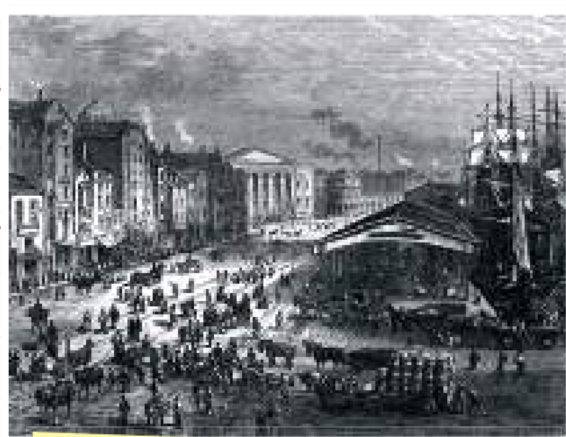
The gradual replacement of sailing ships with steamships accelerated this growth significantly. Steamships could transport much larger quantities of cargo and required fewer specialised sailing skills to operate, making trade both more efficient and more profitable. This rapid commercial expansion made Liverpool extremely attractive to migrants, as employment opportunities appeared readily available throughout the port.
Migrant communities in Liverpool
The Irish community
Irish migrants became fundamental to Liverpool's development. Irish construction workers, known as navvies, built the docks themselves, while thousands more found employment on these same docks as dockers and warehousemen. During the 1840s, Irish-owned businesses began opening throughout the city, and Irish pubs became vital community centres where they offered advice and practical support to newly arrived migrants.
Note
Irish pubs served a crucial social function beyond entertainment - they acted as informal employment agencies, community support networks, and cultural centres where newly arrived migrants could find practical help and maintain connections to their homeland.
By 1851, the Irish population had reached remarkable proportions - over 20% of Liverpool's total population was Irish, numbering approximately 83,000 people. However, most Irish migrants lived in overcrowded, deteriorating districts of the city, particularly in areas where disease could spread rapidly.
The Irish community faced severe health challenges. Those who became ill received care at the Liverpool Workhouse Infirmary. In 1847, a catastrophic typhus epidemic struck - an enormous 60,000 people contracted this disease, which was directly linked to poor living conditions and inadequate sanitation. Large temporary shelters near the docks were hastily constructed to isolate infected individuals, and new restrictions were imposed on Irish migrants entering Liverpool. The disease became widely known as "Irish fever", generating considerable resentment among the existing English population.
Important
The 1847 typhus epidemic was a devastating public health crisis that affected 60,000 people - demonstrating how poor living conditions and overcrowding created dangerous health risks for migrant communities. The labelling of typhus as "Irish fever" unfortunately increased prejudice and discrimination against the Irish community.
The Irish migrants were predominantly Catholic. In 1870, Liverpool contained 8 Catholic parishes, but by 1916, this number had expanded to 24, demonstrating both the growth and the permanent establishment of the Irish community within the city.
Unfortunately, widespread prejudice existed against Irish migrants, with crime frequently blamed on the Irish community. In 1850, half of the 6,000 individuals brought before local magistrates were Irish, which unfortunately reinforced existing negative stereotypes and discrimination.
International sailors
Liverpool's status as a major international port attracted sailors from numerous countries, and many decided to remain in the city permanently after their ships docked.
Indian sailors developed various strategies for establishing themselves in Liverpool. Some continued working as sailors for different shipping companies, others found alternative employment opportunities they could manage, while some established boarding houses that served the maritime community. Many married English women, which significantly helped their integration into local society. In 1890, a mosque was opened specifically to serve Muslim Indians, clearly demonstrating how this community had grown and established permanent roots.
Chinese sailors began arriving in Liverpool during the 1850s, when Liverpool merchants expanded their trading operations to include silk and tea from Shanghai and Hong Kong. Many Chinese sailors chose to settle permanently in Liverpool, establishing their own businesses, shops, and cafes. They quickly developed a reputation for being exceptionally hardworking and reliable. Eventually, Liverpool developed what became the largest Chinatown in Europe. Many Chinese residents married English women and became particularly well-regarded for the strong support they provided to their families.
African sailors reached Liverpool through the city's increased trading relationships with Africa. Many were employed by shipping companies because they accepted lower wages and were willing to work in worse conditions than other sailors. Despite facing significant discrimination, they succeeded in establishing their own distinctive community within Liverpool's increasingly diverse port environment.
Note
Marriage between international sailors and English women was a common pattern that helped facilitate integration into Liverpool society. This created mixed-heritage families that became an important part of the city's multicultural identity.
Timeline of key events
- 1807: Transatlantic slave trade ended in England
- 1833: Slavery abolished throughout the British Empire
- 1840s: Irish businesses began opening across Liverpool
- 1845: Liverpool's docks handled 2.5 million tonnes of goods
- 1847: 60,000 people contracted typhus ("Irish fever")
- 1850: Half of 6,000 people brought before magistrates were Irish
- 1850s: Chinese sailors began arriving from Shanghai and Hong Kong
- 1851: Over 20% of Liverpool's population (83,000 people) was Irish
- 1870: 8 Catholic parishes existed in the city
- 1890: Mosque opened for Muslim Indians
- 1900: Liverpool's port expanded to 4 miles of docks handling 10.5 million tonnes of goods
- 1916: 24 Catholic parishes operated throughout the city
Summary
Key Points to Remember:
-
Liverpool transformed from a slave trade port into Britain's second most profitable port by 1900, with dock capacity growing from 2.5 million tonnes (1845) to 10.5 million tonnes (1900)
-
The Irish formed the largest migrant community, comprising over 20% of the population by 1851, but faced severe discrimination and health crises like the devastating 1847 typhus outbreak that affected 60,000 people
-
International sailors from India, China, and Africa established thriving permanent communities, often integrating through marriage with English women and creating successful businesses
-
Religious diversity flourished alongside migration, with Catholic parishes expanding from 8 to 24 between 1870-1916, and a mosque opening for Muslim Indians in 1890
-
Economic opportunities in raw cotton trade and port expansion attracted migrants, but they often faced prejudice, with half of all court cases in 1850 involving Irish defendants