Migrants: Impact (Edexcel GCSE History): Revision Notes
📚Revision Notes
Migration in modern Britain: Migrants' impact and experiences
Introduction
Since 1900, migrants arriving in Britain have experienced vastly different receptions depending on the time period, their country of origin, and prevailing social attitudes. Their experiences have been shaped by economic conditions, political movements, and changing government policies. Understanding these varied experiences helps us see how British society has both welcomed and rejected different migrant communities over more than a century.
Note
The period from 1900 onwards represents a crucial era in British immigration history, marked by two world wars, economic upheaval, and dramatic shifts in social attitudes towards newcomers.
Changing attitudes: Before and after 1945
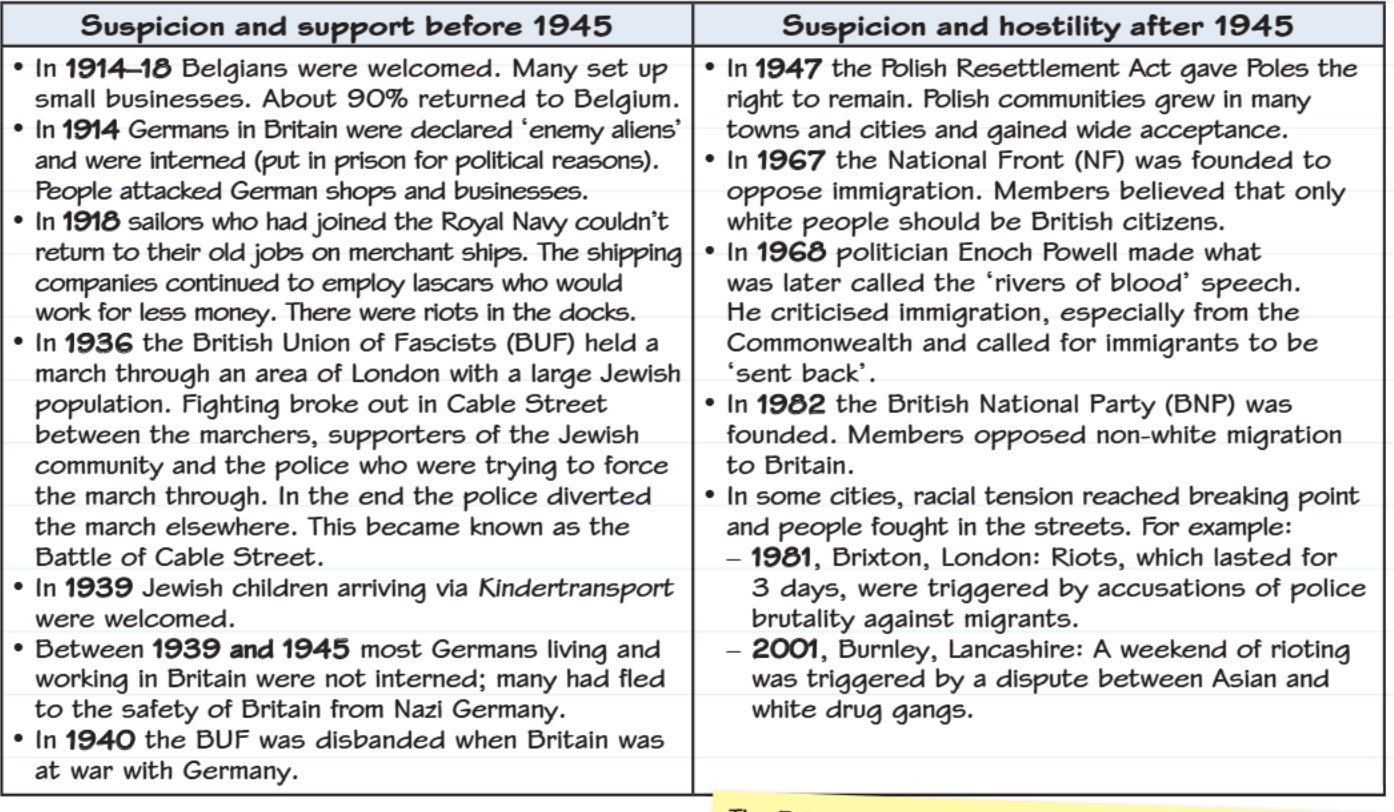
The experience of migrants in Britain can be divided into two distinct periods that show dramatically different patterns of acceptance and hostility.
Important
The year 1945 marks a critical turning point in British attitudes towards immigration. Before this date, responses were largely situational and temporary, but afterward, organised opposition and systematic hostility became much more prominent features of the immigration experience.
Support and suspicion before 1945
During the early 20th century, migrant experiences varied considerably based on circumstances and timing. Belgian refugees who fled to Britain during World War I in 1914-1916 generally received a warm welcome from the British public. Many successfully established small businesses and integrated into local communities, with approximately 90% eventually returning to Belgium after the war ended.
However, the same period saw harsh treatment of German communities already living in Britain. When war broke out in 1914, Germans were officially classified as "enemy aliens" and faced internment in prison camps for their political beliefs rather than any criminal activity. This created a climate of suspicion that led to attacks on German-owned shops and businesses by angry crowds.
Note
The contrast between the treatment of Belgian refugees and German residents illustrates how wartime politics could dramatically alter public attitudes towards different migrant communities, even those already established in Britain.
The economic impact of migration was clearly visible in employment patterns. In 1919, sailors who had lost their jobs on merchant ships due to post-war economic changes were unable to return to work because shipping companies continued to employ foreign workers who would accept lower wages. This created resentment and led to riots in dock areas.
Jewish migration also produced mixed reactions during this period. In 1936, the British Union of Fascists organised a march through areas of London with large Jewish populations. This event, known as the Battle of Cable Street, saw violent fighting break out between fascist marchers, Jewish community supporters, and police who were trying to force the march through. However, the same period also saw more positive responses to Jewish refugees, particularly children arriving through the Kindertransport programme in 1939, who were generally welcomed by British families.
Example
Historical Example: The Battle of Cable Street (1936)
This confrontation demonstrates the complex nature of pre-war attitudes:
- Background: British Union of Fascists planned march through Jewish areas
- Opposition: Local Jewish communities and supporters organised resistance
- Outcome: Violent clashes prevented the march, showing both anti-Semitic sentiment and strong community solidarity
- Significance: Highlighted growing political tensions while demonstrating effective community resistance
Increased hostility after 1945
The post-war period marked a significant shift towards greater suspicion and organised opposition to immigration. Even when the government implemented supportive policies, such as the 1947 Polish Resettlement Act that gave Polish refugees the right to remain in Britain, public attitudes often remained hostile.
The formation of explicitly anti-immigration political parties became a key feature of this period. In 1967, the National Front was established specifically to oppose immigration, arguing that only white people should hold British citizenship. This was followed in 1982 by the founding of the British National Party, which continued similar anti-immigration campaigns.
Political speeches also inflamed tensions significantly. In 1968, Conservative politician Enoch Powell delivered what became known as the "rivers of blood" speech, in which he strongly criticised immigration policies, particularly from Commonwealth countries, and predicted serious racial conflict. This speech legitimised anti-immigrant sentiment among some sections of the public.
Important
Critical Turning Point: Post-1945 Organised Opposition
Unlike the situational hostility of the pre-war period, the post-1945 era saw the emergence of systematic, organised anti-immigration movements that would fundamentally change the nature of public debate about migration in Britain.
Racial tensions and violence
The growing hostility towards migrants led to serious outbreaks of violence in several British cities. These incidents demonstrated how poor relations between communities could escalate into widespread disorder.
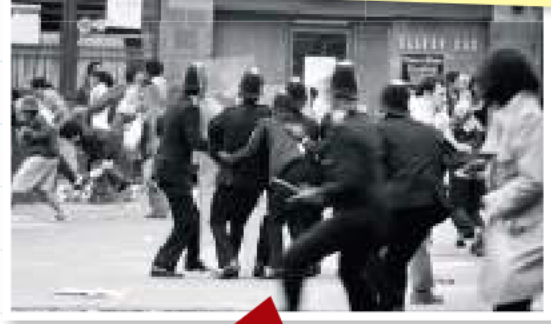
The Brixton riots of 1981 in London lasted for three days and were triggered by allegations of police brutality against migrants and ethnic minorities. The violence highlighted deep-seated tensions between police forces and migrant communities, particularly those from Caribbean backgrounds.
Similar patterns of conflict emerged in other areas with significant migrant populations. In 2001, Burnley in Lancashire experienced a weekend of serious rioting that began with a dispute between Asian and white drug gangs but quickly spread into broader racial violence.
Example
Case Study: The Brixton Riots (1981)
Context: Allegations of police brutality against ethnic minorities Duration: Three days of continuous violence Impact: Highlighted systemic tensions between law enforcement and migrant communities Long-term significance: Led to major reviews of police-community relations and influenced subsequent race relations policies
Note
These violent incidents often started with specific local disputes but quickly escalated into broader conflicts, suggesting that underlying tensions between communities were already present and needed only a trigger to explode into open violence.
Government responses: Race relations legislation
Recognising the need to address discrimination and improve community relations, successive governments introduced legislation specifically designed to protect migrants and ethnic minorities from unfair treatment.
Timeline of key legislation
1965 - Race Relations Act: This groundbreaking law was the first to make certain types of racial discrimination illegal in Britain. However, its scope was limited and it lacked strong enforcement mechanisms.
1968 - Race Relations Act: Building on the earlier legislation, this act specifically targeted discrimination in housing and employment, areas where migrants faced particular difficulties in accessing services and opportunities.
1976 - Race Relations Act: This more comprehensive law established the Commission for Racial Equality, giving it power to investigate discrimination cases and take legal action. It aimed to prevent racial discrimination while also raising public awareness of racial injustice issues.
1998 - Crime and Disorder Act: This legislation introduced more severe punishments for crimes that were motivated by racism, recognising that attacks on migrants and ethnic minorities required stronger legal responses.
Note
The progression of race relations legislation shows an evolution from basic anti-discrimination laws to more comprehensive frameworks that included enforcement mechanisms and specialised institutions to combat racism.
The development of this legislation showed how the government increasingly recognised that successful integration of migrants required active legal protection against discrimination rather than simply hoping that prejudice would fade naturally over time.
Media influence on public opinion
The role of media in shaping public attitudes towards migrants cannot be underestimated. Television, newspapers, and later the internet all had enormous impact on how British people viewed immigration and migrant communities.
Media coverage often presented a divided picture of migration. Some parts of the media portrayed migrants negatively, highlighting problems and conflicts while stirring up prejudice against immigrant communities. These negative portrayals reinforced existing suspicions and made integration more difficult for new arrivals.
However, other media sources took a more positive approach, showing the contributions that migrants made to British society and campaigning against racism. Some outlets actively supported campaigns for equal rights for non-white people, helping to build public support for race relations legislation.
Important
Media's Dual Role
Media influence on immigration attitudes was not one-sided. While some outlets reinforced prejudice and hostility, others actively promoted understanding and equality. This shows how public opinion was actively shaped by competing narratives rather than developing naturally.
This media influence demonstrates how public opinion about migrants was not formed in isolation but was actively shaped by the information and perspectives that people encountered through newspapers, television programmes, and other sources.
Timeline of major events
- 1914-1916: Belgian refugees welcomed; Germans interned as "enemy aliens"
- 1919: Dock riots due to employment competition
- 1936: Battle of Cable Street between fascists and Jewish community supporters
- 1939: Jewish children arrive via Kindertransport programme
- 1947: Polish Resettlement Act passed
- 1965: First Race Relations Act introduced
- 1967: National Front anti-immigration party founded
- 1968: Enoch Powell's "rivers of blood" speech; Second Race Relations Act
- 1976: Third Race Relations Act establishes Commission for Racial Equality
- 1981: Brixton riots last for three days
- 1982: British National Party founded
- 1998: Crime and Disorder Act increases penalties for racist crimes
- 2001: Weekend of rioting in Burnley, Lancashire
Remember!
Summary
Key Points to Remember:
-
Migrant experiences varied dramatically: Before 1945, responses ranged from welcome (Belgians) to hostility (Germans as "enemy aliens"), while after 1945 organised opposition grew stronger.
-
Political movements shaped attitudes: The formation of anti-immigration parties like the National Front (1967) and British National Party (1982), plus speeches like Powell's "rivers of blood" (1968), legitimised anti-migrant sentiment.
-
Violence reflected deeper tensions: Major riots in Brixton (1981) and Burnley (2001) showed how poor community relations could escalate into serious disorder.
-
Government intervention became necessary: Progressive race relations legislation (1965, 1968, 1976, 1998) recognised that legal protection was needed to combat discrimination and improve integration.
-
Media influence was crucial: Newspapers, television and internet coverage both reinforced prejudice and campaigned for equality, showing how public opinion was actively shaped rather than naturally formed.