Modern Britain (Edexcel GCSE History): Revision Notes
📚Revision Notes
Modern Britain: Migration from 1900 to present
Introduction
The period from 1900 onwards brought dramatic changes to British society and significantly altered migration patterns to and from Britain. These changes were influenced by two world wars, the decline of the British Empire, the formation of new international relationships, and increasingly restrictive immigration laws.
The impact of world wars on migration
Both world wars had profound effects on migration and Britain's relationship with its Empire, though in very different ways.
Note
The two world wars fundamentally transformed Britain's relationship with its Empire and revealed the crucial role of migrant workers in maintaining Britain's war effort and economy.
World War I (1914-1918)
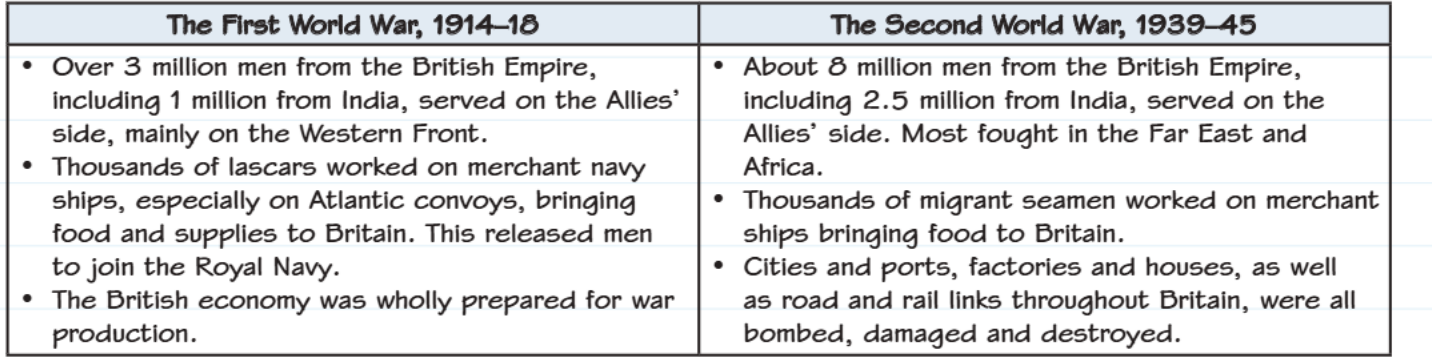
The First World War demonstrated Britain's heavy reliance on its Empire for military support. More than three million men from across the British Empire fought alongside Britain, with India contributing one million soldiers who served primarily on the Western Front. This massive mobilisation showed how interconnected Britain and its colonies had become.
The war also highlighted the importance of migrant workers, particularly lascars (seamen from South Asia) who worked on merchant navy vessels. Thousands of these workers operated Atlantic convoys that brought essential food and supplies to Britain, allowing British men to join the Royal Navy instead. Britain's economy had been completely reorganised for war production, demonstrating the nation's industrial capacity.
World War II (1939-1945)
The Second World War saw even greater Empire participation, with approximately six million men from British territories serving in the Allied forces. India's contribution increased to 2.5 million soldiers, most of whom fought in the Far East and Africa rather than Europe. Once again, thousands of migrant seamen played crucial roles in maintaining Britain's food supplies through dangerous convoy work.
However, unlike the First World War, Britain's home front suffered devastating damage. Cities, ports, factories, houses, and transport networks throughout the country were bombed, damaged, and destroyed. This destruction would later influence both emigration from Britain and immigration policies.
Example
War Statistics Comparison: Empire Contribution
World War I (1914-1918):
- Total Empire troops: 3 million
- Indian contribution: 1 million soldiers
- Main theatres: Western Front
- Britain's home front: Relatively undamaged
World War II (1939-1945):
- Total Empire troops: 6 million (double WWI)
- Indian contribution: 2.5 million soldiers
- Main theatres: Far East and Africa
- Britain's home front: Severely damaged by bombing
The end of empire and decolonisation
Britain's imperial decline
Between 1700 and 1900, the British Empire had grown to become the world's largest, but after 1945, it became clear that Britain could no longer maintain control over its vast territories. Several factors contributed to this dramatic change:
Britain's economy was severely damaged by the Second World War, making it impossible to afford the costs of maintaining an empire. The process of decolonisation became inevitable as independence movements gained strength across the colonies. These movements had been developing their own momentum, with local leaders demanding self-governance.
Important
Decolonisation: The process by which one country stops governing others, allowing former colonies to become independent countries. This was not a choice for Britain but an economic and political necessity after 1945.
India achieved independence in 1947, setting a precedent that many other countries followed throughout the 1950s and 1960s. Most of Ireland had already gained independence in 1922, leaving only the six northeastern counties as Northern Ireland within the United Kingdom.
Formation of the Commonwealth
In 1949, Britain established the Commonwealth of Nations as a way to maintain connections with former colonies after they gained independence. This arrangement allowed newly independent countries to preserve links with Britain and with each other, creating a voluntary association based on shared history and values rather than political control.
Note
The Commonwealth represented a strategic solution to decolonisation, allowing Britain to maintain beneficial relationships and influence with former colonies while acknowledging their independence. This was crucial for trade relationships and international cooperation.
Britain and the European Union
Britain's relationship with Europe evolved significantly during this period. In 1973, Britain joined the European Economic Community (EEC), which had nine member countries. The organisation grew substantially over the following decades, becoming the European Union with 25 members by 2007.
However, this relationship remained controversial among the British public. In 2016, British voters chose to leave the EU in a referendum, ending over four decades of European integration and signalling a shift towards different international relationships.
Immigration legislation and increasing restrictions
As the twentieth century progressed, some British people became concerned about the number of migrants arriving in the country. Parliament responded by passing increasingly restrictive legislation that limited who could enter and remain in Britain.
Note
The pattern of immigration legislation shows a clear progression from relatively open borders in the early 1900s to highly controlled entry by 1981. Each new law built upon previous restrictions, gradually limiting who could enter Britain.
Timeline of major immigration laws
1905 Aliens Act: This early restriction meant that only people who already had jobs or sufficient money could migrate to Britain, marking the beginning of systematic immigration control.
1948 British Nationality Act: In contrast to earlier restrictions, this act gave millions of people in British colonies and former colonies the legal right to enter Britain and remain permanently, reflecting Britain's continued connections with its Empire and Commonwealth.
1962 Commonwealth Immigrants Act: A voucher system was introduced, allowing only those with valuable skills or job offers in areas with worker shortages to obtain permission to migrate. This marked a significant tightening of controls.
1968 Commonwealth Immigrants Act: The number of available vouchers was reduced, and new requirements meant that applicants had to have been born in Britain or have parents or grandparents born there, effectively prioritising those with established British connections.
1971 Immigration Act: The voucher system was replaced with work permits that were valid only for specific time periods. However, people with British-born parents or grandparents were exempt from these restrictions.
1981 Nationality Act: The automatic right for non-British citizens to remain in Britain was removed entirely, completing the transformation from relatively open borders to highly controlled immigration.
Key terms
Decolonisation: The process by which one country stops governing others, allowing former colonies to become independent countries.
Lascars: Seamen, particularly from South Asia, who worked on British merchant ships and played crucial roles during both world wars.
Commonwealth: The voluntary association of independent countries that were formerly part of the British Empire, established in 1949.
Timeline of major events
- 1905: Aliens Act restricts migration to Britain
- 1914-1918: WWI - 3 million Empire troops serve with Britain
- 1922: Most of Ireland gains independence
- 1939-1945: WWII - 6 million Empire troops serve; Britain suffers bombing
- 1947: India gains independence, accelerating decolonisation
- 1948: British Nationality Act grants rights to Commonwealth citizens
- 1949: Commonwealth of Nations established
- 1962: Commonwealth Immigrants Act introduces voucher system
- 1968: Commonwealth Immigrants Act further restricts entry
- 1971: Immigration Act replaces vouchers with work permits
- 1973: Britain joins the European Economic Community
- 1981: Nationality Act removes automatic right of residence
- 2016: Brexit referendum - Britain votes to leave EU
Summary
Key Points to Remember:
-
Both world wars demonstrated Britain's dependence on Empire troops and migrant workers, with millions serving and working to support Britain's war efforts.
-
Economic weakness after 1945 forced Britain to abandon its empire, but the Commonwealth was created to maintain beneficial relationships with former colonies.
-
Immigration legislation became progressively more restrictive from 1905 to 1981, moving from relatively open borders to highly controlled entry requirements.
-
Britain's relationship with Europe evolved from joining the EEC in 1973 to leaving the EU in 2016, reflecting changing attitudes towards international cooperation.
-
The process of decolonisation fundamentally changed global migration patterns, as former colonies gained independence and Britain redefined its international relationships.