York under the Vikings (Edexcel GCSE History): Revision Notes
📚Revision Notes
York under the Vikings

The Viking conquest of York
In 866, Viking forces successfully captured the city of York, transforming it from an Anglo-Saxon stronghold into one of mediaeval England's most important multicultural settlements. The Vikings renamed the city Jorvik, and it became a thriving hub that attracted thousands of merchants and skilled workers from across Europe, Russia, and North Africa.
Note
The transformation of York from a regional Anglo-Saxon centre to an international trading hub represents one of the most significant urban developments in mediaeval England.
Why the Vikings chose York for settlement
The Vikings had strategic reasons for establishing a major settlement at York rather than simply raiding and moving on. Understanding these reasons helps explain why York became such an important Viking centre:
The city served as the political heart of Anglo-Saxon power in northern England, containing the region's only mint for producing coins. This made it an extremely valuable prize for any group seeking to control the north. Additionally, York was surrounded by fertile agricultural land that could support a large population and provide food security for the growing settlement.
The location offered excellent trading opportunities both inland and overseas. York's position allowed Vikings to establish and maintain crucial trade links that would make the city wealthy. The city had already been targeted multiple times by Viking raiders because of its accumulated wealth, making it an obvious choice for permanent settlement.
Finally, the Vikings had been gradually conquering Northumbria, and capturing York in 866 was followed by their final success in 867, giving them complete control over this important Anglo-Saxon kingdom.
The transformation of Viking York
Under Viking rule, York experienced dramatic growth and change. The Anglo-Saxon population, which had numbered around 1,000 people between 867 and 950, was joined by an estimated 10,000 to 15,000 migrants who came to live and work in the expanding city.
Note
This represents a population increase of over 1000% - one of the most dramatic urban expansions in mediaeval European history.
The Vikings constructed hundreds of new houses and workshops throughout the settlement. They also built warehouses and created wharves along the River Ouse to support the growing trade network. This physical expansion reflected York's new role as a major commercial centre rather than just a political stronghold.
The city attracted skilled migrants who worked in diverse trades including clothworking, woodturning, jewelry-making, metalworking, pottery, and blacksmithing. This variety of crafts and industries helped establish York as a centre of production as well as trade.
Economic impact and trade networks
York became genuinely multicultural under Viking rule, with migrants arriving not only from Scandinavia but also from Germany, the Netherlands, Ireland, and Scotland. Anglo-Saxons and Vikings from other parts of England also moved to the city, creating a diverse community.
Trade flourished as merchants utilised the old Roman road system for moving goods inland, while the River Ouse provided access to the North Sea and trade with European ports and cities. This dual transport network - combining river and road access - made York an ideal location for both local and international commerce.
Important
York's success was built on its unique combination of inland road connections and river access to the sea, making it one of mediaeval Europe's most strategically located trading centres.
Religious life: Vikings and the Church
The Vikings demonstrated a pragmatic approach to religion in York. They preserved the existing stone Saxon church, which later became known as York Minster, while also constructing new churches in Viking settlements outside the main city.
In 939, Archbishop Wulfstan played an important diplomatic role by negotiating a border agreement between the Vikings and Anglo-Saxons. This shows how religious leaders adapted to work with the new Viking rulers.
Many coins produced in York featured Christian symbols on one side, demonstrating how trade and Christianity remained connected under Viking rule. Several Viking kings converted to Christianity, and King Guthrum was even buried in York Minster, showing how religious boundaries became less rigid over time.
Relations with the Anglo-Saxons
Within York itself, Saxons and Vikings generally coexisted peacefully, but their rulers frequently engaged in conflict and power struggles. This created a complex situation where ordinary people might live and work together while their leaders fought for political control.
Example
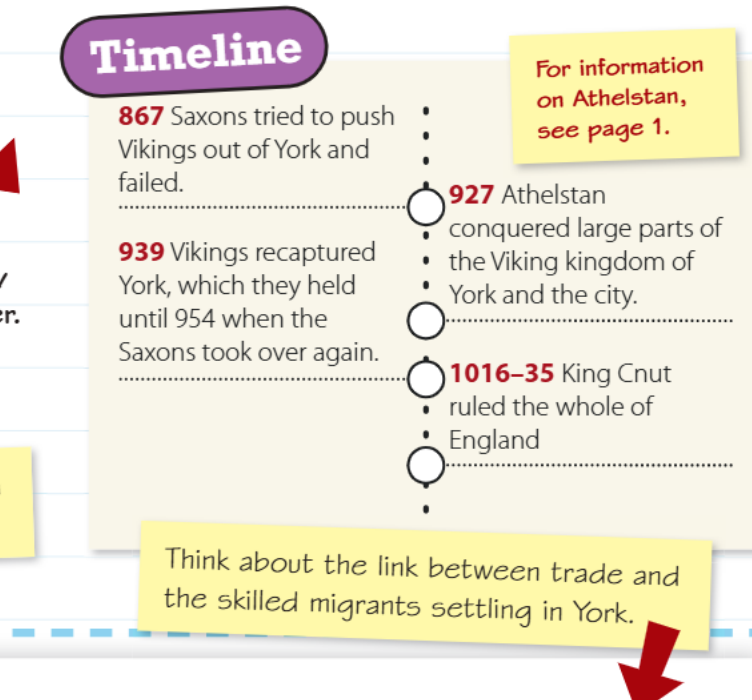
Timeline of Political Control in York
867 - Saxons attempted to push Vikings out of York but failed
927 - Athelstan conquered large parts of the Viking kingdom of York and gained control of the city
939 - Vikings recaptured York and held it until 954, when Saxons regained control
1016-35 - King Cnut ruled over all of England, ending the Viking-Saxon divide
Long-term impact
The influence of Viking and other migrants on York continued long after Viking political rule ended. The multicultural character they established, the trade networks they created, and the crafts and industries they developed helped shape the city's identity for centuries to come.
Summary
Key Points to Remember:
- Vikings captured York in 866 and renamed it Jorvik, transforming it into a major multicultural settlement
- York attracted 10,000-15,000 migrants because of its political importance, fertile land, excellent trade routes, existing wealth, and strategic location
- The city became a thriving centre of trade and crafts, with connections to Europe, Russia, and North Africa
- Vikings maintained existing churches while building new ones, and many Viking rulers converted to Christianity
- Political control of York changed hands multiple times between Vikings and Anglo-Saxons, but ordinary people often lived together peacefully