Industrialisation: successes and failures (Edexcel GCSE History): Revision Notes
📚Revision Notes
Industrialisation: successes and failures
Introduction to Soviet industrialisation
Stalin's Five-Year Plans brought about dramatic transformation of the Soviet Union's economy between 1928 and 1941. The government focused on developing heavy industry to modernise the country and strengthen its military capabilities. This industrialisation drive aimed to turn the USSR from a largely agricultural nation into a modern industrial power that could compete with Western countries.
Note
The Soviet industrialisation programme represented one of the most rapid economic transformations in modern history, attempting to compress decades of development into just over a decade.
The process involved massive state investment in factories, mines, and infrastructure projects. However, this rapid transformation came with both remarkable achievements and significant human costs. Understanding both the successes and failures helps us evaluate the true impact of Soviet industrial policy during this crucial period.
Production increases between 1928 and 1936
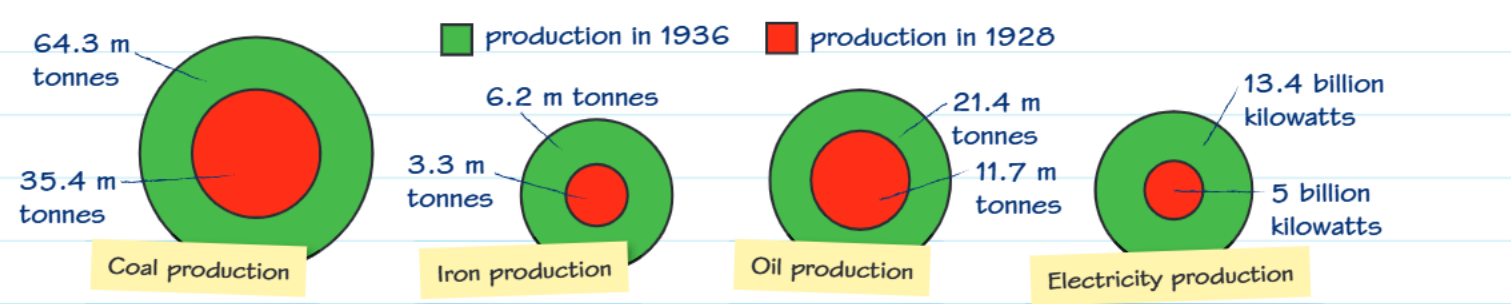
The statistics from this eight-year period demonstrate the scale of industrial growth achieved under the early Five-Year Plans. The government prioritised heavy industry sectors that would support both military strength and further economic development.
Example
Production Growth Statistics (1928-1936):
Coal production: Nearly doubled from 35.4 million tonnes in 1928 to 64.3 million tonnes by 1936
Iron production: Increased from 3.3 million tonnes to 6.2 million tonnes
Oil production: Expanded from 11.7 million tonnes to 21.4 million tonnes
Electricity production: More than doubled from 5 billion kilowatts to 13.4 billion kilowatts
Coal production nearly doubled from 35.4 million tonnes in 1928 to 64.3 million tonnes by 1936. This expansion was crucial because coal powered the factories and provided energy for other industrial processes. Iron production also showed impressive growth, increasing from 3.3 million tonnes to 6.2 million tonnes during the same period. This growth in iron was essential for manufacturing machinery, weapons, and construction materials.
Oil production expanded significantly from 11.7 million tonnes to 21.4 million tonnes, providing fuel for transportation and industrial machinery. Perhaps most dramatically, electricity production more than doubled from 5 billion kilowatts to 13.4 billion kilowatts, powering the new factories and urban centres that were emerging across the Soviet Union.
Major successes of industrialisation
The industrial transformation achieved several important goals that strengthened the Soviet state. Most significantly, the USSR evolved into a fully industrialised nation within just over a decade. This rapid development allowed the country to produce modern military equipment, which proved essential when German forces invaded during the Second World War.
The expansion of heavy industry meant that raw materials production increased substantially, providing the foundation for further economic growth. New industrial towns and cities were constructed, with Magnitogorsk being a prominent example of these planned urban centres built around major industrial projects.
Note
The construction of new industrial cities like Magnitogorsk represented a completely planned approach to urbanisation, where entire communities were built around single industrial projects.
Unemployment was eliminated as the massive construction projects and new factories required millions of workers. Huge industrial complexes were established across the country, creating centres of production that could manufacture everything from tractors to tanks. The Communist Party also gained increased support from industrial workers, who benefited from the job opportunities and perceived progress that industrialisation brought.
Significant failures and human costs
Despite these achievements, the industrialisation programme created serious problems for the Soviet people. Much of the construction work relied on slave labour from prisoners in the Gulags, the harsh labour camps where political prisoners and criminals were sent. These workers faced extremely dangerous conditions with inadequate safety measures and poor medical care.
Important
Human Cost of Industrialisation:
The rapid industrial development came at an enormous human cost, with millions of people subjected to dangerous working conditions, forced labour, and severe living hardships. The focus on meeting production targets often completely ignored worker safety and wellbeing.
Living standards for ordinary citizens often failed to improve despite increased production. Many people lived in overcrowded tents or temporary housing while waiting for proper accommodation. Basic consumer goods remained in short supply because all resources were directed towards heavy industry rather than products that would improve daily life.
The quality of manufactured goods was frequently compromised because managers focused on meeting quantity targets rather than producing reliable products. Many items broke easily or failed to work properly. Productivity remained low compared to other industrialised countries because workers lacked proper training and equipment.
Important
Systemic Problems:
The system suffered from widespread waste and inefficiency due to:
- Poor communication between different parts of the economy
- Inadequate transportation networks
- False reporting by managers who feared punishment for missing targets
- Focus on quantity over quality in all production
The system also suffered from widespread waste and inefficiency. Poor communication between different parts of the economy led to confusion about what was needed where. Transportation networks couldn't always deliver materials when and where they were required. Production targets were often missed or achieved only through false reporting, as factory managers feared punishment for admitting failure.
Understanding the impact of industrialisation
Stalin's industrial policy represented one of the most dramatic economic transformations in modern history. The USSR changed from a predominantly peasant society into a modern industrial nation within a remarkably short timeframe. As Stalin himself declared, the Soviet Union was becoming "a country of metal, cars and tractors."
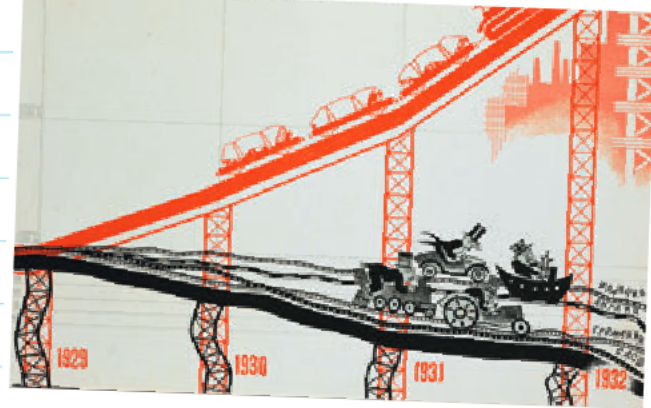
This transformation required massive social changes as people moved from rural areas to work in new urban centres. The government organised and directed all aspects of this development, making it fundamentally different from the gradual industrialisation that had occurred in Western Europe and North America.
Note
Unlike Western industrialisation which developed over many decades through market forces, Soviet industrialisation was a completely state-directed process that attempted to compress this development into just over a decade.
However, the rapid pace of change created significant disruption in the Soviet economy. Raw materials often failed to arrive at factories when needed, and machinery frequently broke down without spare parts available for repairs. The pressure to meet ambitious targets led managers to resort to deception about actual production levels, making it difficult for planners to understand the real situation.
The only way the system could appear successful was through constant lies about achievements and the production of low-quality goods that satisfied quantity requirements but failed to serve their intended purpose effectively. This created a cycle where managers faced changing targets and had to find ways to appear successful regardless of actual results.
Timeline of key events
- 1928: First Five-Year Plan launched, marking the beginning of intensive industrialisation
- 1930: Propaganda campaigns promote industrial growth and worker achievements
- 1931: Major industrial projects like Magnitogorsk reach peak construction activity
- 1932: Second Five-Year Plan begins, continuing the focus on heavy industry
- 1936: End of Second Five-Year Plan shows dramatic production increases across all major sectors
Remember!
Summary
Key Points to Remember:
-
Massive production growth: Coal, iron, oil, and electricity production all increased dramatically between 1928 and 1936, demonstrating the scale of industrial transformation
-
Strategic success: The USSR became fully industrialised and could produce military equipment that proved crucial during World War II
-
Human cost: Industrialisation relied heavily on slave labour from Gulags and created dangerous working conditions for millions of people
-
Quality problems: The focus on meeting quantity targets led to poor-quality goods and widespread waste in the industrial system
-
Economic disruption: Rapid change caused chaos in supply chains and led to frequent shortages of materials and spare parts