Stalin’s rise to power and dictatorship, 1924–41 (Edexcel GCSE History): Revision Notes
📚Revision Notes
The cult of Stalin
What was the cult of Stalin?
After Lenin's death in 1924, a powerful personality cult developed around Stalin. This cult presented Stalin as an infallible leader who could never make mistakes, continuing the tradition that had begun with Lenin. The central message was that Stalin had become "the Lenin of today" - the person best suited to understand and implement Lenin's revolutionary ideas in practice.
Note
Stalin's personality cult was built directly upon the foundation of Lenin's cult, which had already established the concept of an infallible revolutionary leader in Soviet society.

Stalin's public image: "Leader, Teacher, Friend"
Stalin's propaganda machine carefully crafted three key aspects of his public persona:
-
Economic achiever: Stalin was portrayed as the architect of Soviet success, surrounded by symbols of modernisation including thriving factories, productive collective farms, and contented workers. His image was linked to economic progress and prosperity.
-
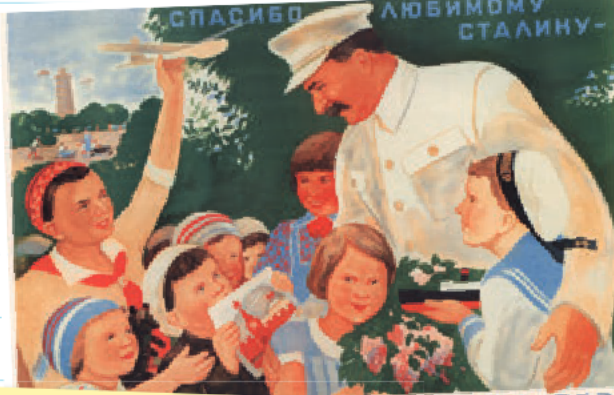
Caring father figure: Perhaps most importantly, Stalin was presented as a warm, friendly leader with a special connection to children and families. He was depicted as the caring father of the entire Soviet nation.
-
The perfect leader: Building on Lenin's legacy, Stalin was shown as the ideal communist leader who understood exactly what the Soviet people needed and how to achieve it.
Why did Stalin create this personality cult?
Several important factors motivated the development of Stalin's cult of personality:
-
Building confidence in leadership: Just as Lenin had been portrayed as infallible, presenting Stalin as the perfect leader gave Soviet citizens confidence that their hardships and sacrifices were worthwhile. It reinforced the belief that they were working together to build socialism.
-
Connecting to Russian traditions: Russia had a long-standing cultural tradition of viewing the ruler as a father figure for the entire country. Stalin's portrayal as "Leader, Teacher, Friend" fitted well with these established expectations and made his rule feel familiar and legitimate.
-
Maintaining political control: The cult served a practical political purpose by helping Stalin gain and keep support for his regime. Even when local party members might disagree with specific policies, the overwhelming propaganda made it difficult to challenge Stalin's authority effectively.
Important
The personality cult served multiple strategic purposes simultaneously - it wasn't just about ego, but was a calculated tool for maintaining power and legitimacy in Soviet society.
How was the cult of Stalin achieved?
Stalin's propaganda machine used multiple methods to build and maintain his personality cult:
-
Visual propaganda: Artists, painters, and poster designers created countless images showing Stalin as the ideal "Leader, Teacher, Friend." These artworks were displayed throughout the USSR, often reimagining Stalin as Lenin's closest ally (which historically he was not) and as the mastermind behind major victories like the October Revolution and Civil War (rather than Trotsky, who actually played the leading role).
-
Literature and media: Authors, playwrights, and poets were encouraged to praise Stalin's achievements in their work. Soviet history books were rewritten to emphasise Stalin's central role in key events like the Bolshevik rise to power, often exaggerating or fabricating his contributions.
-
Constant praise: Stalin's policies and reforms received continuous positive coverage in all media. His face appeared everywhere, and his ideas were consistently presented as brilliant and beyond question.
-
Personal accessibility: The cult portrayed Stalin as genuinely caring about ordinary Soviet citizens. Propaganda claimed that people regularly wrote to him for advice and help, and that he personally responded to their letters, making him seem approachable and concerned with individual welfare.
Note
The propaganda machine systematically rewrote Soviet history to place Stalin at the centre of events where he had played little or no role, effectively erasing the contributions of other Bolshevik leaders like Trotsky.
Primary source evidence
Example
Historical Evidence: The Extent of Stalin's Cult
A collection of articles about Stalin published in 1999 reveals how extreme the personality cult became:
"Stalin was seen as having superhuman powers – 'taller than the Himalayas, wider than the ocean, brighter than the sun' (in the words of a poet). Stalin became the modern 'little father' to the great mass of Russian peasants – a term traditionally applied to the Tsars."
This source demonstrates how Stalin's cult connected him to traditional Russian concepts of leadership while presenting him as possessing almost godlike qualities.
Timeline of key events
- 1924: Lenin dies; cult of Lenin established
- 1924-1929: Stalin consolidates power and begins building his own personality cult
- 1930s: Height of Stalin's cult of personality with widespread propaganda campaigns
- 1941: Cult continues even as USSR faces German invasion
Remember!
Summary
Key Points to Remember:
- Stalin's personality cult portrayed him as "the Lenin of today" - the perfect continuation of revolutionary leadership
- The cult emphasised three key roles: Leader, Teacher, and Friend, especially highlighting his caring relationship with children
- It served multiple purposes: building public confidence, connecting to Russian traditions, and maintaining political control
- The cult was achieved through art, literature, constant media praise, and claims of personal accessibility to ordinary citizens
- Primary sources show Stalin was presented with "superhuman powers" and as a modern version of the traditional Russian "little father" ruler